
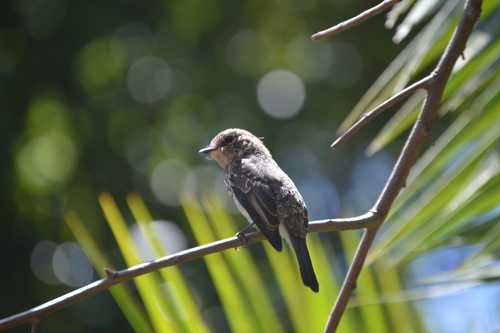
Chorister Robin-Chat

Chorister Robin-Chat

Cossypha dichroa

Silhouette: Martin Bulla, based on François Desbordes' illustration · PhyloPic

LCLeast ConcernNTVUENCR
Daily sighting probability <5% · Rare
at Addo Elephant National Park

In 3 days <5% in a week ~10%

9 Verified sightings at Addo Elephant National Park From 2019 to 2026
521 In all 3 parks
August Best month
☀️ Diurnal When it's spotted

About the Chorister Robin-Chat

The chorister robin-chat (Cossypha dichroa) (previously known as the chorister robin) is a species of bird in the Old World flycatcher family Muscicapidae. It is found in South Africa and Eswatini. Its distribution stretches from the southern Western Cape through the Eastern Cape, KwaZulu-Natal, and Mpumalanga to northern Limpopo. Its natural habitat is evergreen forests, especially in the mist belt region.

The chorister robin-chat was formally described in 1789 by the German naturalist Johann Friedrich Gmelin in his revised and expanded edition of Carl Linnaeus's Systema Naturae. He placed it with the flycatchers in the genus Muscicapa and coined the binomial name Muscicapa dichroa. Gmelin specified the locality as South Africa. This was restricted to Knysna in Western Cape province by Phillip Clancey in 1966.

Gmelin based his account on the "Muscicapa bicolor" that had been described and illustrated in 1787 by the Swedish naturalist Anders Sparrman. The hand-coloured engraved plate had been drawn by Jonas Carl Linnerhielm. The combination Muscicapa bicolor had been previously introduced in 1783 by the Dutch naturalist Pieter Boddaert for a different taxon and therefore... Wikipedia →

Sounds

Song0:23

South Africa · 2021

© Ian-Malcolm Rijsdijk · XC1042965 · CC BY-NC-SA 4.0

Uncertain0:23

South Africa · 2022

© Tim Cockcroft · XC747628 · CC BY-NC-SA 4.0

Song0:58

South Africa · 2019

© Frank Lambert · XC519627 · CC BY-NC-ND 4.0

Global Distribution

Parks Where Found

# Park Country Daily sighting probability
1 Garden Route National Park 🇿🇦 South Africa
~30%
2 iSimangaliso Wetland Park 🇿🇦 South Africa
<5%
3 Addo Elephant National Park 🇿🇦 South Africa
<5%

Zoos & Centres Where Found

# Zoo / Centre Country
1 Barcelona Zoo 🇪🇸 Spain In captivity
2 Aquarama Barcelona 🇪🇸 Spain In captivity

Before you go

What are the chances of seeing a Chorister Robin-Chat in Addo Elephant National Park?

Rare

Under 5% of wildlife watchers report a Chorister Robin-Chat sighting in Addo Elephant National Park on a given day, based on 9 verified sightings from GBIF citizen-science data from 2019 to 2026. It is the 228th most-seen of the 243 birds we can rate there. Over three days the chance rises to under 5%, and over a week to about 10%, if each day is a fresh chance.

When is the best time to see a Chorister Robin-Chat in Addo Elephant National Park?

Any time of year

In every month with enough records, under 5% of wildlife watchers report a Chorister Robin-Chat in Addo Elephant National Park on a given day, so our monthly data shows no clear season.

What time of day is best to see a Chorister Robin-Chat?

Between 9 am and noon

Across all the parks we cover, that three-hour window holds the most Chorister Robin-Chat sightings with a recorded time, and about 9 in 10 of them come between 6 am and 6 pm: it is a daytime animal.

Is Addo Elephant National Park the best place to see a Chorister Robin-Chat?

3rd of 3

Of the 3 parks where we can rate Chorister Robin-Chat sightings, Addo Elephant National Park ranks 3rd at under 5%. The best odds are in Garden Route National Park (South Africa, about 30%) and iSimangaliso Wetland Park (South Africa, under 5%).

Where does the Chorister Robin-Chat sighting chance come from?

GBIF citizen-science records

It is estimated from how often the Chorister Robin-Chat is recorded against all the birds logged in Addo Elephant National Park (9 verified sightings from 2019 to 2026), calibrated against known sighting rates. Figures are rounded to the nearest 10% because citizen-science data supports honest approximations, not decimals, and months with records from fewer than five people show "—". How it works.

← Back to Addo Elephant National Park