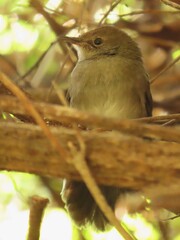
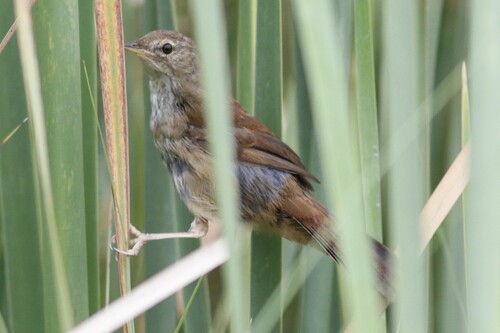
Knysna Warbler

Knysna Warbler

Bradypterus sylvaticus

Silhouette: Sheatherius · PhyloPic

LCNTNear ThreatenedVUENCR Endemic
Daily sighting probability <5% · Rare
at Addo Elephant National Park

In 3 days ~10% in a week ~20%

14 Verified sightings at Addo Elephant National Park From 2019 to 2026
311 In all 3 parks
July Best month
☀️ Diurnal When it's spotted

About the Knysna Warbler

The Knysna warbler or Knysna scrub warbler (Bradypterus sylvaticus) is a very shy and cryptic warbler, endemic to the coastal regions of South Africa. Its population is small and probably declining, due to natural and artificial fragmentation of its habitat, and limited dispersal and reproductive ability.

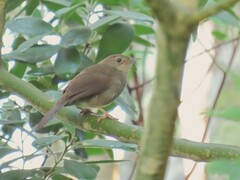
Brown with an olivaceous tinge on the upperpart plumage, including the wings and tail. Below it is paler olivaceous brown, and whitish on the centre of the belly. The chin and throat are olivaceous brown, but mottled whitish and finely streaked. The tail is relatively short and square. The eye, bill, legs and feet are brown, though the lower mandible is paler and horn-coloured.

The habitat of the Knysna warbler is dense tangled scrub of forest edges, on or relatively near the coast. It has adapted to non-native bramble thickets and colonised suburban riparian woodland, though without any marked range expansion.

It occurs along the coastlines of the southern Western Cape and Eastern Cape, and marginally in KwaZulu-Natal, but is extinct from the vicinity of Durban, due to habitat loss. A small population of less than 40 pairs exists on the eastern... Wikipedia →

Sounds

Call0:17

South Africa · 2024

© Marna Buys · XC1103772 · CC BY-NC-SA 4.0

Song0:50

South Africa · 2026

© Ian-Malcolm Rijsdijk · XC1094156 · CC BY-NC-SA 4.0

Contact call0:25

South Africa · 2025

© Tristan Spurway · XC1031080 · CC BY-NC-SA 4.0

Global Distribution

Parks Where Found

# Park Country Daily sighting probability
1 Garden Route National Park 🇿🇦 South Africa
~20%
2 Addo Elephant National Park 🇿🇦 South Africa
<5%
3 Table Mountain National Park 🇿🇦 South Africa
<5%

Before you go

What are the chances of seeing a Knysna Warbler in Addo Elephant National Park?

Rare

Under 5% of wildlife watchers report a Knysna Warbler sighting in Addo Elephant National Park on a given day, based on 14 verified sightings from GBIF citizen-science data from 2019 to 2026. It is the 180th most-seen of the 243 birds we can rate there. Over three days the chance rises to about 10%, and over a week to about 20%, if each day is a fresh chance.

When is the best time to see a Knysna Warbler in Addo Elephant National Park?

July

In that month about 20% of wildlife watchers report a Knysna Warbler in Addo Elephant National Park on a given day, against under 5% in February–June and August–December, the lowest months.

What time of day is best to see a Knysna Warbler?

Between 7 and 10 am

Across all the parks we cover, that three-hour window holds the most Knysna Warbler sightings with a recorded time, and about 9 in 10 of them come between 6 am and 6 pm: it is a daytime animal.

Is Addo Elephant National Park the best place to see a Knysna Warbler?

2nd of 3

Of the 3 parks where we can rate Knysna Warbler sightings, Addo Elephant National Park ranks 2nd at under 5%. The best odds are in Garden Route National Park (South Africa, about 20%).

Where does the Knysna Warbler sighting chance come from?

GBIF citizen-science records

It is estimated from how often the Knysna Warbler is recorded against all the birds logged in Addo Elephant National Park (14 verified sightings from 2019 to 2026), calibrated against known sighting rates. Figures are rounded to the nearest 10% because citizen-science data supports honest approximations, not decimals, and months with records from fewer than five people show "—". How it works.

← Back to Addo Elephant National Park