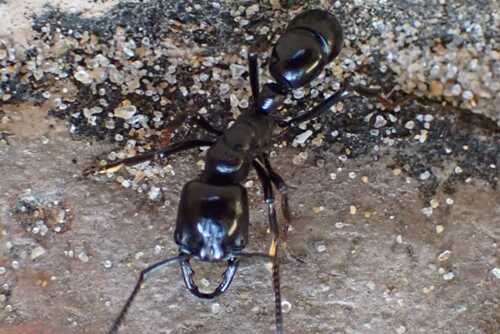
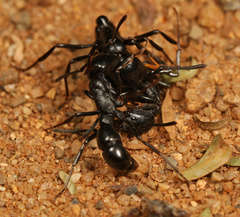
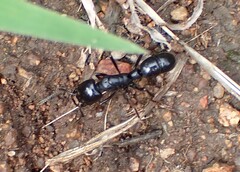
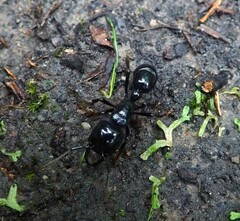
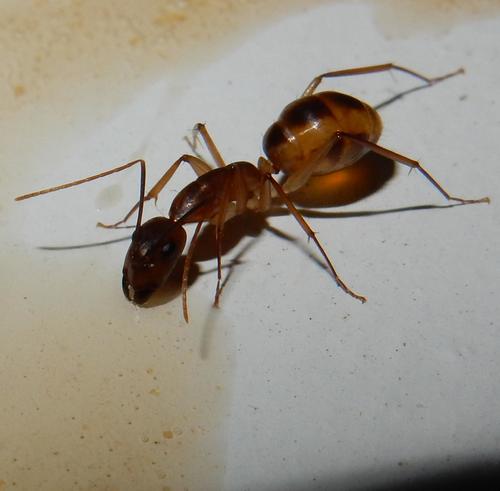
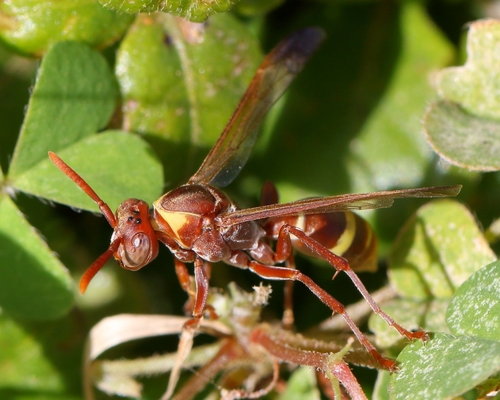
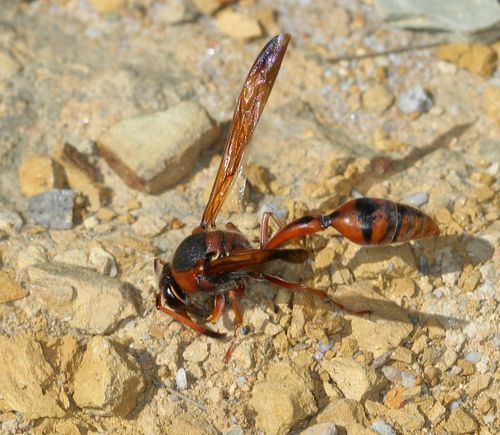
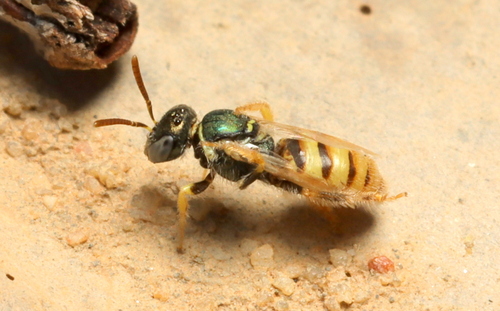
Ringbum Millipede Muncher Ant

Ringbum Millipede Muncher Ant

Plectroctena mandibularis

Daily sighting probability ~10% · With luck
at Addo Elephant National Park

In 3 days ~20% in a week ~40%

9 Verified sightings at Addo Elephant National Park From 2019 to 2026
50 In all 4 parks
October Best month
☀️ Diurnal When it's spotted

About the Ringbum Millipede Muncher Ant

Plectroctena mandibularis, called the ringbum ant or millipede munching ant, is a large species of ant that ranges from the Eastern Cape, South Africa, through East Africa to Ethiopia. Their workers forage singly in open terrain, and their colony size seldom exceeds fifty individuals. It is one of the large Plectroctena species, including P. conjugata and P. minor, that specialize on adult millipedes as prey. The nest is composed of chambers that are typically located two feet or more below the surface, and the nest entrances are usually marked by large piles of earth. They get their colloquial, common name from their tendency to prey on millipedes. Wikipedia →

Global Distribution

Parks Where Found

# Park Country Daily sighting probability
1 Garden Route National Park 🇿🇦 South Africa
~10%
2 Addo Elephant National Park 🇿🇦 South Africa
~10%
3 iSimangaliso Wetland Park 🇿🇦 South Africa
~10%
4 Kruger National Park 🇿🇦 South Africa
<5%

Cities Where Found

# City Country Daily sighting probability
1 Pretoria 🇿🇦 South Africa
~10%
2 Durban 🇿🇦 South Africa
<5%

Before you go

What are the chances of seeing a Ringbum Millipede Muncher Ant in Addo Elephant National Park?

With luck

About 10% of wildlife watchers report a Ringbum Millipede Muncher Ant sighting in Addo Elephant National Park on a given day, based on 9 verified sightings from GBIF citizen-science data from 2019 to 2026. It is the 90th most-seen of the 198 insects we can rate there. Over three days the chance rises to about 20%, and over a week to about 40%, if each day is a fresh chance.

When is the best time to see a Ringbum Millipede Muncher Ant in Addo Elephant National Park?

January–May and September–October

In those months about 10% of wildlife watchers report a Ringbum Millipede Muncher Ant in Addo Elephant National Park on a given day, against under 5% in June–August and November–December, the lowest months.

What time of day is best to see a Ringbum Millipede Muncher Ant?

Between 9 am and noon

Across all the parks we cover, that three-hour window holds the most Ringbum Millipede Muncher Ant sightings with a recorded time, and nearly all of them come between 6 am and 6 pm: it is a daytime animal.

Is Addo Elephant National Park the best place to see a Ringbum Millipede Muncher Ant?

Among the best

Of the 4 parks where we can rate Ringbum Millipede Muncher Ant sightings, Addo Elephant National Park ranks 2nd at about 10%, level with the leaders once rounded. The best odds are in Garden Route National Park (South Africa, about 10%).

Which relatives of the Ringbum Millipede Muncher Ant live in Addo Elephant National Park?

Same family: Formicidae

The closest relatives of the Ringbum Millipede Muncher Ant that you can see in Addo Elephant National Park (family Formicidae, Ants) are Spotted Sugar Ant (about 10%) and Small Black Sugar Ant (about 10%), with each one's daily chance of a sighting.

Where does the Ringbum Millipede Muncher Ant sighting chance come from?

GBIF citizen-science records

It is estimated from how often the Ringbum Millipede Muncher Ant is recorded against all the insects logged in Addo Elephant National Park (9 verified sightings from 2019 to 2026), calibrated against known sighting rates. Figures are rounded to the nearest 10% because citizen-science data supports honest approximations, not decimals, and months with records from fewer than five people show "—". How it works.

← Back to Addo Elephant National Park