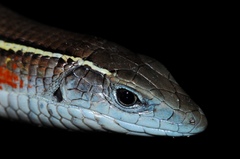
Yellow-throated Plated Lizard

Yellow-throated Plated Lizard

Gerrhosaurus flavigularis

Silhouette: Beth Reinke · PhyloPic

LCLeast ConcernNTVUENCR
Daily sighting probability ~10% · With luck
at Addo Elephant National Park

In 3 days ~20% in a week ~40%

7 Verified sightings at Addo Elephant National Park From 2019 to 2026
42 In all 2 parks
October Best month
☀️ Diurnal When it's spotted

About the Yellow-throated Plated Lizard

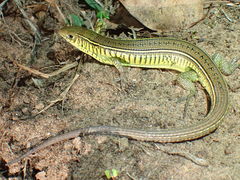
The yellow-throated plated lizard or plated lizard (Gerrhosaurus flavigularis) is a species of lizard, which is about 45½ cm (18 inches) in total length (including tail) and lives in the grassland and scrub of Sudan, Ethiopia and along Eastern Africa down to South Africa.

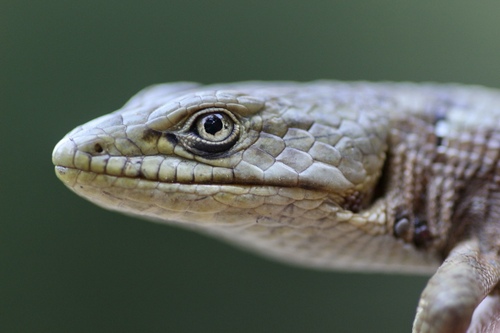
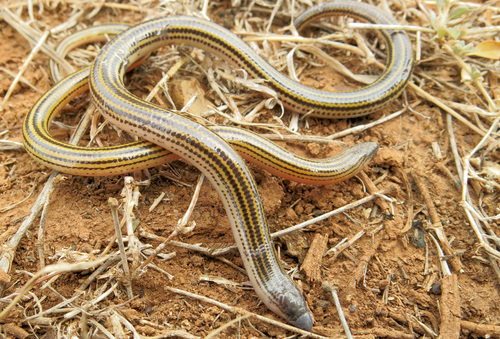
A ground-living and burrowing lizard, this species is usually greenish-grey or brownish, with a yellow (or sometimes red) throat and often a narrow stripe down each side. It is well armored, with hard body plates, and head shields fused to the skull. The tail is generally about two-thirds of the total length. Its limbs are well-developed, though its four five-toed feet are not specially adapted for digging. These lizards mate during the summer. In mating season the males head change color to either red, yellow or even light blue.

It was first described in 1828 by Weigmann, based on specimens at the Natural History Museum in Berlin that were collected in South Africa by Ludwig Krebs. The lizard does most of its tunneling after rain when the ground is soft.

Active by day, it hunts insects and is rarely seen, despite its size. It moves rapidly through the "grass" and at any sign of... Wikipedia →

Global Distribution

Parks Where Found

# Park Country Daily sighting probability
1 Kruger National Park 🇿🇦 South Africa
~10%
2 Addo Elephant National Park 🇿🇦 South Africa
~10%

Cities Where Found

# City Country Daily sighting probability
1 Pretoria 🇿🇦 South Africa
~10%
2 Johannesburg 🇿🇦 South Africa
~10%

Zoos & Centres Where Found

# Zoo / Centre Country
1 San Diego Zoo 🇺🇸 United States In captivity
2 Downtown Aquarium, Houston 🇺🇸 United States In captivity

Closest Relatives at Addo Elephant National Park

No species of the same family or order lives in Addo Elephant National Park, so these are its closest relatives here: other reptiles.

Before you go

What are the chances of seeing a Yellow-throated Plated Lizard in Addo Elephant National Park?

With luck

About 10% of wildlife watchers report a Yellow-throated Plated Lizard sighting in Addo Elephant National Park on a given day, based on 7 verified sightings from GBIF citizen-science data from 2019 to 2026. It is the 19th most-seen of the 27 reptiles we can rate there. Over three days the chance rises to about 20%, and over a week to about 40%, if each day is a fresh chance.

When is the best time to see a Yellow-throated Plated Lizard in Addo Elephant National Park?

March–May, October and December

In those months about 10% of wildlife watchers report a Yellow-throated Plated Lizard in Addo Elephant National Park on a given day, against under 5% in January–February, June–September and November, the lowest months.

What time of day is best to see a Yellow-throated Plated Lizard?

Between 11 am and 2 pm

Across all the parks we cover, that three-hour window holds the most Yellow-throated Plated Lizard sightings with a recorded time, and nearly all of them come between 6 am and 6 pm: it is a daytime animal.

Is Addo Elephant National Park the best place to see a Yellow-throated Plated Lizard?

Among the best

Of the 2 parks where we can rate Yellow-throated Plated Lizard sightings, Addo Elephant National Park ranks 2nd at about 10%, level with the leaders once rounded. The best odds are in Kruger National Park (South Africa, about 10%).

Where does the Yellow-throated Plated Lizard sighting chance come from?

GBIF citizen-science records

It is estimated from how often the Yellow-throated Plated Lizard is recorded against all the reptiles logged in Addo Elephant National Park (7 verified sightings from 2019 to 2026), calibrated against known sighting rates. Figures are rounded to the nearest 10% because citizen-science data supports honest approximations, not decimals, and months with records from fewer than five people show "—". How it works.

← Back to Addo Elephant National Park