Degenhardt's Scorpion-eating Snake

Degenhardt's Scorpion-eating Snake

Stenorrhina degenhardtii

Silhouette: Alex Slavenko · PhyloPic

LCLeast ConcernNTVUENCR
Daily sighting probability ~10% · With luck
at Arenal Volcano National Park

In 3 days ~20% in a week ~40%

7 Verified sightings at Arenal Volcano National Park From 2019 to 2026
19 In all 3 parks
June Best month
☀️ Diurnal When it's spotted

About the Degenhardt's Scorpion-eating Snake

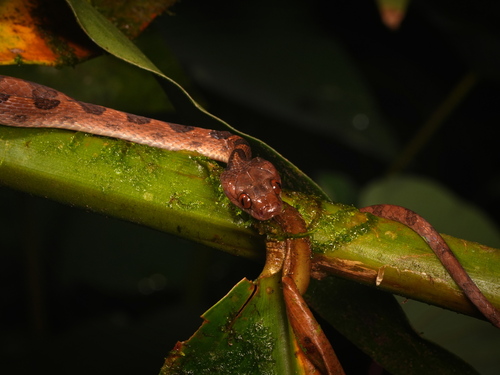
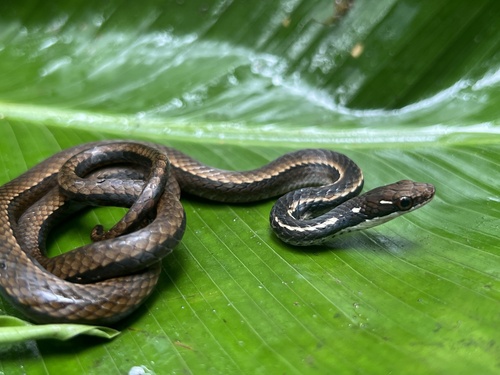
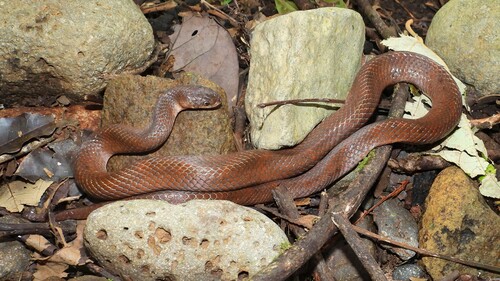
Stenorrhina degenhardtii, also known by its common name Degenhardt's scorpion-eating snake, is a species of snake in the family Colubridae. The species is native to southeastern Mexico, Central America, and northwestern South America. There are three recognized subspecies.

The specific name, degenhardtii, is in honor of a German named Degenhardt who collected amphibians and reptiles in northern South America in the 1840s. S. degenhardtii is found in the Mexican states of Chiapas, Oaxaca, and Veracruz; in the Central American countries of Belize, Costa Rica, Guatemala, Honduras, Nicaragua, and Panama; and in the South American countries of Colombia, Ecuador, Peru, and Venezuela.

The preferred natural habitats of S. degenhardti are forest and savanna, at altitudes from sea level to 2,800 m (9,200 ft), but it has also been found in agricultural areas. A medium-sized snake, S. degenhardtii may attain a total length (including tail) of 65 cm (26 in).

S. degenhardtii is diurnal and terrestrial. S. degenhardtii preys predominately upon scorpions and spiders, but also eats crickets, grasshoppers... Wikipedia →
Global Distribution

Parks Where Found

# Park Country Daily sighting probability
1 Tenorio Volcano National Park 🇨🇷 Costa Rica
~10%
2 Arenal Volcano National Park 🇨🇷 Costa Rica
~10%
3 La Amistad International Park (Panama) 🇵🇦 Panama
<5%

Before you go

What are the chances of seeing a Degenhardt's Scorpion-eating Snake in Arenal Volcano National Park?

With luck

About 10% of wildlife watchers report a Degenhardt's Scorpion-eating Snake sighting in Arenal Volcano National Park on a given day, based on 7 verified sightings from GBIF citizen-science data from 2019 to 2026. It is the 51st most-seen of the 64 reptiles we can rate there. Over three days the chance rises to about 20%, and over a week to about 40%, if each day is a fresh chance.

When is the best time to see a Degenhardt's Scorpion-eating Snake in Arenal Volcano National Park?

May–June and November–January

In those months about 10% of wildlife watchers report a Degenhardt's Scorpion-eating Snake in Arenal Volcano National Park on a given day, against under 5% in February–April and July–October, the lowest months.

What time of day is best to see a Degenhardt's Scorpion-eating Snake?

Between 4 and 7 pm

Across all the parks we cover, that three-hour window holds the most Degenhardt's Scorpion-eating Snake sightings with a recorded time, and about 8 in 10 of them come between 6 am and 6 pm: it is a daytime animal.

Is Arenal Volcano National Park the best place to see a Degenhardt's Scorpion-eating Snake?

Among the best

Of the 3 parks where we can rate Degenhardt's Scorpion-eating Snake sightings, Arenal Volcano National Park ranks 2nd at about 10%, level with the leaders once rounded. The best odds are in Tenorio Volcano National Park (Costa Rica, about 10%).

Which relatives of the Degenhardt's Scorpion-eating Snake live in Arenal Volcano National Park?

Same family: Colubridae

The closest relatives of the Degenhardt's Scorpion-eating Snake that you can see in Arenal Volcano National Park (family Colubridae, Colubrid Snakes) are Ornate Cat-eyed Snake (about 30%), Cloudy Snail-eating Snake (about 20%) and Blunthead Tree Snake (about 20%), with each one's daily chance of a sighting.

Where does the Degenhardt's Scorpion-eating Snake sighting chance come from?

GBIF citizen-science records

It is estimated from how often the Degenhardt's Scorpion-eating Snake is recorded against all the reptiles logged in Arenal Volcano National Park (7 verified sightings from 2019 to 2026), calibrated against known sighting rates. Figures are rounded to the nearest 10% because citizen-science data supports honest approximations, not decimals, and months with records from fewer than five people show "—". How it works.

← Back to Arenal Volcano National Park