False Fer-de-lance

False Fer-de-lance

Xenodon rabdocephalus

Silhouette: Alex Slavenko · PhyloPic

LCLeast ConcernNTVUENCR
Daily sighting probability ~10% · With luck
at Arenal Volcano National Park

In 3 days ~20% in a week ~40%

11 Verified sightings at Arenal Volcano National Park From 2019 to 2026
16 In all 2 parks
November Best month
☀️ Diurnal When it's spotted

About the False Fer-de-lance

Xenodon rabdocephalus, commonly known as the false fer-de-lance, is a species of mildly venomous rear-fanged snake in the family Colubridae. The species is native to Central America and northern South America. There are two recognized subspecies.

X. rabdocephalus is found in southern Mexico in the states of Guerrero, Veracruz, Yucatan and Campeche, through Guatemala, Belize, Honduras, El Salvador, Costa Rica and Panama. In northern South America it is found in Colombia, Venezuela, Guyana, Suriname, French Guiana, Ecuador, Peru, Bolivia and Brazil where it occurs in the states of Amapá, Rondônia, Pará, Espírito Santo and Bahia.

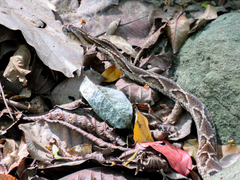
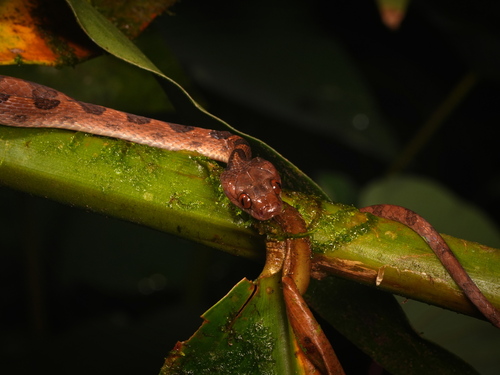
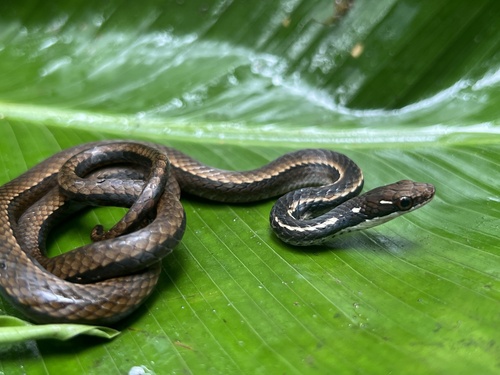
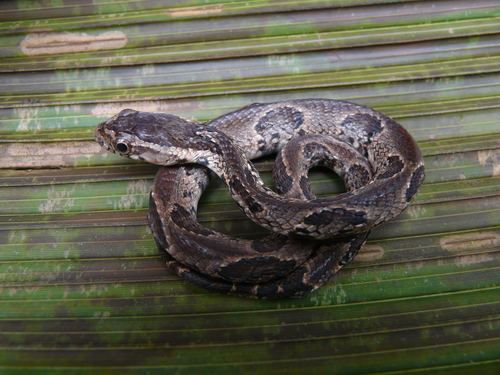
The preferred natural habitat of X. rabdocephalus is forest in the moist lowlands and the premontane regions, at altitudes from sea level to 1,500 m (4,900 ft). X. rabdocephalus is a medium-sized snake which reaches a total length (including tail) of 80 cm (31 in). It is mainly brown with a series of brown and grey hourglass-shaped dorsal blotches on the body.

X. rabdocephalus feeds mainly on frogs and toads, including tadpoles. X. rabdocephalus is oviparous. Wikipedia →
Global Distribution

Parks Where Found

# Park Country Daily sighting probability
1 Arenal Volcano National Park 🇨🇷 Costa Rica
~10%
2 Braulio Carrillo National Park 🇨🇷 Costa Rica
~10%

Zoos & Centres Where Found

# Zoo / Centre Country
1 Parque museo La Venta 🇲🇽 Mexico In captivity

Before you go

What are the chances of seeing a False Fer-de-lance in Arenal Volcano National Park?

With luck

About 10% of wildlife watchers report a False Fer-de-lance sighting in Arenal Volcano National Park on a given day, based on 11 verified sightings from GBIF citizen-science data from 2019 to 2026. It is the 46th most-seen of the 64 reptiles we can rate there. Over three days the chance rises to about 20%, and over a week to about 40%, if each day is a fresh chance.

When is the best time to see a False Fer-de-lance in Arenal Volcano National Park?

April, June–July and November–February

In those months about 10% of wildlife watchers report a False Fer-de-lance in Arenal Volcano National Park on a given day, against under 5% in March, May and August–October, the lowest months.

What time of day is best to see a False Fer-de-lance?

Between 9 am and noon

Across all the parks we cover, that three-hour window holds the most False Fer-de-lance sightings with a recorded time, and about 8 in 10 of them come between 6 am and 6 pm: it is a daytime animal.

Is Arenal Volcano National Park the best place to see a False Fer-de-lance?

Yes

Of the 2 parks where we can rate False Fer-de-lance sightings, Arenal Volcano National Park has the highest daily chance: about 10%. Next come Braulio Carrillo National Park (Costa Rica, about 10%).

Which relatives of the False Fer-de-lance live in Arenal Volcano National Park?

Same family: Colubridae

The closest relatives of the False Fer-de-lance that you can see in Arenal Volcano National Park (family Colubridae, Colubrid Snakes) are Ornate Cat-eyed Snake (about 30%), Cloudy Snail-eating Snake (about 20%) and Blunthead Tree Snake (about 20%), with each one's daily chance of a sighting.

Where does the False Fer-de-lance sighting chance come from?

GBIF citizen-science records

It is estimated from how often the False Fer-de-lance is recorded against all the reptiles logged in Arenal Volcano National Park (11 verified sightings from 2019 to 2026), calibrated against known sighting rates. Figures are rounded to the nearest 10% because citizen-science data supports honest approximations, not decimals, and months with records from fewer than five people show "—". How it works.

← Back to Arenal Volcano National Park