Regal Fritillary

Regal Fritillary

Speyeria idalia

Daily sighting probability ~10% · With luck
at Badlands National Park

In 3 days ~30% in a week ~50%

5 Verified sightings at Badlands National Park From 2019 to 2026
5 In 1 park
September Best month
☀️ Diurnal When it's spotted

About the Regal Fritillary

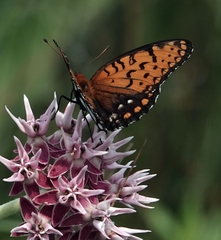
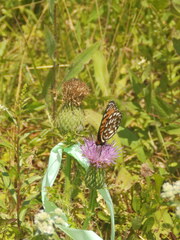
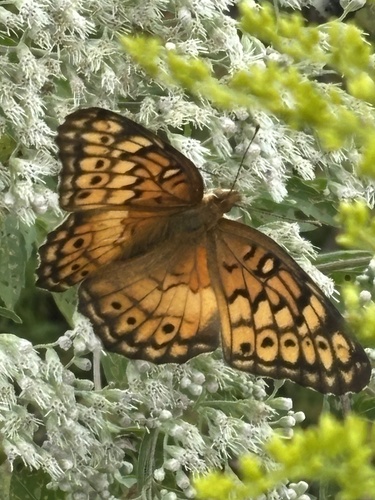
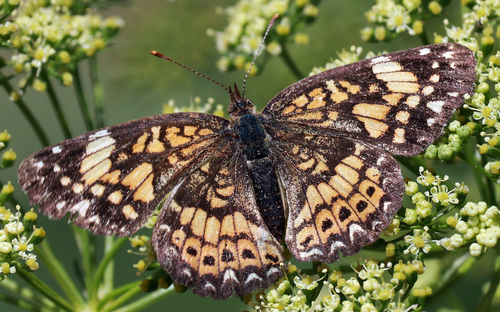
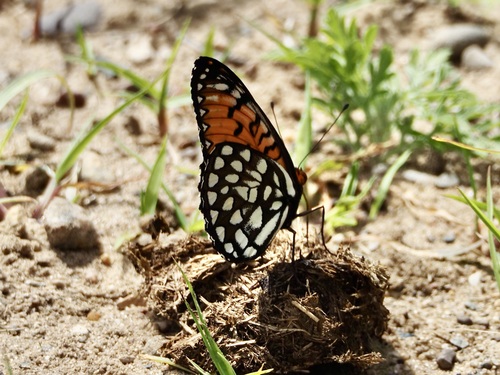
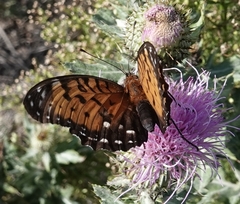
The regal fritillary (Speyeria idalia) is a striking nymphalid butterfly found in tallgrass and mixed-grass prairies in the east-central United States. This prairie-specialist butterfly is deep orange with distinctive dark hindwings with two bands of spots (Brock 2003). On the female, both bands of spots are white; on the male, the outer band of spots is orange. Females also tend to be slightly larger than males. The ventral surface of the hindwings is olive brown to black in color with bold silvery white spots (Selby 2007). The wingspan of S. idalia usually measures 68–105 millimetres (2.7–4.1 in) (Selby 2007). Flight is in the summertime from approximately June to September and adults tend to be swift in flight, coasting close to the ground (Brock 2003). It is listed as a species of special concern and believed extirpated in the US state of Connecticut.

Regal fritillary larvae are approximately 0.08 inches long after they hatch and reach a length of approximately 1.75 inches when fully developed (Edwards 1879). The mature larvae have a black body with yellowish-orange bands and stripes. There are yellowish middorsal and lateral stripes and a number of dorsal, subdorsal, and lateral fleshy spines extending from the body. The head of the mature larva is rounded and small, orangish-red on top and black underneath (Edwards 1879).

The larval food source for the regal fritillary and all members of the genus Speyeria are violets (Viola spp.) (Selby 2007). The violets are an extremely important component of habitat sustainability for the regal fritillary and there is a correlation between the number of violets present and the number of butterflies found in a given area (Kelly and Debinski 1998). These various violet species are associated with the different areas of the regal fritillary's range. For example, the bird's-foot violet and the prairie violet tend to be the preferred larval food source for the regal in the Midwest and Great Plains regions (Selby 2007).

The adult butterflies may feed on a variety of nectar plants and their availability throughout the summer flight time can be as important as the presence of larval food plants in determining whether an area can support populations of butterfly species (Selby 2007). Wikipedia →
Global Distribution

Parks Where Found

# Park Country Daily sighting probability
1 Badlands National Park 🇺🇸 United States
~10%

More parks will be added in future updates.

Before you go

What are the chances of seeing a Regal Fritillary in Badlands National Park?

With luck

About 10% of wildlife watchers report a Regal Fritillary sighting in Badlands National Park on a given day, based on 5 verified sightings from GBIF citizen-science data from 2019 to 2026. It is the 31st most-seen of the 37 insects we can rate there. Over three days the chance rises to about 30%, and over a week to about 50%, if each day is a fresh chance.

When is the best time to see a Regal Fritillary in Badlands National Park?

September

In that month about 20% of wildlife watchers report a Regal Fritillary in Badlands National Park on a given day, against under 5% in October to May, the lowest months.

What time of day is best to see a Regal Fritillary?

Between 2 and 5 pm

Across all the parks we cover, that three-hour window holds the most Regal Fritillary sightings with a recorded time, and nearly all of them come between 6 am and 6 pm: it is a daytime animal.

Where else can you see a Regal Fritillary?

Only Badlands National Park, in our data

Badlands National Park is the only park on Wallace's Line with enough records to rate Regal Fritillary sightings: about 10% of wildlife watchers there report one on a given day.

Which relatives of the Regal Fritillary live in Badlands National Park?

Same family: Nymphalidae

The closest relatives of the Regal Fritillary that you can see in Badlands National Park (family Nymphalidae, Brush-footed Butterflies) are Variegated Fritillary (about 30%), Painted Lady (about 20%) and Red Admiral (about 10%), with each one's daily chance of a sighting.

Where does the Regal Fritillary sighting chance come from?

GBIF citizen-science records

It is estimated from how often the Regal Fritillary is recorded against all the insects logged in Badlands National Park (5 verified sightings from 2019 to 2026), calibrated against known sighting rates. Figures are rounded to the nearest 10% because citizen-science data supports honest approximations, not decimals, and months with records from fewer than five people show "—". How it works.

← Back to Badlands National Park