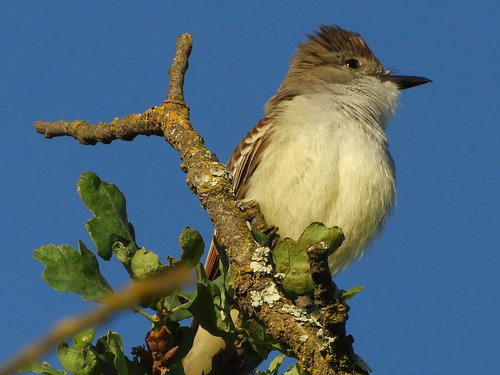
California Gnatcatcher

California Gnatcatcher

Polioptila californica

Silhouette: Sheatherius · PhyloPic

LCLeast ConcernNTVUENCR
Daily sighting probability ~10% · With luck
at Bahía de Loreto National Park

In 3 days ~30% in a week ~50%

105 Verified sightings at Bahía de Loreto National Park From 2019 to 2026
198 In all 3 parks
October Best month
☀️ Diurnal When it's spotted

About the California Gnatcatcher

The California gnatcatcher (Polioptila californica) is a small, 10.8-centimetre-long (4.3 in) insectivorous bird which frequents dense coastal sage scrub growth. This species was recently split from the similar black-tailed gnatcatcher of the Sonoran and Chihuahuan deserts. This bird is often solitary, but joins with other birds in winter flocks.

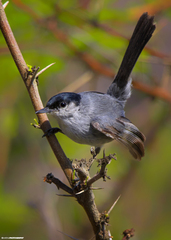
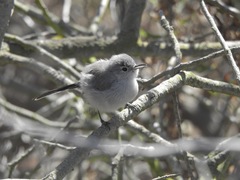
The male California gnatcatcher is dusky gray overall, distinguished only by its black crown and thin black beak. It has a long, thin black tail with narrow white tips and edges on the underside of the tail feathers. However, the male loses its plumage colors by winter and obtains a plumage color similar to the females. The female is similar to the male, but with a blue-gray instead of a black crown.

In its range from coastal Southern California south through Baja California and Baja California Sur, this inconspicuous non-migratory resident is most often seen flitting hastily into undergrowth, or heard giving its call, which sounds like a kitten's meow, a rising and falling zeeeeer, zeeeeer.

The California gnatcatcher's diet consists of small insects and spiders. In the main part of its range on the... Wikipedia →

Sounds

Call0:32

United States · 2019

© Paul Marvin · XC493230 · CC BY-NC-SA 4.0

Call0:41

United States · 2014

© Andrew Spencer · XC203742 · CC BY-NC-SA 4.0

Call0:16

Mexico · 2006

© Richard E Webster · XC71934 · CC BY-NC-ND 2.5

Global Distribution

Parks Where Found

# Park Country Daily sighting probability
1 Bahía de Loreto National Park 🇲🇽 Mexico
~10%
2 Cabo Pulmo National Park 🇲🇽 Mexico
~10%
3 El Vizcaíno Biosphere Reserve 🇲🇽 Mexico
~10%

Cities Where Found

# City Country Daily sighting probability
1 San Diego 🇺🇸 United States
<5%
2 Los Angeles 🇺🇸 United States
<5%

Before you go

What are the chances of seeing a California Gnatcatcher in Bahía de Loreto National Park?

With luck

About 10% of wildlife watchers report a California Gnatcatcher sighting in Bahía de Loreto National Park on a given day, based on 105 verified sightings from GBIF citizen-science data from 2019 to 2026. It is the 72nd most-seen of the 169 birds we can rate there. Over three days the chance rises to about 30%, and over a week to about 50%, if each day is a fresh chance.

When is the best time to see a California Gnatcatcher in Bahía de Loreto National Park?

October

In that month about 30% of wildlife watchers report a California Gnatcatcher in Bahía de Loreto National Park on a given day, against under 5% in February, the lowest month. That is one of Bahía de Loreto National Park's wettest months, with about 20 mm of rain against almost none in April.

What time of day is best to see a California Gnatcatcher?

Between 9 am and noon

Across all the parks we cover, that three-hour window holds the most California Gnatcatcher sightings with a recorded time, and about 9 in 10 of them come between 6 am and 6 pm: it is a daytime animal.

Is Bahía de Loreto National Park the best place to see a California Gnatcatcher?

Yes

Of the 3 parks where we can rate California Gnatcatcher sightings, Bahía de Loreto National Park has the highest daily chance: about 10%. Next come Cabo Pulmo National Park (Mexico, about 10%) and El Vizcaíno Biosphere Reserve (Mexico, about 10%).

Where does the California Gnatcatcher sighting chance come from?

GBIF citizen-science records

It is estimated from how often the California Gnatcatcher is recorded against all the birds logged in Bahía de Loreto National Park (105 verified sightings from 2019 to 2026), calibrated against known sighting rates. Figures are rounded to the nearest 10% because citizen-science data supports honest approximations, not decimals, and months with records from fewer than five people show "—". How it works.

← Back to Bahía de Loreto National Park