Gila Woodpecker

Gila Woodpecker

Melanerpes uropygialis

Silhouette: Jason Dilworth · PhyloPic

LCLeast ConcernNTVUENCR
Daily sighting probability ~60% · Likely
at Bahía de Loreto National Park

In 3 days ~90% in a week >90%

781 Verified sightings at Bahía de Loreto National Park From 2019 to 2026
10,948 In all 4 parks
November Best month
☀️ Diurnal When it's spotted

About the Gila Woodpecker

The Gila woodpecker (Melanerpes uropygialis) is a medium-sized woodpecker of the desert regions of the southwestern United States and western Mexico. In the U.S., they range through southeastern California, southern Nevada, Arizona, and New Mexico.

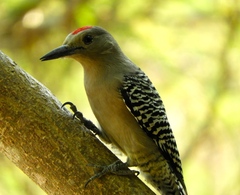
The back and wings of this bird are spotted and barred with a black and white zebra-like pattern. The neck, throat, belly and head are greyish-tan in color. The male has a small red cap on the top of the head. Females and juveniles birds are similar, but both lack the red cap of the adult male. White wing patches are prominent in flight. The dark tail has white bars on the central tail feathers. The birds range from 8–10 in (20–25 cm) in length.

This woodpecker's voice is a rolling churr sound. It also makes a yip yip yip sound and a kee-u, kee-u, kee-u sound. Its drum is long and steady. This woodpecker's habitat consists of low desert scrub typical of the Sonoran Desert, as well as arroyos (washes) and small towns. They build nests in holes made in saguaro cacti or mesquite trees. Cavities excavated by these woodpeckers in saguaro cacti (known as a... Wikipedia →

Sounds

Song0:06

United States · 2024

© Pat Goltz · XC1148217 · CC BY-NC-SA 4.0

Call0:21

United States · 2025

© David Tattersley · XC1000173 · CC BY-NC-SA 4.0

Interaction calls0:35

United States · 2022

© Richard E. Webster · XC780894 · CC BY-NC-SA 4.0

Global Distribution

Parks Where Found

# Park Country Daily sighting probability
1 Saguaro National Park 🇺🇸 United States
~90%
2 Cabo Pulmo National Park 🇲🇽 Mexico
~80%
3 Bahía de Loreto National Park 🇲🇽 Mexico
~60%
4 El Vizcaíno Biosphere Reserve 🇲🇽 Mexico
~20%

Cities Where Found

# City Country Daily sighting probability
1 Phoenix 🇺🇸 United States
~80%
2 Mesa 🇺🇸 United States
~80%
3 Guadalajara 🇲🇽 México
~60%

Before you go

What are the chances of seeing a Gila Woodpecker in Bahía de Loreto National Park?

Likely

About 60% of wildlife watchers report a Gila Woodpecker sighting in Bahía de Loreto National Park on a given day, based on 781 verified sightings from GBIF citizen-science data from 2019 to 2026. It is the 6th most-seen of the 169 birds we can rate there. Over three days the chance rises to about 90%, and over a week to over 90%, if each day is a fresh chance.

When is the best time to see a Gila Woodpecker in Bahía de Loreto National Park?

March, May and October–December

In those months about 70% of wildlife watchers report a Gila Woodpecker in Bahía de Loreto National Park on a given day, against about 40% in July, the lowest month.

What time of day is best to see a Gila Woodpecker?

Between 6 and 9 am

Across all the parks we cover, that three-hour window holds the most Gila Woodpecker sightings with a recorded time, and about 8 in 10 of them come between 6 am and 6 pm: it is a daytime animal.

Is Bahía de Loreto National Park the best place to see a Gila Woodpecker?

3rd of 4

Of the 4 parks where we can rate Gila Woodpecker sightings, Bahía de Loreto National Park ranks 3rd at about 60%. The best odds are in Saguaro National Park (United States, about 90%) and Cabo Pulmo National Park (Mexico, about 80%). All parks ranked.

Which relatives of the Gila Woodpecker live in Bahía de Loreto National Park?

Same family: Picidae

The closest relatives of the Gila Woodpecker that you can see in Bahía de Loreto National Park (family Picidae, Woodpeckers) are Gilded Flicker (about 20%) and Ladder-backed Woodpecker (about 10%), with each one's daily chance of a sighting.

Where does the Gila Woodpecker sighting chance come from?

GBIF citizen-science records

It is estimated from how often the Gila Woodpecker is recorded against all the birds logged in Bahía de Loreto National Park (781 verified sightings from 2019 to 2026), calibrated against known sighting rates. Figures are rounded to the nearest 10% because citizen-science data supports honest approximations, not decimals, and months with records from fewer than five people show "—". How it works.

← Back to Bahía de Loreto National Park