Spotted Round Stingray

Spotted Round Stingray

Urobatis maculatus

Silhouette: M Kolmann · PhyloPic

Daily sighting probability ~30% · Possible
at Bahía de Loreto National Park

In 3 days ~70% in a week ~90%

14 Verified sightings at Bahía de Loreto National Park From 2019 to 2026
14 In 1 park
July Best month
☀️ Diurnal When it's spotted

About the Spotted Round Stingray

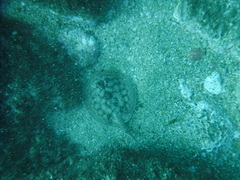
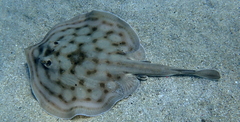
Urobatis maculatus, known as the spotted round ray or Cortez round stingray, is a species of round ray, within the genus Urobatis, and of the family Urotrygonidae. It is endemic to Mexico, with its natural habitats being shallow seas, subtidal aquatic beds, coral reefs, estuarine waters, intertidal marshes, and coastal saline lagoons.

Spotted round rays reach a length of 42 centimetres (17 in) TL. The spotted round ray is ideal for captivity due to its hardiness and smaller size, and it is also a favorable candidate for breeding in aquaria. It can be kept in a minimum 180 gallon aquarium with fine substrate, little décor, a bottom with much surface area (for sufficient swimming space), excellent filtration, protected internal tank equipment like heaters and filter intakes (by surrounding them with polyurethane foam barriers), and a secure lid. In the aquarium trade, it may be confused with the Round stingray, Urobatis halleri, which in the hobby may be called the Cortez ray as well.

The spotted round ray can be parasitized by the flatworm Pleorchis magniporus. Photos of Spotted round ray in the Sealife Collection Wikipedia →

Global Distribution

Parks Where Found

# Park Country Daily sighting probability
1 Bahía de Loreto National Park 🇲🇽 Mexico
~30%

More parks will be added in future updates.

Zoos & Centres Where Found

# Zoo / Centre Country
1 Seattle Aquarium 🇺🇸 United States In captivity
2 Seattle Marine Aquarium 🇺🇸 United States In captivity

Before you go

What are the chances of seeing a Spotted Round Stingray in Bahía de Loreto National Park?

Possible

About 30% of wildlife watchers report a Spotted Round Stingray sighting in Bahía de Loreto National Park on a given day, based on 14 verified sightings from GBIF citizen-science data from 2019 to 2026. Over three days the chance rises to about 70%, and over a week to about 90%, if each day is a fresh chance.

When is the best time to see a Spotted Round Stingray in Bahía de Loreto National Park?

April and July

In those months about 70% of wildlife watchers report a Spotted Round Stingray in Bahía de Loreto National Park on a given day, against about 10% in March, the lowest month. Those are among Bahía de Loreto National Park's driest months, with almost no rain against 80 mm in September. June, August and October–January have too few records to rate.

What time of day is best to see a Spotted Round Stingray?

Between 3 and 6 pm

Across all the parks we cover, that three-hour window holds the most Spotted Round Stingray sightings with a recorded time, and about 8 in 10 of them come between 6 am and 6 pm: it is a daytime animal.

Where else can you see a Spotted Round Stingray?

Only Bahía de Loreto National Park, in our data

Bahía de Loreto National Park is the only park on Wallace's Line with enough records to rate Spotted Round Stingray sightings: about 30% of wildlife watchers there report one on a given day.

Which relatives of the Spotted Round Stingray live in Bahía de Loreto National Park?

Same order: Myliobatiformes

The closest relatives of the Spotted Round Stingray that you can see in Bahía de Loreto National Park (order Myliobatiformes, Stingrays) are Pacific Eagle Ray (about 40%) and Munk's Pygmy Devil Ray (about 30%), with each one's daily chance of a sighting.

Where does the Spotted Round Stingray sighting chance come from?

GBIF citizen-science records

It is estimated from how often the Spotted Round Stingray is recorded against all the sharks and rays logged in Bahía de Loreto National Park (14 verified sightings from 2019 to 2026), calibrated against known sighting rates. Figures are rounded to the nearest 10% because citizen-science data supports honest approximations, not decimals, and months with records from fewer than five people show "—". How it works.

← Back to Bahía de Loreto National Park