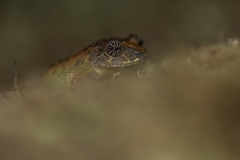
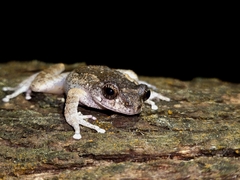
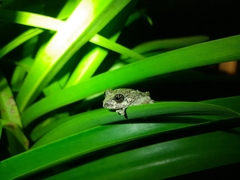
Cross-backed Bush Frog

Cross-backed Bush Frog

Raorchestes signatus

Endemic
Daily sighting probability ~10% · With luck
at Bandipur National Park

In 3 days ~30% in a week ~60%

14 Verified sightings at Bandipur National Park From 2019 to 2026
14 In 1 park
June Best month
☀️🌙 Day & Night When it's spotted

About the Cross-backed Bush Frog

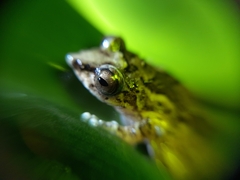
Raorchestes signatus is a species of frog in the family Rhacophoridae. It is endemic to the Western Ghats, India. This arboreal frog has been observed in montane evergreen forests, shola forests, patches of forest, and occasionally towns, grasslands, and tea plantations. This frog has been observed between 1780 and 2465 meters above sea level.

Like other frogs in Raorchestes, this frog breeds through direct development with no free-swimming tadpole stage. Scientists have observed some deformed individuals and speculate that it could be caused by overexposure to ultraviolet light.

The IUCN classifies this frog as vulnerable to extinction because of its smallish range and because of ongoing habitat degradation. It suffers from deforestation associated with logging and agriculture. The frog also suffers from exposure to pollution, fertilizers, and herbicides, some of which prevent the frog from reproducing.

Scientists cite climate change as another threat to this species. The Nilgiri Hills are warmer than previously, which has exacerbated encroachment by invasive species, such as eucalyptus and acacia trees. Climate change has also altered the way the water sits underground.

Scientists believe the fungus Batrachochytrium dendrobatidis can infect this frog. Batrachochytrium dendrobatidis causes the fungal disease chytridiomycosis. Wikipedia →

Global Distribution

Parks Where Found

# Park Country Daily sighting probability
1 Bandipur National Park 🇮🇳 India
~10%

More parks will be added in future updates.

Before you go

What are the chances of seeing a Cross-backed Bush Frog in Bandipur National Park?

With luck

About 10% of wildlife watchers report a Cross-backed Bush Frog sighting in Bandipur National Park on a given day, based on 14 verified sightings from GBIF citizen-science data from 2019 to 2026. Over three days the chance rises to about 30%, and over a week to about 60%, if each day is a fresh chance.

When is the best time to see a Cross-backed Bush Frog in Bandipur National Park?

April–June and August–September

In those months about 20% of wildlife watchers report a Cross-backed Bush Frog in Bandipur National Park on a given day, against under 5% in March, July and October–January, the lowest months.

What time of day is best to see a Cross-backed Bush Frog?

Between 7 and 10 pm

Across all the parks we cover, that three-hour window holds the most Cross-backed Bush Frog sightings with a recorded time, and about half of them come between 6 am and 6 pm: it is seen both by day and at night.

Where else can you see a Cross-backed Bush Frog?

Only Bandipur National Park, in our data

Bandipur National Park is the only park on Wallace's Line with enough records to rate Cross-backed Bush Frog sightings: about 10% of wildlife watchers there report one on a given day.

Where does the Cross-backed Bush Frog sighting chance come from?

GBIF citizen-science records

It is estimated from how often the Cross-backed Bush Frog is recorded against all the amphibians logged in Bandipur National Park (14 verified sightings from 2019 to 2026), calibrated against known sighting rates. Figures are rounded to the nearest 10% because citizen-science data supports honest approximations, not decimals, and months with records from fewer than five people show "—". How it works.

← Back to Bandipur National Park