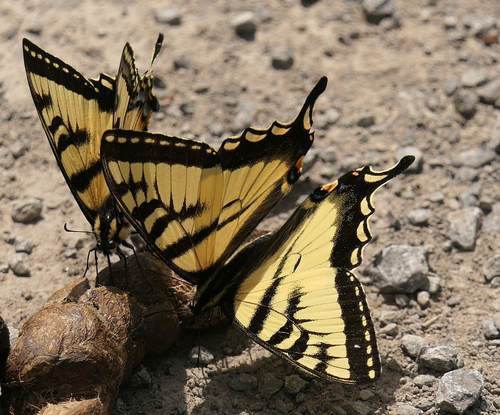
Spear-Marked Black Moth

Spear-Marked Black Moth

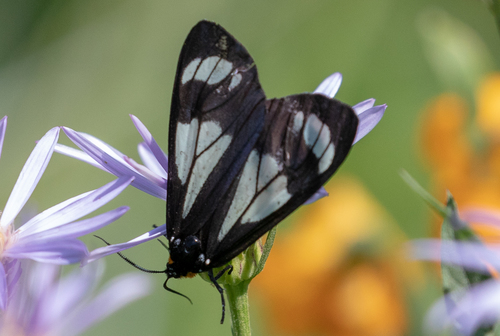
Rheumaptera hastata

Daily sighting probability ~10% · With luck
at Banff National Park

In 3 days ~10% in a week ~30%

6 Verified sightings at Banff National Park From 2019 to 2026
6 In 1 park
July Best month
☀️ Diurnal When it's spotted

About the Spear-Marked Black Moth

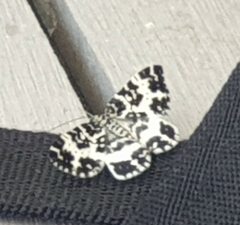
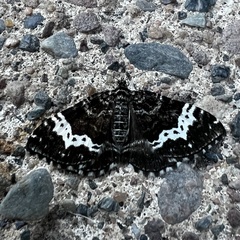
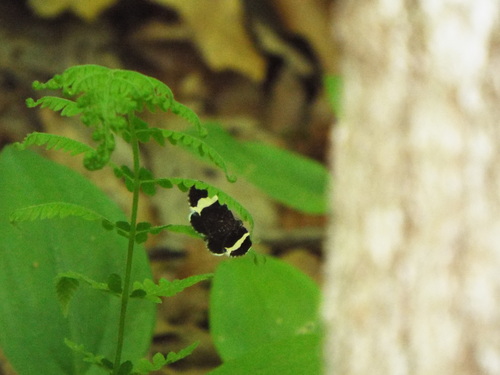
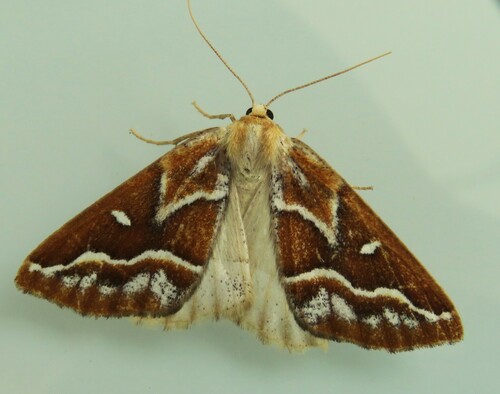
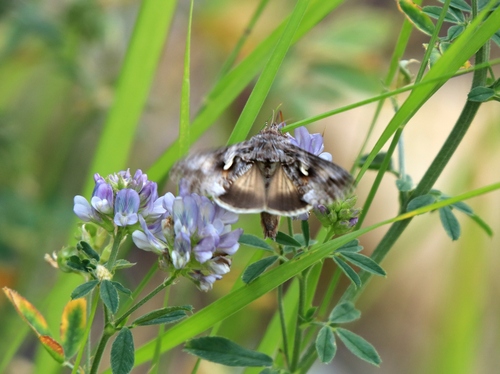
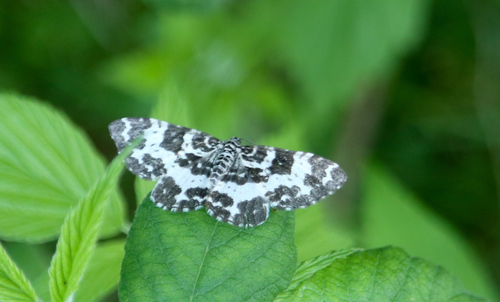
The argent and sable moth (Rheumaptera hastata) is a day-flying moth of the family Geometridae, with distinctive black and white colors. They tend to live on wetlands and hillsides. The larvae spin together the leaves of their food plants (such as birch and bog myrtle) to form their cocoons. It was named argent and sable in 1778. Argent and sable refer to the heraldic color names for white and black. Their distribution is Holarctic. The species was first described by Carl Linnaeus in his 1758 10th edition of Systema Naturae.

The species occurs in almost all parts of Europe. The distribution area stretches over northern Asia to the Russian Far East and large parts of China on to Japan. The species occurs in large parts of North America. Currently three subspecies are distinguished Rheumaptera hastata hastata, Rheumaptera hastata nigrescens and Rheumaptera hastata thulearia.

The wings have a black ground color with variable white pattern elements. A wider inner cross and a narrow basal cross line are typical. The dark midfield is traversed by white patches, which may be continuous. The outer cross line forms a wide white band, which usually has a row... Wikipedia →
Global Distribution

Parks Where Found

# Park Country Daily sighting probability
1 Banff National Park 🇨🇦 Canada
~10%

More parks will be added in future updates.

Before you go

What are the chances of seeing a Spear-Marked Black Moth in Banff National Park?

With luck

About 10% of wildlife watchers report a Spear-Marked Black Moth sighting in Banff National Park on a given day, based on 6 verified sightings from GBIF citizen-science data from 2019 to 2026. It is the 76th most-seen of the 105 insects we can rate there. Over three days the chance rises to about 10%, and over a week to about 30%, if each day is a fresh chance.

When is the best time to see a Spear-Marked Black Moth in Banff National Park?

July

In that month about 10% of wildlife watchers report a Spear-Marked Black Moth in Banff National Park on a given day, against under 5% in August to June, the lowest months.

What time of day is best to see a Spear-Marked Black Moth?

Between 1 and 4 pm

Across all the parks we cover, that three-hour window holds the most Spear-Marked Black Moth sightings with a recorded time, and nearly all of them come between 6 am and 6 pm: it is a daytime animal.

Where else can you see a Spear-Marked Black Moth?

Only Banff National Park, in our data

Banff National Park is the only park on Wallace's Line with enough records to rate Spear-Marked Black Moth sightings: about 10% of wildlife watchers there report one on a given day.

Where does the Spear-Marked Black Moth sighting chance come from?

GBIF citizen-science records

It is estimated from how often the Spear-Marked Black Moth is recorded against all the insects logged in Banff National Park (6 verified sightings from 2019 to 2026), calibrated against known sighting rates. Figures are rounded to the nearest 10% because citizen-science data supports honest approximations, not decimals, and months with records from fewer than five people show "—". How it works.

← Back to Banff National Park