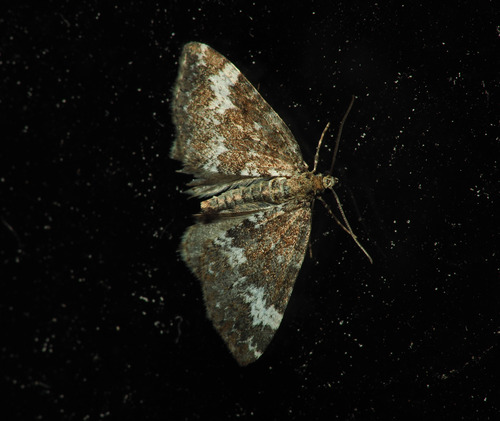
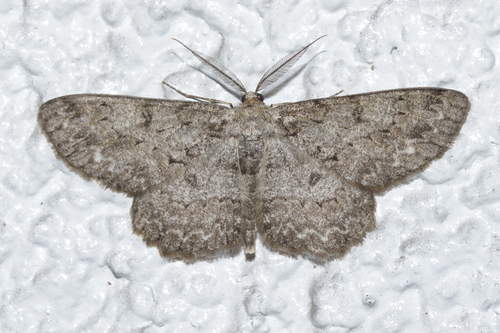
Scallop Shell Moth

Scallop Shell Moth

Rheumaptera undulata

Daily sighting probability ~10% · With luck
at Bavarian Forest National Park

In 3 days ~20% in a week ~40%

14 Verified sightings at Bavarian Forest National Park From 2019 to 2026
14 In 1 park
July Best month
☀️🌙 Day & Night When it's spotted

About the Scallop Shell Moth

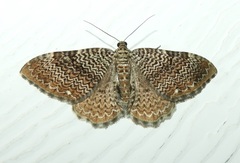
Rheumaptera undulata or Hydria undulata (in some schemes), the scallop shell, is a moth of the family Geometridae. It was first described by Carl Linnaeus in his 1758 10th edition of Systema Naturae. It is found in most of the Palearctic realm and North America.

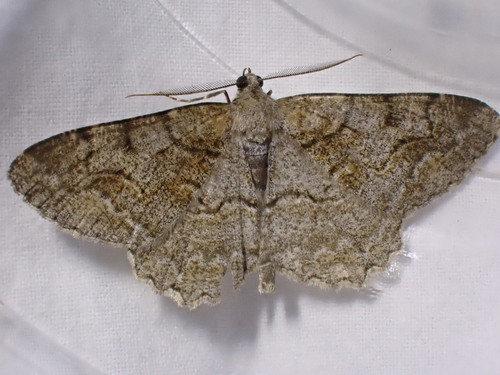
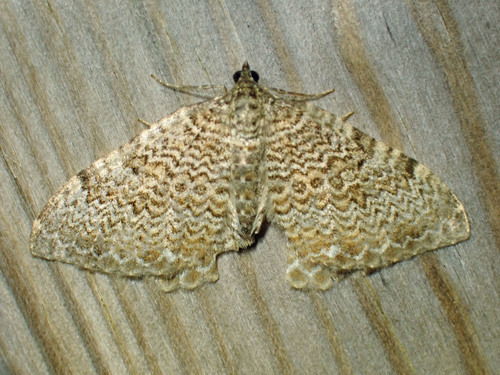
The main habitat is light quarry and floodplain forests, bushy forest edges as well as gardens and park landscapes. In the Alps, the species rises to heights of 1500 metres. The wingspan is 25–30 mm. The ground colour of the forewings is pale. The crosslines are darker, wavy, evenly spaced and numerous. The outer margin is pale brown with a scalloped fringe. The hindwings resemble the forewings but are paler.

The larva is relatively powerful, naked except for some short white bristles. It creates a "lonely" shelter by spinning a single leaf (or a small cluster of shoot tips) together with silk. The dorsum is light to dark grey, with narrow white longitudinal stripes. The venter is pale.

There is one generation per year with adults on wing from the end of May to August in Europe. Larvae can be found in August and September. It overwinters as a pupa. The larvae feed on birch (including Betula... Wikipedia →
Global Distribution

Parks Where Found

# Park Country Daily sighting probability
1 Bavarian Forest National Park 🇩🇪 Germany
~10%

More parks will be added in future updates.

Cities Where Found

# City Country Daily sighting probability
1 Helsinki 🇫🇮 Finland
<5%

Before you go

What are the chances of seeing a Scallop Shell Moth in Bavarian Forest National Park?

With luck

About 10% of wildlife watchers report a Scallop Shell Moth sighting in Bavarian Forest National Park on a given day, based on 14 verified sightings from GBIF citizen-science data from 2019 to 2026. It is the 377th most-seen of the 1115 insects we can rate there. Over three days the chance rises to about 20%, and over a week to about 40%, if each day is a fresh chance.

When is the best time to see a Scallop Shell Moth in Bavarian Forest National Park?

June–July and September

In those months about 10% of wildlife watchers report a Scallop Shell Moth in Bavarian Forest National Park on a given day, against under 5% in August and October–May, the lowest months.

What time of day is best to see a Scallop Shell Moth?

Between noon and 3 pm

Across all the parks we cover, that three-hour window holds the most Scallop Shell Moth sightings with a recorded time, and about 6 in 10 of them come between 6 am and 6 pm: it is seen both by day and at night.

Where else can you see a Scallop Shell Moth?

Only Bavarian Forest National Park, in our data

Bavarian Forest National Park is the only park on Wallace's Line with enough records to rate Scallop Shell Moth sightings: about 10% of wildlife watchers there report one on a given day.

Which relatives of the Scallop Shell Moth live in Bavarian Forest National Park?

Same family: Geometridae

The closest relatives of the Scallop Shell Moth that you can see in Bavarian Forest National Park (family Geometridae, Geometer Moths) are Common Heath (about 20%), Latticed Heath (about 20%) and Yellow Shell Moth (about 20%), with each one's daily chance of a sighting.

Where does the Scallop Shell Moth sighting chance come from?

GBIF citizen-science records

It is estimated from how often the Scallop Shell Moth is recorded against all the insects logged in Bavarian Forest National Park (14 verified sightings from 2019 to 2026), calibrated against known sighting rates. Figures are rounded to the nearest 10% because citizen-science data supports honest approximations, not decimals, and months with records from fewer than five people show "—". How it works.

← Back to Bavarian Forest National Park