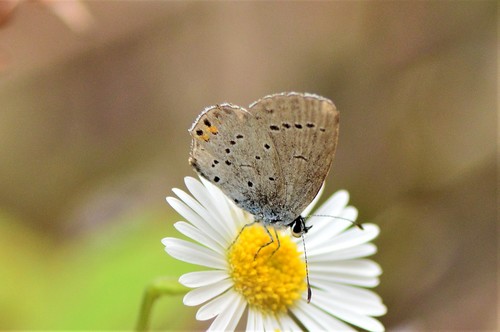
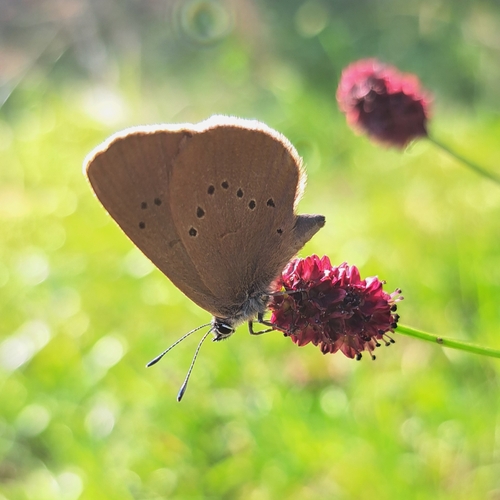
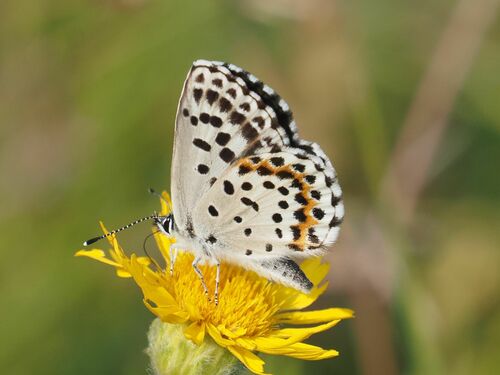
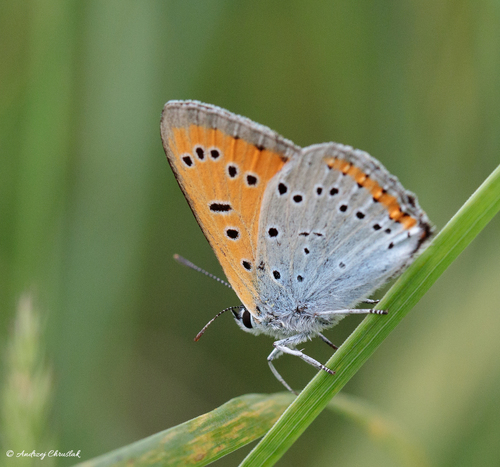
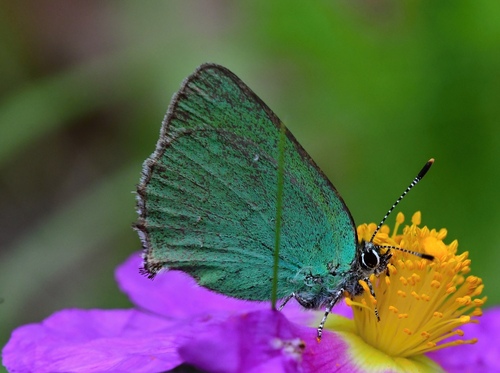
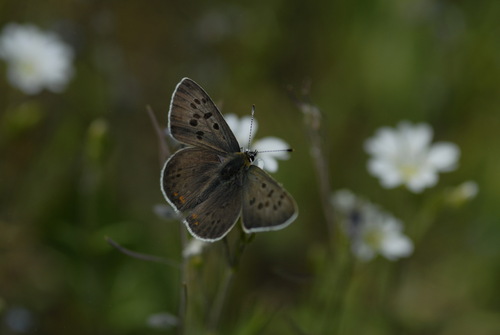
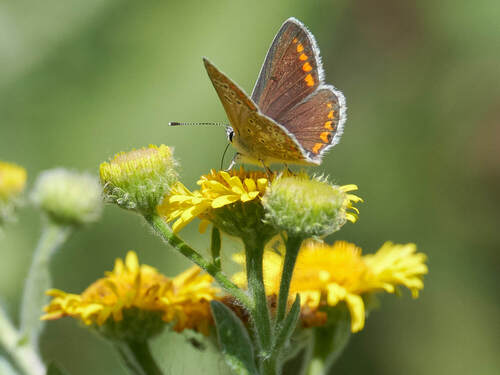
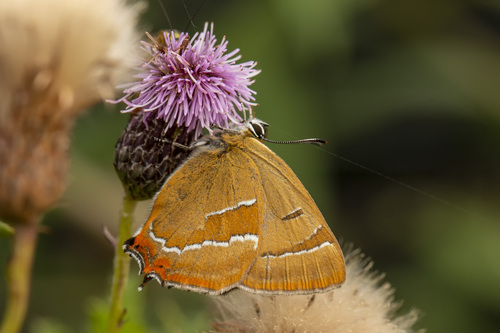
Scarce Large Blue

Scarce Large Blue

Phengaris teleius

Daily sighting probability ~10% · With luck
at Bavarian Forest National Park

In 3 days ~30% in a week ~50%

33 Verified sightings at Bavarian Forest National Park From 2019 to 2026
33 In 1 park
July Best month
☀️ Diurnal When it's spotted

About the Scarce Large Blue

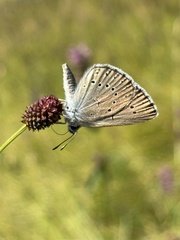
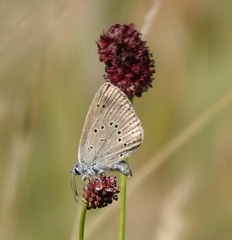
The scarce large blue (Phengaris teleius) is a species of butterfly in the family Lycaenidae. It is found in Austria, Slovenia, Croatia, the Czech Republic, France, Georgia, Germany, Hungary, Italy, Japan, Kazakhstan, Mongolia, Poland, Romania, Russia, northern Serbia, Spain, Switzerland, and Ukraine and East across the Palearctic to Japan. The species was first described by Johann Andreas Benignus Bergsträsser in 1779.

The larva of this species first feeds on Sanguisorba officinalis (great burnet), then moves onto ant nests and is a predator of the ant brood. Myrmica rubra and Myrmica scabrinodis have been reported as frequent host ant species. A recent microhabitat preference study indicates that grazing is necessary for maintaining the present distribution and abundance of these butterflies.

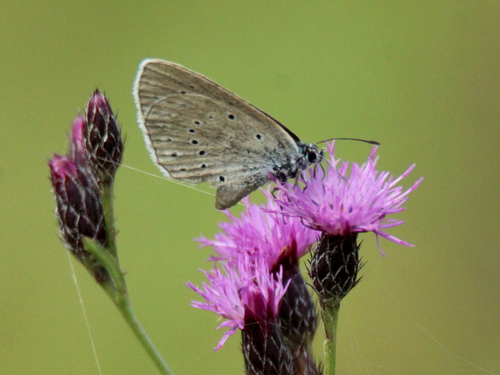
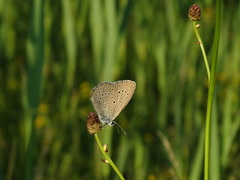
L. euphemus Hbn. (= diomedes Rott.) (83 a), Male above almost entirely blue, but not shining; the margins, the discocellular spot of the forewing and commonly some small spots on the disc black; female much blacker, often a little paler on the disc, this lighter area bearing rows of black spots. Underside with very numerous ocelli, which are rarely... Wikipedia →
Global Distribution

Parks Where Found

# Park Country Daily sighting probability
1 Bavarian Forest National Park 🇩🇪 Germany
~10%

More parks will be added in future updates.

Before you go

What are the chances of seeing a Scarce Large Blue in Bavarian Forest National Park?

With luck

About 10% of wildlife watchers report a Scarce Large Blue sighting in Bavarian Forest National Park on a given day, based on 33 verified sightings from GBIF citizen-science data from 2019 to 2026. It is the 156th most-seen of the 1115 insects we can rate there. Over three days the chance rises to about 30%, and over a week to about 50%, if each day is a fresh chance.

When is the best time to see a Scarce Large Blue in Bavarian Forest National Park?

July

In that month about 30% of wildlife watchers report a Scarce Large Blue in Bavarian Forest National Park on a given day, against under 5% in September to June, the lowest months.

What time of day is best to see a Scarce Large Blue?

Between 3 and 6 pm

Across all the parks we cover, that three-hour window holds the most Scarce Large Blue sightings with a recorded time, and about 8 in 10 of them come between 6 am and 6 pm: it is a daytime animal.

Where else can you see a Scarce Large Blue?

Only Bavarian Forest National Park, in our data

Bavarian Forest National Park is the only park on Wallace's Line with enough records to rate Scarce Large Blue sightings: about 10% of wildlife watchers there report one on a given day.

Which relatives of the Scarce Large Blue live in Bavarian Forest National Park?

Same family: Lycaenidae

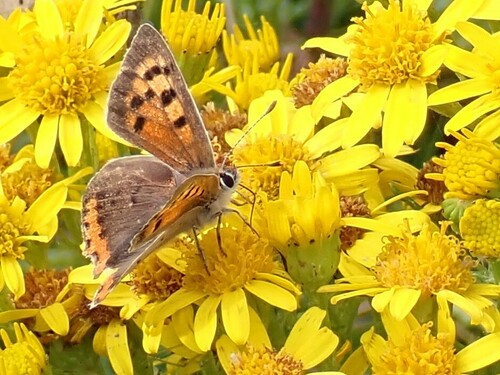
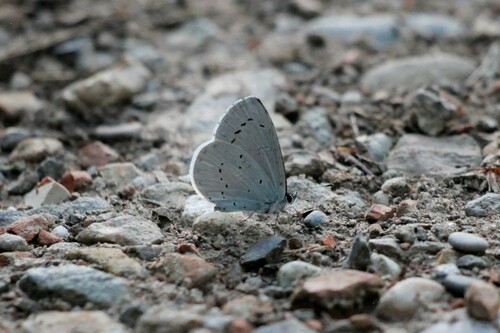
The closest relatives of the Scarce Large Blue that you can see in Bavarian Forest National Park (family Lycaenidae, Gossamer-winged Butterflies) are Common Blue (about 30%), Small Copper (about 20%) and Holly Blue (about 20%), with each one's daily chance of a sighting.

Where does the Scarce Large Blue sighting chance come from?

GBIF citizen-science records

It is estimated from how often the Scarce Large Blue is recorded against all the insects logged in Bavarian Forest National Park (33 verified sightings from 2019 to 2026), calibrated against known sighting rates. Figures are rounded to the nearest 10% because citizen-science data supports honest approximations, not decimals, and months with records from fewer than five people show "—". How it works.

← Back to Bavarian Forest National Park