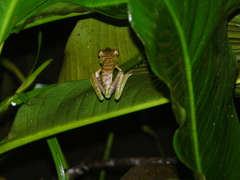
Parachuting Red-eyed Leaf Frog

Parachuting Red-eyed Leaf Frog

Agalychnis saltator

Silhouette: Margot Michaud · PhyloPic

LCLeast ConcernNTVUENCR
Daily sighting probability ~30% · Possible
at Braulio Carrillo National Park

In 3 days ~60% in a week ~90%

72 Verified sightings at Braulio Carrillo National Park From 2019 to 2026
72 In 1 park
July Best month
🌙 Nocturnal When it's spotted

About the Parachuting Red-eyed Leaf Frog

Agalychnis saltator, also known as the parachuting red-eyed leaf frog and misfit leaf frog, is a species of frog in the subfamily Phyllomedusinae. It is found in the Caribbean lowlands from north-eastern Honduras to eastern-central Costa Rica at elevations of 15–1,300 m (49–4,265 ft) asl.

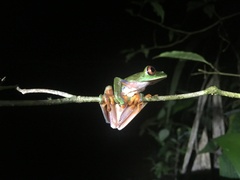
Male Agalychnis saltator measure 38–44 mm (1.5–1.7 in) and females 52–62 mm (2.0–2.4 in) in snout–vent length. They have distinctive red eyes with vertical pupils. The dorsum is light or dark leaf green with bluish purple flanks. They have large suction disks and extensive webbing between the fingers and toes.

Agalychnis saltator are nocturnal and arboreal. They inhabit lowland and montane humid and wet forests, and to a lesser extent, adjacent premontane wet forests and rainforests. They live in tree canopies, but descend to temporary pools to reproduce. Male frog can leap from considerable heights to plants on the mating sites, extending its limbs and spreading out the skin between its fingers and toes, hence the name "parachuting frog".

Agalychnis saltator are explosive breeders that breed after heavy rains. A single breeding aggregation... Wikipedia →

Sounds

Advertisement call0:10

Costa Rica · 2025

© Chris Harrison · XC1043412 · CC BY-NC-SA 4.0

Global Distribution

Parks Where Found

# Park Country Daily sighting probability
1 Braulio Carrillo National Park 🇨🇷 Costa Rica
~30%

More parks will be added in future updates.

Before you go

What are the chances of seeing a Parachuting Red-eyed Leaf Frog in Braulio Carrillo National Park?

Possible

About 30% of wildlife watchers report a Parachuting Red-eyed Leaf Frog sighting in Braulio Carrillo National Park on a given day, based on 72 verified sightings from GBIF citizen-science data from 2019 to 2026. It is the 15th most-seen of the 46 amphibians we can rate there. Over three days the chance rises to about 60%, and over a week to about 90%, if each day is a fresh chance.

When is the best time to see a Parachuting Red-eyed Leaf Frog in Braulio Carrillo National Park?

June–July and September–October

In those months about 40% of wildlife watchers report a Parachuting Red-eyed Leaf Frog in Braulio Carrillo National Park on a given day, against under 5% in February, the lowest month.

What time of day is best to see a Parachuting Red-eyed Leaf Frog?

Between 7 and 10 pm

Across all the parks we cover, that three-hour window holds the most Parachuting Red-eyed Leaf Frog sightings with a recorded time, and about 9 in 10 of them come between 6 pm and 6 am: it is mostly seen at night.

Where else can you see a Parachuting Red-eyed Leaf Frog?

Only Braulio Carrillo National Park, in our data

Braulio Carrillo National Park is the only park on Wallace's Line with enough records to rate Parachuting Red-eyed Leaf Frog sightings: about 30% of wildlife watchers there report one on a given day.

Which relatives of the Parachuting Red-eyed Leaf Frog live in Braulio Carrillo National Park?

Same genus: Agalychnis

The closest relatives of the Parachuting Red-eyed Leaf Frog that you can see in Braulio Carrillo National Park (genus Agalychnis, Leaf Frogs) are Red-eyed Treefrog (about 60%), Blue-sided Tree Frog (about 10%) and Gliding Leaf Frog (about 10%), with each one's daily chance of a sighting.

Where does the Parachuting Red-eyed Leaf Frog sighting chance come from?

GBIF citizen-science records

It is estimated from how often the Parachuting Red-eyed Leaf Frog is recorded against all the amphibians logged in Braulio Carrillo National Park (72 verified sightings from 2019 to 2026), calibrated against known sighting rates. Figures are rounded to the nearest 10% because citizen-science data supports honest approximations, not decimals, and months with records from fewer than five people show "—". How it works.

← Back to Braulio Carrillo National Park