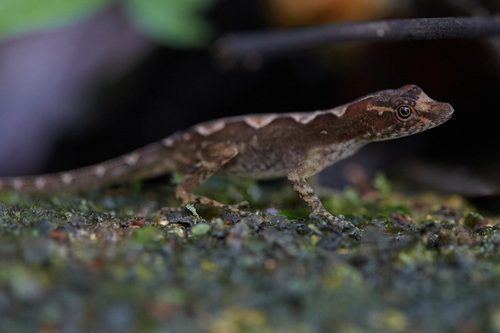
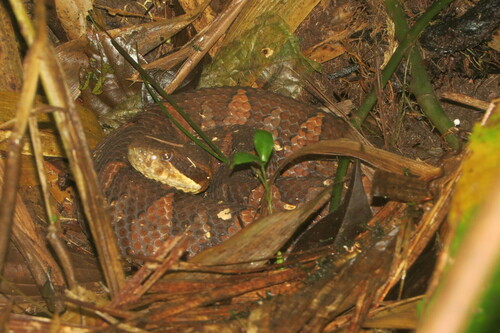
Picado's Pit Viper

Picado's Pit Viper

Atropoides picadoi

Silhouette: Steven Traver · PhyloPic

LCLeast ConcernNTVUENCR Endemic
Daily sighting probability ~10% · With luck
at Braulio Carrillo National Park

In 3 days ~20% in a week ~40%

5 Verified sightings at Braulio Carrillo National Park From 2019 to 2026
5 In 1 park
October Best month
☀️🌙 Day & Night When it's spotted

About the Picado's Pit Viper

Atropoides picadoi, also known as Picado's jumping pit viper, is a pit viper species in the subfamily Crotalinae of the family Viperidae. The species is endemic to Costa Rica. There are no subspecies that are recognised as being valid. It is monotypic in the genus Atropoides.

The specific name, picadoi, is in honor of Costa Rican herpetologist Clodomiro Picado Twight. Adults of A. picadoi commonly reach a total length (including tail) of 75–95 cm (2.46–3.12 ft) with a maximum of 120.2 cm (3.94 ft). A. picadoi is extremely stout, though not quite so much as A. mexicanus.

Atropoides picadoi is found in the mountains of Costa Rica and western Panama at 50–1,500 m (160–4,920 ft) altitude. Its geographic range includes the Cordillera de Tilarán, the Cordillera Central, and the Cordillera de Talamanca. The type locality given is "La Palma, [San José Province], Costa Rica, 4500 feet".

Dunn ER (1939). "A New Pit Viper from Costa Rica". Proceedings of the Biological Society of Washington 52: 165-166. (Trimeresurus nummifer picadoi, new subspecies). Atropoides picadoi at the Reptarium... Wikipedia →
Global Distribution

Parks Where Found

# Park Country Daily sighting probability
1 Braulio Carrillo National Park 🇨🇷 Costa Rica
~10%

More parks will be added in future updates.

Before you go

What are the chances of seeing a Picado's Pit Viper in Braulio Carrillo National Park?

With luck

About 10% of wildlife watchers report a Picado's Pit Viper sighting in Braulio Carrillo National Park on a given day, based on 5 verified sightings from GBIF citizen-science data from 2019 to 2026. It is the 52nd most-seen of the 57 reptiles we can rate there. Over three days the chance rises to about 20%, and over a week to about 40%, if each day is a fresh chance.

When is the best time to see a Picado's Pit Viper in Braulio Carrillo National Park?

October

In that month about 20% of wildlife watchers report a Picado's Pit Viper in Braulio Carrillo National Park on a given day, against under 5% in June, August and November–April, the lowest months.

What time of day is best to see a Picado's Pit Viper?

Between 8 and 11 am

Across all the parks we cover, that three-hour window holds the most Picado's Pit Viper sightings with a recorded time, and about 7 in 10 of them come between 6 am and 6 pm: it is seen both by day and at night.

Where else can you see a Picado's Pit Viper?

Only Braulio Carrillo National Park, in our data

Braulio Carrillo National Park is the only park on Wallace's Line with enough records to rate Picado's Pit Viper sightings: about 10% of wildlife watchers there report one on a given day.

Which relatives of the Picado's Pit Viper live in Braulio Carrillo National Park?

Same family: Viperidae

The closest relatives of the Picado's Pit Viper that you can see in Braulio Carrillo National Park (family Viperidae, Vipers) are Fer-de-lance (about 60%), Side-striped palm pit viper (about 10%) and Black-speckled Palm Pit Viper (about 10%), with each one's daily chance of a sighting.

Where does the Picado's Pit Viper sighting chance come from?

GBIF citizen-science records

It is estimated from how often the Picado's Pit Viper is recorded against all the reptiles logged in Braulio Carrillo National Park (5 verified sightings from 2019 to 2026), calibrated against known sighting rates. Figures are rounded to the nearest 10% because citizen-science data supports honest approximations, not decimals, and months with records from fewer than five people show "—". How it works.

← Back to Braulio Carrillo National Park