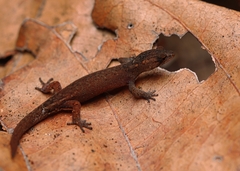
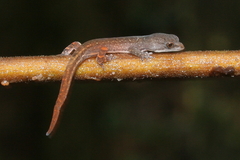
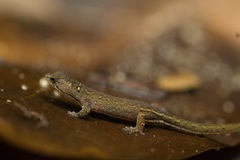
Brazilian pygmy gecko

Brazilian pygmy gecko

Chatogekko amazonicus

Silhouette: Jose Carlos Arenas-Monroy · PhyloPic

LCLeast ConcernNTVUENCR
Daily sighting probability ~30% · Possible
at Brownsberg Nature Park

In 3 days ~70% in a week ~90%

6 Verified sightings at Brownsberg Nature Park From 2019 to 2026
6 In 1 park
May Best month
☀️🌙 Day & Night When it's spotted

About the Brazilian pygmy gecko

The Brazilian pygmy gecko (Chatogekko amazonicus) is a species of South American lizard in the family Sphaerodactylidae. The species is monotypic in the genus Chatogekko. It grows to a maximum total length (including tail) of only 24 millimetres (0.94 in). It is found in leaf litter on the forest floor, and preys on springtails and mites. The species is oviparous.

The gecko's skin is superhydrophobic as a result of tiny hairs on its surface, allowing Chatogekko amazonicus to be able to avoid drowning in rainstorms despite its small size, and even float on water. The following cladogram presented by Gamble et al. in 2011 represents phylogenetic relationships among the genera of sphaerodactyl geckos which were recognized as being valid at that time.

Andersson LG (1918). "New Lizards from South America. Collected by Nils Holmgren and A. Roman". Arkiv för Zoologi 1 (16): 1–9. (Sphærodactylus amazonicus, new species, pp. 1–2). Wikipedia →

Global Distribution

Parks Where Found

# Park Country Daily sighting probability
1 Brownsberg Nature Park 🇸🇷 Suriname
~30%

More parks will be added in future updates.

Before you go

What are the chances of seeing a Brazilian pygmy gecko in Brownsberg Nature Park?

Possible

About 30% of wildlife watchers report a Brazilian pygmy gecko sighting in Brownsberg Nature Park on a given day, based on 6 verified sightings from GBIF citizen-science data from 2019 to 2026. It is the 15th most-seen of the 22 reptiles we can rate there. Over three days the chance rises to about 70%, and over a week to about 90%, if each day is a fresh chance.

When is the best time to see a Brazilian pygmy gecko in Brownsberg Nature Park?

May

In that month about 70% of wildlife watchers report a Brazilian pygmy gecko in Brownsberg Nature Park on a given day, against under 5% in January and February, the lowest months. That is one of Brownsberg Nature Park's wettest months, with about 490 mm of rain against 55 mm in October. June and August–September have too few records to rate.

What time of day is best to see a Brazilian pygmy gecko?

Between 9 am and noon

Across all the parks we cover, that three-hour window holds the most Brazilian pygmy gecko sightings with a recorded time, and about 6 in 10 of them come between 6 am and 6 pm: it is seen both by day and at night.

Where else can you see a Brazilian pygmy gecko?

Only Brownsberg Nature Park, in our data

Brownsberg Nature Park is the only park on Wallace's Line with enough records to rate Brazilian pygmy gecko sightings: about 30% of wildlife watchers there report one on a given day.

Where does the Brazilian pygmy gecko sighting chance come from?

GBIF citizen-science records

It is estimated from how often the Brazilian pygmy gecko is recorded against all the reptiles logged in Brownsberg Nature Park (6 verified sightings from 2019 to 2026), calibrated against known sighting rates. Figures are rounded to the nearest 10% because citizen-science data supports honest approximations, not decimals, and months with records from fewer than five people show "—". How it works.

← Back to Brownsberg Nature Park