Scottish Crossbill

Scottish Crossbill

Loxia scotica

Silhouette: Emma Hughes · PhyloPic

LCLeast ConcernNTVUENCR Endemic
Daily sighting probability <5% · Rare
at Cairngorms National Park

In 3 days <5% in a week ~10%

39 Verified sightings at Cairngorms National Park From 2019 to 2026
39 In 1 park
December Best month
☀️ Diurnal When it's spotted

About the Scottish Crossbill

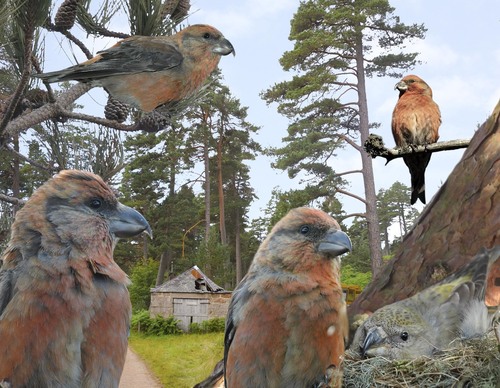
The Scottish crossbill (Loxia scotica) is a small passerine bird in the finch family Fringillidae. It is endemic to the Caledonian Forests of Scotland, one of only two land vertebrate species endemic to the British Isles (the other being red grouse, Lagopus scotica).

The genus name Loxia is from Ancient Greek loxos, 'crosswise', and scotica is Latin for 'Scottish'. The Scottish Gaelic name for a crossbill is Cam-ghob, which means 'crooked beak'. The British Ornithologists Union first classed the Scottish crossbill as a separate and distinct species in 1980, but some ornithologists believed there was insufficient scientific research for its status. It was considered to be possibly a race of either the red crossbill or the parrot crossbill, both of which also occur in the Caledonian Forest.

RSPB research showed that Scottish crossbills have quite distinct flight and excitement calls from other crossbills – some even stated they have "Scottish accents". Research in Scotland has shown that red, parrot and Scottish crossbills are reproductively isolated, and the diagnostic calls and bill dimensions have not been lost. They are therefore good species.

The... Wikipedia →
Sounds

Call0:23

United Kingdom · 2023

© Marcin Sołowiej · XC821424 · CC BY-NC-SA 4.0

Song0:27

United Kingdom · 2022

© Andrew Harrop · XC715938 · CC BY-NC-SA 4.0

Flight call0:41

France · 2021

© Stanislas Wroza · XC626622 · CC BY-NC-SA 4.0

Global Distribution

Parks Where Found

# Park Country Daily sighting probability
1 Cairngorms National Park 🇬🇧 United Kingdom
<5%

More parks will be added in future updates.

Before you go

What are the chances of seeing a Scottish Crossbill in Cairngorms National Park?

Rare

Under 5% of wildlife watchers report a Scottish Crossbill sighting in Cairngorms National Park on a given day, based on 39 verified sightings from GBIF citizen-science data from 2019 to 2026. It is the 114th most-seen of the 140 birds we can rate there. Over three days the chance rises to under 5%, and over a week to about 10%, if each day is a fresh chance.

When is the best time to see a Scottish Crossbill in Cairngorms National Park?

December

In that month about 10% of wildlife watchers report a Scottish Crossbill in Cairngorms National Park on a given day, against under 5% in January to November, the lowest months.

What time of day is best to see a Scottish Crossbill?

Between 8 and 11 am

Across all the parks we cover, that three-hour window holds the most Scottish Crossbill sightings with a recorded time, and about 8 in 10 of them come between 6 am and 6 pm: it is a daytime animal.

Where else can you see a Scottish Crossbill?

Only Cairngorms National Park, in our data

Cairngorms National Park is the only park on Wallace's Line with enough records to rate Scottish Crossbill sightings: under 5% of wildlife watchers there report one on a given day.

Where does the Scottish Crossbill sighting chance come from?

GBIF citizen-science records

It is estimated from how often the Scottish Crossbill is recorded against all the birds logged in Cairngorms National Park (39 verified sightings from 2019 to 2026), calibrated against known sighting rates. Figures are rounded to the nearest 10% because citizen-science data supports honest approximations, not decimals, and months with records from fewer than five people show "—". How it works.

← Back to Cairngorms National Park