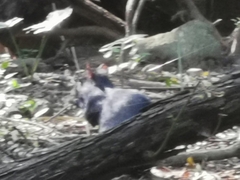
Mexican Agouti

Mexican Agouti

Dasyprocta mexicana

Silhouette: Margot Michaud · PhyloPic

LCNTVUENCRCritically Endangered Endemic
Daily sighting probability ~20% · Possible
at Cañón del Sumidero National Park

In 3 days ~40% in a week ~70%

42 Verified sightings at Cañón del Sumidero National Park From 2019 to 2026
42 In 1 park
November Best month
☀️ Diurnal When it's spotted

About the Mexican Agouti

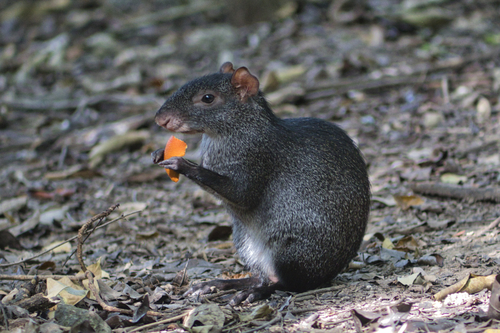
The Mexican agouti, (Dasyprocta mexicana), also known as the Mexican black agouti, is a species of rodent in the genus Dasyprocta. This species was first discovered in 1860 in Veracruz, Mexico and described by Henri Louis Frédéric de Saussure.

Dasyprocta mexicana is a medium-sized rodent, weighing between 2 kilograms to 4 kilograms as an adult. This length of D. mexicana ranges from 40 centimeters to 60 centimeters, which is inclusive of the tail that ranges from 2 centimeters to 3 centimeters in length and is located at the most posterior point of the body. While data is limited on the height of this particular species, it is expected to be similar to the average height of 23 centimeters seen in similar sized agoutis.

The head and body of D. mexicana constitute majority of this length, as this portion is on average 44.6 centimeters to 56 centimeters long. The dorsal areas of the head and body of D. mexicana possess either a black or darkened brown coat colour, distinguishing this species from other members in their genus. Throughout this darkened coat, white hairs are sparingly dispersed. Additionally, different portions of the rodent's head and back can... Wikipedia →
Global Distribution

Parks Where Found

# Park Country Daily sighting probability
1 Cañón del Sumidero National Park 🇲🇽 Mexico
~20%

More parks will be added in future updates.

Zoos & Centres Where Found

# Zoo / Centre Country
1 Zoológico Miguél Álvarez del Toro 🇲🇽 Mexico In captivity

Before you go

What are the chances of seeing a Mexican Agouti in Cañón del Sumidero National Park?

Possible

About 20% of wildlife watchers report a Mexican Agouti sighting in Cañón del Sumidero National Park on a given day, based on 42 verified sightings from GBIF citizen-science data from 2019 to 2026. It is the 3rd most-seen of the 5 mammals we can rate there. Over three days the chance rises to about 40%, and over a week to about 70%, if each day is a fresh chance.

When is the best time to see a Mexican Agouti in Cañón del Sumidero National Park?

November

In that month about 30% of wildlife watchers report a Mexican Agouti in Cañón del Sumidero National Park on a given day, against about 10% in May, September and December–March, the lowest months. That is one of Cañón del Sumidero National Park's driest months, with about 45 mm of rain against 260 mm in June.

What time of day is best to see a Mexican Agouti?

Between 9 am and noon

Across all the parks we cover, that three-hour window holds the most Mexican Agouti sightings with a recorded time, and about 8 in 10 of them come between 6 am and 6 pm: it is a daytime animal.

Where else can you see a Mexican Agouti?

Only Cañón del Sumidero National Park, in our data

Cañón del Sumidero National Park is the only park on Wallace's Line with enough records to rate Mexican Agouti sightings: about 20% of wildlife watchers there report one on a given day.

Where does the Mexican Agouti sighting chance come from?

GBIF citizen-science records

It is estimated from how often the Mexican Agouti is recorded against all the mammals logged in Cañón del Sumidero National Park (42 verified sightings from 2019 to 2026), calibrated against known sighting rates. Figures are rounded to the nearest 10% because citizen-science data supports honest approximations, not decimals, and months with records from fewer than five people show "—". How it works.

← Back to Cañón del Sumidero National Park