Yellow Grosbeak

Yellow Grosbeak

Pheucticus chrysopeplus

Silhouette: Sheatherius · PhyloPic

LCLeast ConcernNTVUENCR
Daily sighting probability ~10% · With luck
at Cañón del Sumidero National Park

In 3 days ~30% in a week ~60%

88 Verified sightings at Cañón del Sumidero National Park From 2019 to 2026
173 In all 3 parks
April Best month
☀️ Diurnal When it's spotted

About the Yellow Grosbeak

The yellow grosbeak (Pheucticus chrysopeplus) is a bird in the family Cardinalidae, the cardinals, grosbeaks, and “tanager” allies. It is found in Mexico and Guatemala. It also occurs as a vagrant in the United States. The yellow grosbeak was formally described in 1832 with the binomial Cocothraustes chrysopeplus. Some authors have treated it, the black-thighed grosbeak (P. tibialis), and the golden grosbeak (P. chrysogaster) as conspecific.

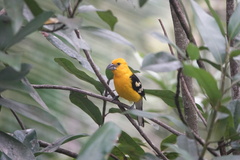
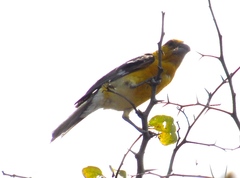
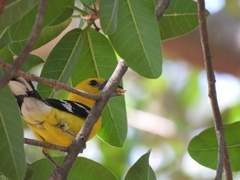
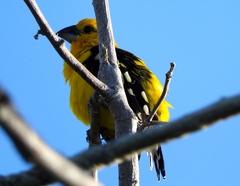
The yellow grosbeak is the largest member of its genus in Mexico and Central America. It is 21.5 to 24 cm (8.5 to 9.4 in) long; one female weighed 77.6 g (2.7 oz). Adult males of the nominate subspecies have a deep yellow head, nape, and breast. Their back and rump are a brighter yellow with some faint darker mottling. The sides of their mantle are black and their uppertail coverts black with wide white tips. Their wings are mostly black with wide white tips on the greater and median coverts, white bases on the primaries, and white... Wikipedia →

Sounds

Call0:52

Mexico · 2021

© Manuel Grosselet · XC678430 · CC BY-NC-SA 4.0

Song0:18

Mexico · 2021

© Aziza Cooper · XC646495 · CC BY-NC-SA 4.0

Song0:30

Mexico · 2019

© Richard E. Webster · XC503269 · CC BY-NC-SA 4.0

Global Distribution

Parks Where Found

# Park Country Daily sighting probability
1 El Triunfo 🇲🇽 Mexico
~20%
2 Cañón del Sumidero National Park 🇲🇽 Mexico
~10%
3 Rocky Mountain National Park 🇺🇸 United States
~10%

Zoos & Centres Where Found

# Zoo / Centre Country
1 Xcaret 🇲🇽 Mexico In captivity
2 Burgers' Ocean 🇳🇱 Netherlands In captivity
3 Royal Burgers' Zoo 🇳🇱 Netherlands In captivity
4 Arizona-Sonora Desert Museum 🇺🇸 United States In captivity

Before you go

What are the chances of seeing a Yellow Grosbeak in Cañón del Sumidero National Park?

With luck

About 10% of wildlife watchers report a Yellow Grosbeak sighting in Cañón del Sumidero National Park on a given day, based on 88 verified sightings from GBIF citizen-science data from 2019 to 2026. It is the 101st most-seen of the 243 birds we can rate there. Over three days the chance rises to about 30%, and over a week to about 60%, if each day is a fresh chance.

When is the best time to see a Yellow Grosbeak in Cañón del Sumidero National Park?

April

In that month about 30% of wildlife watchers report a Yellow Grosbeak in Cañón del Sumidero National Park on a given day, against under 5% in March and June, the lowest months. That is one of Cañón del Sumidero National Park's driest months, with about 20 mm of rain against 260 mm in June.

What time of day is best to see a Yellow Grosbeak?

Between 8 and 11 am

Across all the parks we cover, that three-hour window holds the most Yellow Grosbeak sightings with a recorded time, and about 9 in 10 of them come between 6 am and 6 pm: it is a daytime animal.

Is Cañón del Sumidero National Park the best place to see a Yellow Grosbeak?

2nd of 3

Of the 3 parks where we can rate Yellow Grosbeak sightings, Cañón del Sumidero National Park ranks 2nd at about 10%. The best odds are in El Triunfo (Mexico, about 20%).

Where does the Yellow Grosbeak sighting chance come from?

GBIF citizen-science records

It is estimated from how often the Yellow Grosbeak is recorded against all the birds logged in Cañón del Sumidero National Park (88 verified sightings from 2019 to 2026), calibrated against known sighting rates. Figures are rounded to the nearest 10% because citizen-science data supports honest approximations, not decimals, and months with records from fewer than five people show "—". How it works.

← Back to Cañón del Sumidero National Park