Lesser Roadrunner

Lesser Roadrunner

Geococcyx velox

Silhouette: Nicolas Huet le Jeune and Jean-Gabriel Prêtre (vectorized by T. Michael Keesey) · PhyloPic

LCLeast ConcernNTVUENCR
Daily sighting probability ~10% · With luck
at Celaque National Park

In 3 days ~30% in a week ~60%

29 Verified sightings at Celaque National Park From 2019 to 2026
56 In all 3 parks
December Best month
☀️ Diurnal When it's spotted

About the Lesser Roadrunner

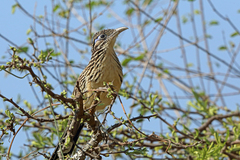
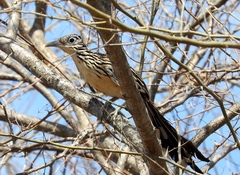
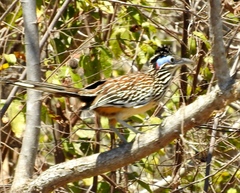
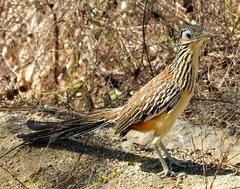
The lesser roadrunner (Geococcyx velox) is a large, long-legged bird that is a member of the cuckoo family, Cuculidae. It is found in Mesoamerica. Its Latin name means "swift earth-cuckoo". Along with the greater roadrunner, it is one of two species in the genus Geococcyx.

The lesser roadrunner is a slender bird that reaches a length of 46 to 51 cm (18 in), the tail itself accounting for about 24 cm (9.4 in). Its average length is 46 cm (18 in). The male weighs 174–207 grams (6.1–7.3 oz), while the female weighs 162–192 grams (5.7–6.8 oz).

The crown, crest and neck of the lesser roadrunner are black with a bronze glow and small light brown spots. The back neck is black-brown, with feathers are lined with a pale brown, so that a brown-white dashes arises. The plumage of the upper body is dark brown with light speckles and lightens to maroon towards the rump, and its breast is white. The rectrices are black with a dark purple luster. Young roadrunners resemble adults, but have ocher-colored lines, and duller skin around the eye.

The iris is yellow to brown, with a yellow to silvery-white ring surrounding the pupil. The eye ring is pale lavender to bright blue. The... Wikipedia →

Sounds

Song1:12

Mexico · 2015

© Frank Lambert · XC352732 · CC BY-NC-ND 4.0

Bill clap0:04

Mexico · 2022

© Manuel Grosselet · XC733740 · CC BY-NC-SA 4.0

Song0:04

Mexico · 2022

© Peter de Rouw · XC735971 · CC BY-NC-SA 4.0

Global Distribution

Parks Where Found

# Park Country Daily sighting probability
1 Celaque National Park 🇭🇳 Honduras
~10%
2 La Tigra National Park 🇭🇳 Honduras
<5%
3 Cañón del Sumidero National Park 🇲🇽 Mexico
<5%

Before you go

What are the chances of seeing a Lesser Roadrunner in Celaque National Park?

With luck

About 10% of wildlife watchers report a Lesser Roadrunner sighting in Celaque National Park on a given day, based on 29 verified sightings from GBIF citizen-science data from 2019 to 2026. It is the 70th most-seen of the 193 birds we can rate there. Over three days the chance rises to about 30%, and over a week to about 60%, if each day is a fresh chance.

When is the best time to see a Lesser Roadrunner in Celaque National Park?

December

In that month about 30% of wildlife watchers report a Lesser Roadrunner in Celaque National Park on a given day, against under 5% in April, the lowest month. That is one of Celaque National Park's driest months, with about 100 mm of rain against 370 mm in September.

What time of day is best to see a Lesser Roadrunner?

Between 8 and 11 am

Across all the parks we cover, that three-hour window holds the most Lesser Roadrunner sightings with a recorded time, and about 9 in 10 of them come between 6 am and 6 pm: it is a daytime animal.

Is Celaque National Park the best place to see a Lesser Roadrunner?

Yes

Of the 3 parks where we can rate Lesser Roadrunner sightings, Celaque National Park has the highest daily chance: about 10%. Next come La Tigra National Park (Honduras, under 5%) and Cañón del Sumidero National Park (Mexico, under 5%).

Which relatives of the Lesser Roadrunner live in Celaque National Park?

Same family: Cuculidae

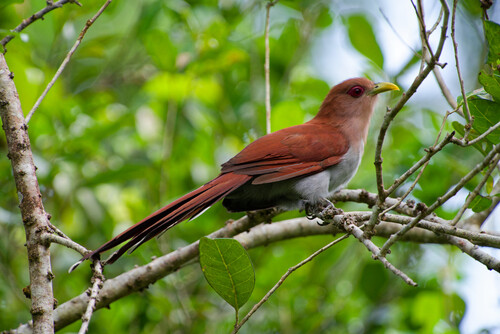
The closest relatives of the Lesser Roadrunner that you can see in Celaque National Park (family Cuculidae, Cuckoos) are Groove-billed Ani (about 30%) and Squirrel Cuckoo (about 20%), with each one's daily chance of a sighting.

Where does the Lesser Roadrunner sighting chance come from?

GBIF citizen-science records

It is estimated from how often the Lesser Roadrunner is recorded against all the birds logged in Celaque National Park (29 verified sightings from 2019 to 2026), calibrated against known sighting rates. Figures are rounded to the nearest 10% because citizen-science data supports honest approximations, not decimals, and months with records from fewer than five people show "—". How it works.

← Back to Celaque National Park