
Bahia Wagtail-Tyrant

Bahia Wagtail-Tyrant

Stigmatura bahiae

Silhouette: Emily Willoughby · PhyloPic

LCLeast ConcernNTVUENCR
Daily sighting probability ~10% · With luck
at Chapada Diamantina National Park

In 3 days ~20% in a week ~40%

46 Verified sightings at Chapada Diamantina National Park From 2019 to 2026
46 In 1 park
July Best month
☀️ Diurnal When it's spotted

About the Bahia Wagtail-Tyrant

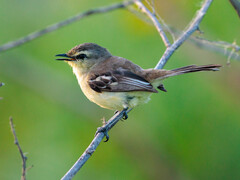
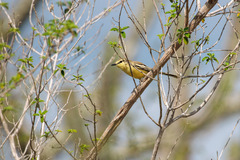
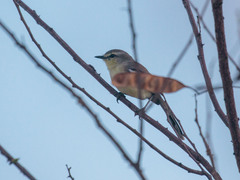
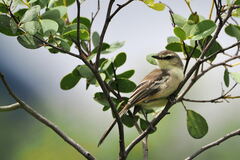
The Bahia wagtail-tyrant (Stigmatura bahiae) is a species of bird in the family Tyrannidae, the tyrant flycatchers. It is endemic to eastern Brazil. What is now the Bahia wagtail-tyrant was originally described as Stigmatura budytoides bahiae, a subspecies of the greater wagtail-tyrant. What is now the lesser wagtail-tyrant (S. napensis) was described as another subspecies at the same time. They were later treated as two subspecies of the lesser wagtail-tyrant. BirdLife International's Handbook of the Birds of the World separated them from each other as monotypic species in 2014. The Clements taxonomy did so in late 2022 and the International Ornithological Committee in early 2023. As of late 2024 the South American Classification Committee of the American Ornithological Society had not adopted the split.

The Bahia wagtail-tyrant is 13 cm (5.1 in) long. The sexes have the same plumage; males are slightly larger than females. Adults have a thin pale yellow supercilium and a dark line through the eye on an otherwise pale yellowish face. Their crown and upperparts are warm brownish. Their wings are dusky with wide white edges on the innermost... Wikipedia →

Sounds

Recording0:04

Brazil · 2016

© Luciano Bernardes · iNaturalist · CC BY-NC 4.0

Global Distribution

Parks Where Found

# Park Country Daily sighting probability
1 Chapada Diamantina National Park 🇧🇷 Brazil
~10%

More parks will be added in future updates.

Before you go

What are the chances of seeing a Bahia Wagtail-Tyrant in Chapada Diamantina National Park?

With luck

About 10% of wildlife watchers report a Bahia Wagtail-Tyrant sighting in Chapada Diamantina National Park on a given day, based on 46 verified sightings from GBIF citizen-science data from 2019 to 2026. It is the 148th most-seen of the 271 birds we can rate there. Over three days the chance rises to about 20%, and over a week to about 40%, if each day is a fresh chance.

When is the best time to see a Bahia Wagtail-Tyrant in Chapada Diamantina National Park?

July

In that month about 20% of wildlife watchers report a Bahia Wagtail-Tyrant in Chapada Diamantina National Park on a given day, against under 5% in January–March and October, the lowest months.

What time of day is best to see a Bahia Wagtail-Tyrant?

Between 6 and 9 am

Across all the parks we cover, that three-hour window holds the most Bahia Wagtail-Tyrant sightings with a recorded time, and about 9 in 10 of them come between 6 am and 6 pm: it is a daytime animal.

Where else can you see a Bahia Wagtail-Tyrant?

Only Chapada Diamantina National Park, in our data

Chapada Diamantina National Park is the only park on Wallace's Line with enough records to rate Bahia Wagtail-Tyrant sightings: about 10% of wildlife watchers there report one on a given day.

Which relatives of the Bahia Wagtail-Tyrant live in Chapada Diamantina National Park?

Same family: Tyrannidae

The closest relatives of the Bahia Wagtail-Tyrant that you can see in Chapada Diamantina National Park (family Tyrannidae, Tyrant Flycatchers) are Tropical Kingbird (about 50%), Plain-crested Elaenia (about 50%) and Great Kiskadee (about 50%), with each one's daily chance of a sighting.

Where does the Bahia Wagtail-Tyrant sighting chance come from?

GBIF citizen-science records

It is estimated from how often the Bahia Wagtail-Tyrant is recorded against all the birds logged in Chapada Diamantina National Park (46 verified sightings from 2019 to 2026), calibrated against known sighting rates. Figures are rounded to the nearest 10% because citizen-science data supports honest approximations, not decimals, and months with records from fewer than five people show "—". How it works.

← Back to Chapada Diamantina National Park