

Ceará Gnateater

Ceará Gnateater

Conopophaga cearae

Silhouette: Sheatherius · PhyloPic

LCNTNear ThreatenedVUENCR
Daily sighting probability <5% · Rare
at Chapada Diamantina National Park

In 3 days ~10% in a week ~30%

28 Verified sightings at Chapada Diamantina National Park From 2019 to 2026
28 In 1 park
April Best month
☀️ Diurnal When it's spotted

About the Ceará Gnateater

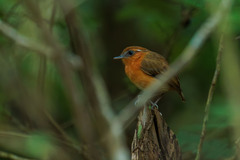
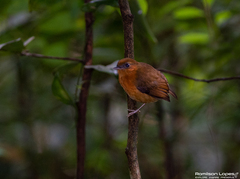
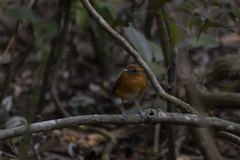
The Ceará Gnateater or Caatinga Gnateater (Conopophaga cearae) is a passerine bird of the gnateater family, Conopophagidae. It is found in forest understory and bushes in northeastern Brazil. The Ceara Gnateater is locally called "chupa-dente", or "tooth-sucker" in Portuguese due to the sound it produces when it vocalizes.

They are about 11.5 to 14 cm (4.5 to 5.5 in) long and weigh on average 24.5g (0.86 oz). The Ceará Gnateater used to be considered a subspecies of the Rufous Gnateater (Conopophaga lineata), but genetic evidence showed they are distinct species. They were split into two different independent taxa in 2015. The vocalization of the two species is similar, but the Ceara Gnateater has a lower-pitched song that is slightly slower than that of the Rufous Gnateater. They are also different in appearance. Ceará Gnateaters have a more vivid orange or apricot color with a white belly patch and a bight eye line, while Rufous Gnateaters have a dirty orange to brown color with a light grey belly and a duller grey eye line.

Ceará Gnateaters are endemic to a small region in northeastern Brazil in isolated patches of Atlantic Forest... Wikipedia →

Sounds

Recording0:13

Brazil · 2022

© Cicero Simão Lima Santos · XC742057 · CC BY-NC-SA 4.0

Call0:31

Brazil · 2022

© Barry Edmonston · XC712372 · CC BY-NC-SA 4.0

Song1:28

Brazil · 2020

© Ciro Albano · XC587369 · CC BY-NC-SA 4.0

Global Distribution

Parks Where Found

# Park Country Daily sighting probability
1 Chapada Diamantina National Park 🇧🇷 Brazil
<5%

More parks will be added in future updates.

Before you go

What are the chances of seeing a Ceará Gnateater in Chapada Diamantina National Park?

Rare

Under 5% of wildlife watchers report a Ceará Gnateater sighting in Chapada Diamantina National Park on a given day, based on 28 verified sightings from GBIF citizen-science data from 2019 to 2026. It is the 178th most-seen of the 271 birds we can rate there. Over three days the chance rises to about 10%, and over a week to about 30%, if each day is a fresh chance.

When is the best time to see a Ceará Gnateater in Chapada Diamantina National Park?

April

In that month about 20% of wildlife watchers report a Ceará Gnateater in Chapada Diamantina National Park on a given day, against under 5% in January–March, July–August and October–November, the lowest months.

What time of day is best to see a Ceará Gnateater?

Between 8 and 11 am

Across all the parks we cover, that three-hour window holds the most Ceará Gnateater sightings with a recorded time, and about 9 in 10 of them come between 6 am and 6 pm: it is a daytime animal.

Where else can you see a Ceará Gnateater?

Only Chapada Diamantina National Park, in our data

Chapada Diamantina National Park is the only park on Wallace's Line with enough records to rate Ceará Gnateater sightings: under 5% of wildlife watchers there report one on a given day.

Which relatives of the Ceará Gnateater live in Chapada Diamantina National Park?

Same order: Passeriformes

The closest relatives of the Ceará Gnateater that you can see in Chapada Diamantina National Park (order Passeriformes, Perching Birds) are Rufous-collared Sparrow (about 60%), Pale-breasted Thrush (about 60%) and Southern House Wren (about 60%), with each one's daily chance of a sighting.

Where does the Ceará Gnateater sighting chance come from?

GBIF citizen-science records

It is estimated from how often the Ceará Gnateater is recorded against all the birds logged in Chapada Diamantina National Park (28 verified sightings from 2019 to 2026), calibrated against known sighting rates. Figures are rounded to the nearest 10% because citizen-science data supports honest approximations, not decimals, and months with records from fewer than five people show "—". How it works.

← Back to Chapada Diamantina National Park