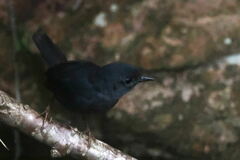
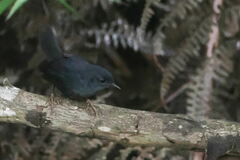

Diamantina Tapaculo

Diamantina Tapaculo

Scytalopus diamantinensis

Silhouette: Ferran Sayol · PhyloPic

LCNTVUENEndangeredCR Endemic
Daily sighting probability ~20% · Possible
at Chapada Diamantina National Park

In 3 days ~50% in a week ~80%

188 Verified sightings at Chapada Diamantina National Park From 2019 to 2026
188 In 1 park
March Best month
☀️ Diurnal When it's spotted

About the Diamantina Tapaculo

The Diamantina tapaculo (Scytalopus diamantinensis) is a species of bird in the family Rhinocryptidae. It is endemic to northeastern Brazil. The Diamantina tapaculo was described as a new species in 2007. At that time it was thought to be closely related to the Planalto tapaculo (Scytalopus pachecoi), and the South American Classification Committee of the American Ornithological Society (AOS) and the Clements taxonomy have agreed. However, the International Ornithological Congress (IOC) has not accepted that placement.

The Diamantina tapaculo is approximately 10 to 11 cm (3.9 to 4.3 in) long and weighs approximately 15 g (0.53 oz). The adult's plumage is identical to that of the Planalto tapaculo. The male's upperparts are mainly dark gray and the underparts paler gray. The flanks are buff with dark bars, which differentiate it from the similar but unbarred mouse-colored tapaculo. The female is browner.

The Diamantina tapaculo is found only in the Chapada Diamantina in Brazil's Bahia state. It inhabits some of the remaining patches of dense forest in a region otherwise characterized by campo rupestre, a... Wikipedia →

Sounds

Song1:25

Brazil · 2020

© Ciro Albano · XC576465 · CC BY-NC-SA 4.0

Canto0:37

Brazil · 2016

© Caio Brito · XC427937 · CC BY-NC-SA 4.0

Call0:44

Brazil · 2012

© Jon King · XC114455 · CC BY-NC-SA 3.0

Global Distribution

Parks Where Found

# Park Country Daily sighting probability
1 Chapada Diamantina National Park 🇧🇷 Brazil
~20%

More parks will be added in future updates.

Before you go

What are the chances of seeing a Diamantina Tapaculo in Chapada Diamantina National Park?

Possible

About 20% of wildlife watchers report a Diamantina Tapaculo sighting in Chapada Diamantina National Park on a given day, based on 188 verified sightings from GBIF citizen-science data from 2019 to 2026. It is the 56th most-seen of the 271 birds we can rate there. Over three days the chance rises to about 50%, and over a week to about 80%, if each day is a fresh chance.

When is the best time to see a Diamantina Tapaculo in Chapada Diamantina National Park?

March and April

In those months about 40% of wildlife watchers report a Diamantina Tapaculo in Chapada Diamantina National Park on a given day, against about 10% in February, May–June and August, the lowest months.

What time of day is best to see a Diamantina Tapaculo?

Between 6 and 9 am

Across all the parks we cover, that three-hour window holds the most Diamantina Tapaculo sightings with a recorded time, and about 7 in 10 of them come between 6 am and 6 pm: it is a daytime animal.

Where else can you see a Diamantina Tapaculo?

Only Chapada Diamantina National Park, in our data

Chapada Diamantina National Park is the only park on Wallace's Line with enough records to rate Diamantina Tapaculo sightings: about 20% of wildlife watchers there report one on a given day.

Which relatives of the Diamantina Tapaculo live in Chapada Diamantina National Park?

Same order: Passeriformes

The closest relatives of the Diamantina Tapaculo that you can see in Chapada Diamantina National Park (order Passeriformes, Perching Birds) are Rufous-collared Sparrow (about 60%), Pale-breasted Thrush (about 60%) and Southern House Wren (about 60%), with each one's daily chance of a sighting.

Where does the Diamantina Tapaculo sighting chance come from?

GBIF citizen-science records

It is estimated from how often the Diamantina Tapaculo is recorded against all the birds logged in Chapada Diamantina National Park (188 verified sightings from 2019 to 2026), calibrated against known sighting rates. Figures are rounded to the nearest 10% because citizen-science data supports honest approximations, not decimals, and months with records from fewer than five people show "—". How it works.

← Back to Chapada Diamantina National Park