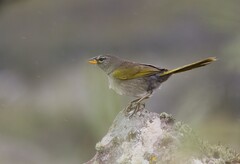
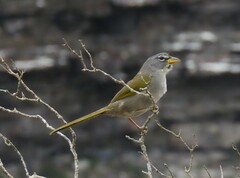
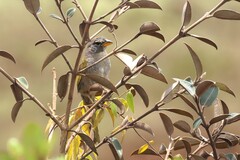
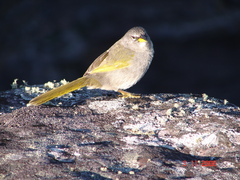

Pale-throated Pampa-Finch

Pale-throated Pampa-Finch

Embernagra longicauda

Silhouette: Sheatherius · PhyloPic

LCLeast ConcernNTVUENCR Endemic
Daily sighting probability ~30% · Possible
at Chapada Diamantina National Park

In 3 days ~70% in a week ~90%

224 Verified sightings at Chapada Diamantina National Park From 2019 to 2026
224 In 1 park
October Best month
☀️ Diurnal When it's spotted

About the Pale-throated Pampa-Finch

The serra finch or pale-throated Pampa-finch (Embernagra longicauda) is a species of bird in the family Thraupidae, the tanagers and allies. It is endemic to Brazil. The serra finch was formally described in 1844 with its current binomial Embernagra longicauda. At the time, genus Embernagra was a member of the finch family Fringillidae. Some early twentieth century authors placed the genus Embernagra in the family Carduelidae. Others later reassigned it to what was then a large family of Old and New World species, Emberizidae. A molecular phylogenetic study published in 2014 found that the serra finch belonged in the tanager family Thraupidae. In addition to the species' current alternate name "pale-throated Pampa-finch", it has also been called the "buff-throated Pampa-finch" and "pale-throated sierra-finch". It shares the genus Embernagra with the Pampa finch (E. platensis), which some systems call the "great Pampa-finch".

The serra finch is monotypic. The serra finch is about 21.5 cm (8.5 in) long. It has short wings, a long tail, and a long and thick bill. The sexes have the same plumage. Adults have a dark line from the lores through... Wikipedia →

Sounds

Song0:20

Brazil · 2019

© Garry Bakker · XC577546 · CC BY-NC-SA 4.0

Canto0:32

Brazil · 2018

© Caio Brito · XC556301 · CC BY-NC-SA 4.0

Duet0:38

Brazil · 2009

© Helberth Cardoso · XC42660 · CC BY-NC-ND 2.5

Global Distribution

Parks Where Found

# Park Country Daily sighting probability
1 Chapada Diamantina National Park 🇧🇷 Brazil
~30%

More parks will be added in future updates.

Before you go

What are the chances of seeing a Pale-throated Pampa-Finch in Chapada Diamantina National Park?

Possible

About 30% of wildlife watchers report a Pale-throated Pampa-Finch sighting in Chapada Diamantina National Park on a given day, based on 224 verified sightings from GBIF citizen-science data from 2019 to 2026. It is the 30th most-seen of the 271 birds we can rate there. Over three days the chance rises to about 70%, and over a week to about 90%, if each day is a fresh chance.

When is the best time to see a Pale-throated Pampa-Finch in Chapada Diamantina National Park?

September and October

In those months about 40% of wildlife watchers report a Pale-throated Pampa-Finch in Chapada Diamantina National Park on a given day, against about 20% in March to June, the lowest months.

What time of day is best to see a Pale-throated Pampa-Finch?

Between 7 and 10 am

Across all the parks we cover, that three-hour window holds the most Pale-throated Pampa-Finch sightings with a recorded time, and about 9 in 10 of them come between 6 am and 6 pm: it is a daytime animal.

Where else can you see a Pale-throated Pampa-Finch?

Only Chapada Diamantina National Park, in our data

Chapada Diamantina National Park is the only park on Wallace's Line with enough records to rate Pale-throated Pampa-Finch sightings: about 30% of wildlife watchers there report one on a given day.

Which relatives of the Pale-throated Pampa-Finch live in Chapada Diamantina National Park?

Same family: Thraupidae

The closest relatives of the Pale-throated Pampa-Finch that you can see in Chapada Diamantina National Park (family Thraupidae, Tanagers and Allies) are Bananaquit (about 60%), Blue Dacnis (about 50%) and Red-cowled Cardinal (about 50%), with each one's daily chance of a sighting.

Where does the Pale-throated Pampa-Finch sighting chance come from?

GBIF citizen-science records

It is estimated from how often the Pale-throated Pampa-Finch is recorded against all the birds logged in Chapada Diamantina National Park (224 verified sightings from 2019 to 2026), calibrated against known sighting rates. Figures are rounded to the nearest 10% because citizen-science data supports honest approximations, not decimals, and months with records from fewer than five people show "—". How it works.

← Back to Chapada Diamantina National Park