Puku

Puku

Kobus vardonii

Silhouette: Jan A. Venter, Herbert H. T. Prins, David A. Balfour & Rob Slotow (vectorized by T. Michael Keesey) · PhyloPic

LCNTNear ThreatenedVUENCR
Daily sighting probability ~20% · Possible
at Chobe National Park

In 3 days ~50% in a week ~80%

39 Verified sightings at Chobe National Park From 2019 to 2026
243 In all 3 parks
February Best month
☀️ Diurnal When it's spotted

About the Puku

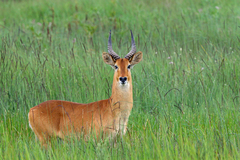
The puku (Kobus vardonii) is a medium-sized antelope found in wet grasslands in southern Democratic Republic of Congo, Namibia, Tanzania, Zambia and more concentrated in the Okavango Delta in Botswana. Nearly one-third of all puku are found in protected areas, zoos, and national parks due to their diminishing habitat.

Puku stand about 80 cm (31 in) at the shoulder and weigh from 70 to 80 kg (150 to 180 lb). The puku is sandy brown in colour, with the underbelly a slightly lighter brown. The coat is rougher than that of the similar-sized southern reedbuck, lechwe or impala, or the smaller oribi. Males have horns which are ridge-structured, 50 cm (20 in) long, and lyre-shaped.

There are two subspecies, the Senga Puku (Kobus vardonii senganus) and the southern puku (Kobus vardonii vardonii). Puku are found almost exclusively in marshy grassland and dambos, where they eat grasses. The puku diet is flexible in regards to type of grasses consumed. There is little dietary competition with other bovids. This species is crepuscular, active in the early morning and late afternoon. When scared, puku repeat a shrill whistle sound. Females gather... Wikipedia →

Sounds

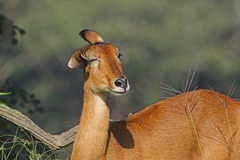
Alarm call0:15

Zambia · 2023

© Marc Anderson · XC1077455 · CC BY-NC-ND 4.0

Global Distribution

Parks Where Found

# Park Country Daily sighting probability
1 South Luangwa National Park 🇿🇲 Zambia
~80%
2 Kafue National Park 🇿🇲 Zambia
~70%
3 Chobe National Park 🇧🇼 Botswana
~20%

Zoos & Centres Where Found

# Zoo / Centre Country
1 Le Pal 🇫🇷 France In captivity

Before you go

What are the chances of seeing a Puku in Chobe National Park?

Possible

About 20% of wildlife watchers report a Puku sighting in Chobe National Park on a given day, based on 39 verified sightings from GBIF citizen-science data from 2019 to 2026. It is the 24th most-seen of the 35 mammals we can rate there. Over three days the chance rises to about 50%, and over a week to about 80%, if each day is a fresh chance.

When is the best time to see a Puku in Chobe National Park?

February–March, May–June and November

In those months about 30% of wildlife watchers report a Puku in Chobe National Park on a given day, against under 5% in January and October, the lowest months.

What time of day is best to see a Puku?

Between 6 and 9 am

Across all the parks we cover, that three-hour window holds the most Puku sightings with a recorded time, and about 8 in 10 of them come between 6 am and 6 pm: it is a daytime animal.

Is Chobe National Park the best place to see a Puku?

3rd of 3

Of the 3 parks where we can rate Puku sightings, Chobe National Park ranks 3rd at about 20%. The best odds are in South Luangwa National Park (Zambia, about 80%) and Kafue National Park (Zambia, about 70%).

Which relatives of the Puku live in Chobe National Park?

Same genus: Kobus

The closest relatives of the Puku that you can see in Chobe National Park (genus Kobus, Waterbucks, Kobs, and Lechwes) are Waterbuck (about 40%) and Lechwe (about 30%), with each one's daily chance of a sighting.

Where does the Puku sighting chance come from?

GBIF citizen-science records

It is estimated from how often the Puku is recorded against all the mammals logged in Chobe National Park (39 verified sightings from 2019 to 2026), calibrated against known sighting rates. Figures are rounded to the nearest 10% because citizen-science data supports honest approximations, not decimals, and months with records from fewer than five people show "—". How it works.

← Back to Chobe National Park