Cuban Martin

Cuban Martin

Progne cryptoleuca

Silhouette: Andy Wilson · PhyloPic

LCLeast ConcernNTVUENCR Endemic
Daily sighting probability <5% · Rare
at Ciénaga de Zapata

In 3 days ~10% in a week ~20%

49 Verified sightings at Ciénaga de Zapata From 2019 to 2026
49 In 1 park
July Best month
☀️ Diurnal When it's spotted

About the Cuban Martin

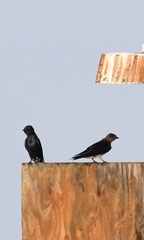
The Cuban martin (Progne cryptoleuca) is a large swallow endemic to Cuba. It is closely related to the Caribbean martin (P. dominicensis), which breeds on Caribbean islands from Jamaica east to Tobago, and the Sinaloa martin (P. sinaloae), which breeds in Mexico.

It has at various times been considered alternatively as a race of the purple martin, Progne subis. Adult Cuban martins are 18.5 cm in length, with a forked tail and relatively broad wings, and weigh 40 g. Adult males are a glossy blue-black with contrasting white lower underparts. Females and juveniles are duller than the male, with grey-brown breast and flanks and white lower underparts.

Adult male Cuban martins can be distinguished from adult male Caribbean martins by their dark bellies: Caribbean martins have a prominent white patch on theirs. Adult females and immatures aren't as easily distinguished.

On the other hand, adult male Cuban martins and Purple martins cannot be reliably distinguished in the field. Adult female and immature Purple martins have a scaly breast pattern which can be used to distinguish the two species.

Unlike these two similar species, the Cuban martin is endemic to Cuba and Isla... Wikipedia →

Sounds

Call0:35

Cuba · 2025

© FREDERIC Lionel · XC995067 · CC BY-NC-SA 4.0

Song0:19

Cuba · 2018

© Wayne Fidler · XC411601 · CC BY-NC-SA 4.0

Call1:05

Cuba · 2021

© Nils Navarro · XC631939 · CC BY-NC-SA 4.0

Global Distribution

Parks Where Found

# Park Country Daily sighting probability
1 Ciénaga de Zapata 🇨🇺 Cuba
<5%

More parks will be added in future updates.

Cities Where Found

# City Country Daily sighting probability
1 Havana 🇨🇺 Cuba
~10%

Before you go

What are the chances of seeing a Cuban Martin in Ciénaga de Zapata?

Rare

Under 5% of wildlife watchers report a Cuban Martin sighting in Ciénaga de Zapata on a given day, based on 49 verified sightings from GBIF citizen-science data from 2019 to 2026. It is the 133rd most-seen of the 177 birds we can rate there. Over three days the chance rises to about 10%, and over a week to about 20%, if each day is a fresh chance.

When is the best time to see a Cuban Martin in Ciénaga de Zapata?

July

In that month about 40% of wildlife watchers report a Cuban Martin in Ciénaga de Zapata on a given day, against under 5% in May–June and October–March, the lowest months. September has too few records to rate.

What time of day is best to see a Cuban Martin?

Between 7 and 10 am

Across all the parks we cover, that three-hour window holds the most Cuban Martin sightings with a recorded time, and about 9 in 10 of them come between 6 am and 6 pm: it is a daytime animal.

Where else can you see a Cuban Martin?

Only Ciénaga de Zapata, in our data

Ciénaga de Zapata is the only park on Wallace's Line with enough records to rate Cuban Martin sightings: under 5% of wildlife watchers there report one on a given day.

Which relatives of the Cuban Martin live in Ciénaga de Zapata?

Same family: Hirundinidae

The closest relatives of the Cuban Martin that you can see in Ciénaga de Zapata (family Hirundinidae, Swallows and Martins) are Cave Swallow (about 20%), Tree Swallow (about 10%) and Barn Swallow (about 10%), with each one's daily chance of a sighting.

Where does the Cuban Martin sighting chance come from?

GBIF citizen-science records

It is estimated from how often the Cuban Martin is recorded against all the birds logged in Ciénaga de Zapata (49 verified sightings from 2019 to 2026), calibrated against known sighting rates. Figures are rounded to the nearest 10% because citizen-science data supports honest approximations, not decimals, and months with records from fewer than five people show "—". How it works.

← Back to Ciénaga de Zapata