Desmarest's Hutia

Desmarest's Hutia

Capromys pilorides

Silhouette: T. Michael Keesey · PhyloPic

LCLeast ConcernNTVUENCR
Daily sighting probability ~20% · Possible
at Ciénaga de Zapata

In 3 days ~50% in a week ~80%

5 Verified sightings at Ciénaga de Zapata From 2019 to 2026
5 In 1 park
July Best month
☀️ Diurnal When it's spotted

About the Desmarest's Hutia

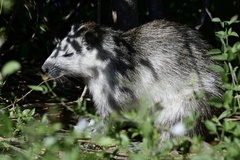
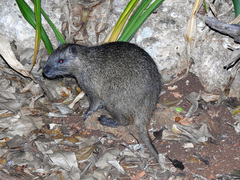
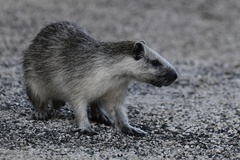
Desmarest's hutia or the Cuban hutia (Capromys pilorides) is a stout, furry, rat-like mammal found only on Cuba and nearby islands. Growing to about 60 cm (2 ft), it normally lives in pairs and feeds on leaves, fruit, bark and sometimes small animals. It is the largest living hutia (subfamily Capromyinae), a group of rodents native to the Caribbean that are mostly endangered or extinct. Desmarest's hutia remains widespread throughout its range, though one subspecies (C. p. lewisi) native to the nearby Cayman Islands went extinct shortly after European colonization in the 1500s.

The Desmarest's hutia has a head-and-body length of 31–60 cm (12–24 in), a tail that is 14–29 cm (5.5–11.4 in) long, and weighs 2.8–8.5 kg (6.2–18.7 lb). It has thick, coarse fur which extends to the tip of the tail. The colour of the body fur varies from black to brown, with a light sand colour and red also seen. The body is stocky and the legs short. It moves with a slow, waddling gait, but can perform a quick hop when pursued. The feet have five toes with large claws which assist the animal in climbing. The stomach is divided into three compartments by constrictions in the gut and is among... Wikipedia →

Global Distribution

Parks Where Found

# Park Country Daily sighting probability
1 Ciénaga de Zapata 🇨🇺 Cuba
~20%

More parks will be added in future updates.

Zoos & Centres Where Found

# Zoo / Centre Country
1 Prague Zoo 🇨🇿 Czechia In captivity
2 Rákosův pavilon 🇨🇿 Czechia In captivity
3 Velemlokárium 🇨🇿 Czechia In captivity

Before you go

What are the chances of seeing a Desmarest's Hutia in Ciénaga de Zapata?

Possible

About 20% of wildlife watchers report a Desmarest's Hutia sighting in Ciénaga de Zapata on a given day, based on 5 verified sightings from GBIF citizen-science data from 2019 to 2026. Over three days the chance rises to about 50%, and over a week to about 80%, if each day is a fresh chance.

When is the best time to see a Desmarest's Hutia in Ciénaga de Zapata?

July

In that month about 40% of wildlife watchers report a Desmarest's Hutia in Ciénaga de Zapata on a given day, against under 5% in April and December, the lowest months. May and September have too few records to rate.

What time of day is best to see a Desmarest's Hutia?

Between 11 am and 2 pm

Across all the parks we cover, that three-hour window holds the most Desmarest's Hutia sightings with a recorded time, and about 8 in 10 of them come between 6 am and 6 pm: it is a daytime animal.

Where else can you see a Desmarest's Hutia?

Only Ciénaga de Zapata, in our data

Ciénaga de Zapata is the only park on Wallace's Line with enough records to rate Desmarest's Hutia sightings: about 20% of wildlife watchers there report one on a given day.

Where does the Desmarest's Hutia sighting chance come from?

GBIF citizen-science records

It is estimated from how often the Desmarest's Hutia is recorded against all the mammals logged in Ciénaga de Zapata (5 verified sightings from 2019 to 2026), calibrated against known sighting rates. Figures are rounded to the nearest 10% because citizen-science data supports honest approximations, not decimals, and months with records from fewer than five people show "—". How it works.

← Back to Ciénaga de Zapata