Yellow-billed Shrike

Yellow-billed Shrike

Corvinella corvina

Silhouette: PhyloPic

Daily sighting probability ~50% · Likely
at Abuja

In 3 days ~90% in a week >90%

108 Verified sightings at Abuja
431 In all 2 parks From 2019 to 2026
March Best month
☀️ Diurnal When it's spotted

About the Yellow-billed Shrike

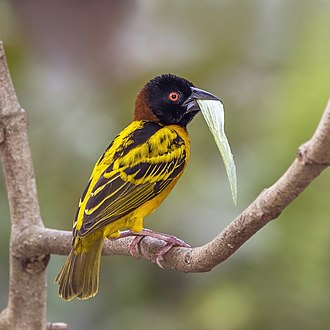
The yellow-billed shrike (Corvinella corvina) is a large passerine bird in the shrike family. It is sometimes known as the long-tailed shrike, but this invites confusion with the long-tailed shrike, Lanius schach, of tropical southern Asia. It is the only species placed in the genus Corvinella. The yellow-billed shrike is a common resident breeding bird in tropical Africa from Senegal eastwards to Uganda and locally in westernmost Kenya. It frequents forest and other habitats with trees.

The yellow-billed shrike was formally described in 1809 as Lanius corvinus by the English naturalist George Shaw. The specific epithet is from Latin meaning "raven-like". Shaw based his account on "La Grande-pie-grieche" that had been described and illustrated in 1799 by the French naturalist François Levaillant. Levaillant had acquired a preserved specimen from a dealer and did not know its origin. In 1831 the French naturalist René Lesson introduced the genus Corvinella to accommodate the yellow-billed shrike and also designated the type location as Senegal. Based on the results of molecular genetic studies, this species has sometimes been placed in the genus Lanius, but the phylogenetic... Wikipedia →

Sounds

Song1:12

Gambia · 2025

© Romuald Mikusek · XC1018433 · CC BY-NC-SA 4.0

Call1:21

Ghana · 2022

© Peter Boesman · XC719048 · CC BY-NC-ND 4.0

Alarm call0:33

Guinea-Bissau · 2020

© Joost van Bruggen · XC523696 · CC BY-NC-ND 4.0

Global Distribution

Parks Where Found

# Park Country Daily sighting probability
1 Kidepo Valley National Park 🇺🇬 Uganda
~70%
2 Niokolo-Koba National Park 🇸🇳 Senegal
~30%

Cities Where Found

# City Country Daily sighting probability
1 Accra 🇬🇭 Ghana
~50%
2 Ouagadougou 🇧🇫 Burkina Faso
~50%
3 Abuja 🇳🇬 Nigeria
~50%
4 Serrekunda 🇬🇲 Gambia
~30%
5 Lomé 🇹🇬 Togo
~20%
6 Cotonou 🇧🇯 Benin
~10%

Before you go

What are the chances of seeing a Yellow-billed Shrike in Abuja?

Likely

About 50% of wildlife watchers report a Yellow-billed Shrike sighting in Abuja on a given day, based on 108 verified sightings from GBIF citizen-science data. It is the 17th most-seen of the 131 birds we can rate there. Over three days the chance rises to about 90%, and over a week to over 90%, if each day is a fresh chance.

When is the best time to see a Yellow-billed Shrike in Abuja?

March, October and December

In those months about 60% of wildlife watchers report a Yellow-billed Shrike in Abuja on a given day, against about 30% in August, the lowest month. Those are among Abuja's driest months, with about 45 mm of rain a month against 250 mm in August.

What time of day is best to see a Yellow-billed Shrike?

Between 3 and 6 pm

Across all the parks we cover, that three-hour window holds the most Yellow-billed Shrike sightings with a recorded time, and about 9 in 10 of them come between 6 am and 6 pm: it is a daytime animal.

Is Abuja the best place to see a Yellow-billed Shrike?

Among the best

Of the 6 cities where we can rate Yellow-billed Shrike sightings, Abuja ranks 3rd at about 50%, level with the leaders once rounded. The best odds are in Accra (Ghana, about 50%) and Ouagadougou (Burkina Faso, about 50%).

Which relatives of the Yellow-billed Shrike live in Abuja?

Same order: Passeriformes

The closest relatives of the Yellow-billed Shrike that you can see in Abuja (order Passeriformes, Perching Birds) are Common Bulbul (about 90%), African Thrush (about 90%) and Variable Sunbird (about 70%), with each one's daily chance of a sighting.

Where does the Yellow-billed Shrike sighting chance come from?

GBIF citizen-science records

It is estimated from how often the Yellow-billed Shrike is recorded against all the birds logged in Abuja (108 verified sightings), calibrated against known sighting rates. Figures are rounded to the nearest 10% because citizen-science data supports honest approximations, not decimals, and months with records from fewer than five people show "—". How it works.

← Back to Abuja