Northern White-faced Owl

Northern White-faced Owl

Ptilopsis leucotis

Silhouette: Ferran Sayol · PhyloPic

LCLeast ConcernNTVUENCR
Daily sighting probability <5% · Rare
at Accra

In 3 days <5% in a week ~10%

6 Verified sightings at Accra
42 In all 3 parks From 2019 to 2026
November Best month
☀️🌙 Day & Night When it's spotted

About the Northern White-faced Owl

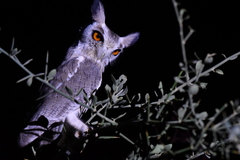
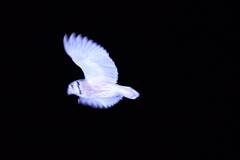
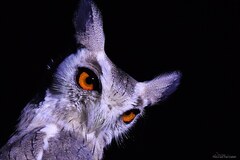
The northern white-faced owl (Ptilopsis leucotis) is a species of owl in the family Strigidae. The southern white-faced owl (P. granti) was formerly included in this species and the two were known as the white-faced scops-owl.

It is found in a band across Africa between the Sahara and the Equator. It occurs in Benin, Burkina Faso, Cameroon, Central African Republic, Chad, Republic of the Congo, Ivory Coast, Djibouti, Eritrea, Ethiopia, Gambia, Ghana, Guinea, Guinea-Bissau, Kenya, Liberia, Mali, Mauritania, Niger, Nigeria, Senegal, Sierra Leone, Somalia, Sudan, Togo and Uganda.

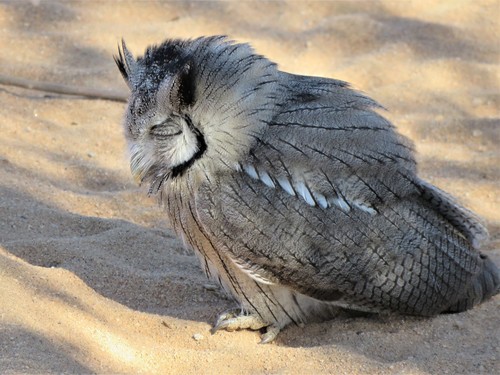
This owl has a rather notable defense mechanism. When faced with a similar-sized predator (like another owl slightly larger than it), the bird flares its wings to appear larger. When faced with something much larger than itself (such as an eagle), it pulls its feathers inwards, elongates its body, and narrows its eyes to thin slits. It is thought that it uses this ability to camouflage itself, and it shares the ability with relatives like the African scops owl.

Many different types of owls have some ability to adopt a "concealing posture", also known by the German word Tarnstellung... Wikipedia →
Sounds

Song0:32

Senegal · 2024

© Frank Lambert · XC1041471 · CC BY-NC-ND 4.0

Aberrant0:58

Guinea-Bissau · 2020

© Joost van Bruggen · XC523072 · CC BY-NC-ND 4.0

Song0:49

Ghana · 2022

© Peter Boesman · XC719468 · CC BY-NC-ND 4.0

Global Distribution

Parks Where Found

# Park Country Daily sighting probability
1 Niokolo-Koba National Park 🇸🇳 Senegal
~10%
2 Murchison Falls National Park 🇺🇬 Uganda
<5%
3 Samburu National Reserve 🇰🇪 Kenya
<5%

Cities Where Found

# City Country Daily sighting probability
1 Serrekunda 🇬🇲 Gambia
~10%
2 Accra 🇬🇭 Ghana
<5%

Zoos & Centres Where Found

# Zoo / Centre Country
1 Philadelphia Zoo 🇺🇸 United States In captivity
2 Birdland Park and Gardens 🇬🇧 United Kingdom In captivity
3 Cim d'Àligues 🇪🇸 Spain In captivity
4 Prospect Park Zoo 🇺🇸 United States In captivity
5 Zoo Lagos 🇵🇹 Portugal In captivity
6 Parc Animalier de Serre-Ponçon 🇫🇷 France In captivity
7 DMM Kariyushi Aquarium 🇯🇵 Japan In captivity
8 Bed-Stuy Aquarium 🇺🇸 United States In captivity
9 Hillerød Mini Zoo 🇩🇰 Denmark In captivity

Before you go

What are the chances of seeing a Northern White-faced Owl in Accra?

Rare

Under 5% of wildlife watchers report a Northern White-faced Owl sighting in Accra on a given day, based on 6 verified sightings from GBIF citizen-science data. It is the 144th most-seen of the 162 birds we can rate there. Over three days the chance rises to under 5%, and over a week to about 10%, if each day is a fresh chance.

When is the best time to see a Northern White-faced Owl in Accra?

November

In that month about 10% of wildlife watchers report a Northern White-faced Owl in Accra on a given day, against under 5% in December to October, the lowest months.

What time of day is best to see a Northern White-faced Owl?

Between 10 am and 1 pm

Across all the parks we cover, that three-hour window holds the most Northern White-faced Owl sightings with a recorded time, and about 7 in 10 of them come between 6 am and 6 pm: it is seen both by day and at night.

Is Accra the best place to see a Northern White-faced Owl?

2nd of 2

Of the 2 cities where we can rate Northern White-faced Owl sightings, Accra ranks 2nd at under 5%. The best odds are in Serrekunda (Gambia, about 10%).

Where does the Northern White-faced Owl sighting chance come from?

GBIF citizen-science records

It is estimated from how often the Northern White-faced Owl is recorded against all the birds logged in Accra (6 verified sightings), calibrated against known sighting rates. Figures are rounded to the nearest 10% because citizen-science data supports honest approximations, not decimals, and months with records from fewer than five people show "—". How it works.

← Back to Accra