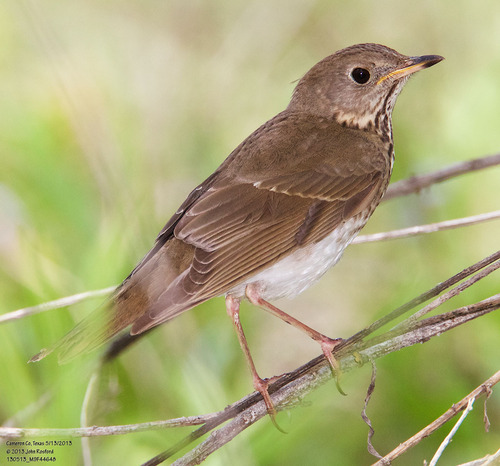
Bicknell's Thrush

Bicknell's Thrush

Catharus bicknelli

Silhouette: Sharon Wegner-Larsen · PhyloPic

LCNTVUVulnerableENCR
Daily sighting probability <5% · Rare
at Baltimore

In 3 days <5%

13 Verified sightings at Baltimore
May Best month
☀️ Diurnal When it's spotted

About the Bicknell's Thrush

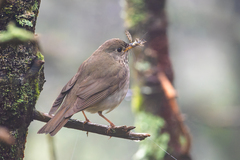
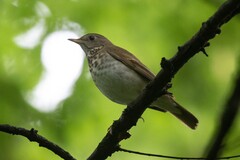
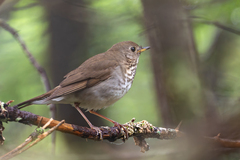
Bicknell's thrush (Catharus bicknelli) is a medium-sized thrush, at 17.5 cm (6.9 in) and 28 g (0.99 oz). One of North America's rarest and most localized songbirds, it breeds on coniferous mountain tops and disturbed habitats of northeastern North America. While very similar in appearance and vocalization to the gray-cheeked thrush (Catharus minimus), the two species differ slightly in their morphology and vocalizations, although they have with completely different breeding ranges. It was named after Eugene Bicknell, an American amateur ornithologist, who made the first scientific discovery of the species on Slide Mountain in the Catskills in the late 19th century. John Burroughs, in his essay, "The Heart of the Southern Catskills" (1886), writes effusively about the voice of Bicknell's thrush heard near the summit on his climbs of Slide Mountain, and how on his stays on Slide saw them nowhere else but "about the summit", and saw no other thrush but Bicknell's.

Bicknell's thrush is just slightly smaller than the other northern migratory Catharus thrushes, with an average length of approximately 17 cm (6.7 in) and a weight ranging generally from 26 to 30g. Both sexes... Wikipedia →

Sounds

Song0:20

Canada · 2022

© Melissa Hafting · XC734340 · CC BY-NC-SA 4.0

Call0:18

United States · 2019

© Will Sweet · XC501697 · CC BY-NC-SA 4.0

Call1:29

United States · 2000

© Rolf A. de By · XC469601 · CC BY-NC-SA 4.0

Global Distribution

Parks Where Found

# Park Country Daily sighting probability

More parks will be added in future updates.

Cities Where Found

# City Country Daily sighting probability
1 Baltimore 🇺🇸 United States
<5%
2 New York City 🇺🇸 United States
<5%
3 Montreal 🇨🇦 Canada
<5%
4 Philadelphia 🇺🇸 United States
<5%

Before you go

What are the chances of seeing a Bicknell's Thrush in Baltimore?

Rare

Under 5% of wildlife watchers report a Bicknell's Thrush sighting in Baltimore on a given day, based on 13 verified sightings from GBIF citizen-science data. It is the 232nd most-seen of the 246 birds we can rate there. Over three days the chance rises to under 5%, if each day is a fresh chance.

When is the best time to see a Bicknell's Thrush in Baltimore?

Any time of year

In every month with enough records, under 5% of wildlife watchers report a Bicknell's Thrush in Baltimore on a given day, so our monthly data shows no clear season.

What time of day is best to see a Bicknell's Thrush?

Between 9 am and noon

Across all the parks we cover, that three-hour window holds the most Bicknell's Thrush sightings with a recorded time, and about 8 in 10 of them come between 6 am and 6 pm: it is a daytime animal.

Is Baltimore the best place to see a Bicknell's Thrush?

Yes

Of the 4 cities where we can rate Bicknell's Thrush sightings, Baltimore has the highest daily chance: under 5%. Next come New York City (United States, under 5%) and Montreal (Canada, under 5%).

Which relatives of the Bicknell's Thrush live in Baltimore?

Same genus: Catharus

The closest relatives of the Bicknell's Thrush that you can see in Baltimore (genus Catharus, Brown Thrushes and Nightingale-Thrushes) are Hermit Thrush (about 10%) and Swainson's Thrush (about 10%), with each one's daily chance of a sighting.

Where does the Bicknell's Thrush sighting chance come from?

GBIF citizen-science records

It is estimated from how often the Bicknell's Thrush is recorded against all the birds logged in Baltimore (13 verified sightings), calibrated against known sighting rates. Figures are rounded to the nearest 10% because citizen-science data supports honest approximations, not decimals, and months with records from fewer than five people show "—". How it works.

← Back to Baltimore