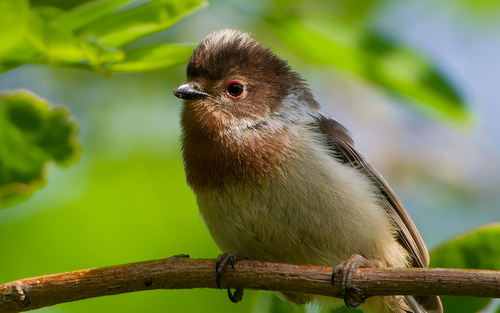
Siberian Accentor

Siberian Accentor

Prunella montanella

Silhouette: Matt Wilkins · PhyloPic

LCLeast ConcernNTVUENCR
Daily sighting probability <5% · Rare
at Beijing

In 3 days ~10% in a week ~20%

222 Verified sightings at Beijing
March Best month
☀️ Diurnal When it's spotted

About the Siberian Accentor

The Siberian accentor (Prunella montanella) is a small passerine bird that breeds in northern Russia from the Ural Mountains eastwards across Siberia. It is migratory, wintering in Korea and eastern China, with rare occurrences in western Europe and northwestern North America. Its typical breeding habitat is subarctic deciduous forests and open coniferous woodland, often close to water, although it also occurs in mountains and spruce taiga. It inhabits bushes and shrubs in winter, frequently near streams, but may also be found in dry grassland and woods.

The Siberian accentor has brown upperparts and wings, with bright chestnut streaking on its back and a greyish-brown rump and tail. The head has a dark brown crown and a long, wide pale yellow supercilium ("eyebrow"). All plumages are quite similar. The nest is an open cup in dense shrub or a tree into which the female lays four to six glossy deep blue-green eggs that hatch in about ten days. Adults and chicks feed mainly on insects, typically picked off the ground, but sometimes taken from vegetation. In winter, the accentors may also consume seeds or feed near human habitation.

Breeding over a huge area, the Siberian accentor has a large and stable population. It is therefore evaluated as a species of least concern by the International Union for Conservation of Nature (IUCN), although, as a northern breeding species, it may be affected by climate change in the long term. October and November 2016 saw an unprecedented influx of this species into western Europe, reaching as far as the United Kingdom. Wikipedia →

Sounds

Call0:24

South Korea · 2012

© Grant Fisher · XC115095 · CC BY-NC-SA 3.0

Song0:36

Russian Federation · 2026

© Alexander Kirillov · XC1185384 · CC BY-NC-SA 4.0

Flight call0:11

Sweden · 2020

© Mårten Müller · XC629187 · CC BY-NC-SA 4.0

Global Distribution

Parks Where Found

# Park Country Daily sighting probability

More parks will be added in future updates.

Cities Where Found

# City Country Daily sighting probability
1 Beijing 🇨🇳 China
<5%
2 Seoul 🇰🇷 South Korea
<5%

Before you go

What are the chances of seeing a Siberian Accentor in Beijing?

Rare

Under 5% of wildlife watchers report a Siberian Accentor sighting in Beijing on a given day, based on 222 verified sightings from GBIF citizen-science data. It is the 130th most-seen of the 324 birds we can rate there. Over three days the chance rises to about 10%, and over a week to about 20%, if each day is a fresh chance.

When is the best time to see a Siberian Accentor in Beijing?

February–March and November–December

In those months about 10% of wildlife watchers report a Siberian Accentor in Beijing on a given day, against under 5% in January and April–October, the lowest months. Those are among Beijing's driest months, with about 10 mm of rain a month against 150 mm in July.

What time of day is best to see a Siberian Accentor?

Between 10 am and 1 pm

Across all the parks we cover, that three-hour window holds the most Siberian Accentor sightings with a recorded time, and about 9 in 10 of them come between 6 am and 6 pm: it is a daytime animal.

Is Beijing the best place to see a Siberian Accentor?

Yes

Of the 2 cities where we can rate Siberian Accentor sightings, Beijing has the highest daily chance: under 5%. Next come Seoul (South Korea, under 5%).

Which relatives of the Siberian Accentor live in Beijing?

Same order: Passeriformes

The closest relatives of the Siberian Accentor that you can see in Beijing (order Passeriformes, Perching Birds) are Oriental Magpie (about 90%), Azure-winged Magpie (about 90%) and Eurasian Tree Sparrow (about 90%), with each one's daily chance of a sighting.

Where does the Siberian Accentor sighting chance come from?

GBIF citizen-science records

It is estimated from how often the Siberian Accentor is recorded against all the birds logged in Beijing (222 verified sightings), calibrated against known sighting rates. Figures are rounded to the nearest 10% because citizen-science data supports honest approximations, not decimals, and months with records from fewer than five people show "—". How it works.

← Back to Beijing