Greater Hatchet-faced Tree Frog

Greater Hatchet-faced Tree Frog

Sphaenorhynchus lacteus

Silhouette: Dmitry Bogdanov (vectorized by T. Michael Keesey) · PhyloPic

LCLeast ConcernNTVUENCR
Daily sighting probability ~20% · Possible
at Belém

In 3 days ~50% in a week ~80%

6 Verified sightings at Belém
April Best month
☀️🌙 Day & Night When it's spotted

About the Greater Hatchet-faced Tree Frog

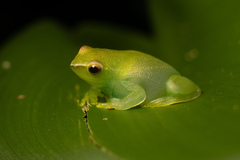
Sphaenorhynchus lacteus, the Orinoco lime treefrog, is a species of frog in the family Hylidae. It is a widely distributed species found in the Orinoco and Amazon basins in Venezuela, the Guianas (Guyana, Suriname, French Guiana), Colombia, Brazil, Ecuador, Peru, and Bolivia. It also occurs in Trinidad and Tobago.

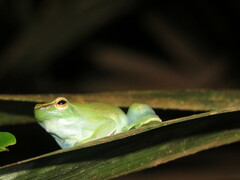
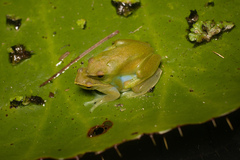
Adult males measure 26–42 mm (1.0–1.7 in) and females 38–46 mm (1.5–1.8 in) in snout–vent length. The snout is pointed in dorsal view and angles sharply back when viewed laterally. The tympanum is visible. The fingers are one-half to two-thirds webbed whereas the toes are fully webbed. The dorsum is bright green with dark brown canthal stripe. The venter and outer margins of the limbs are white whereas the ventral surfaces of the limbs are bluish green. The iris is pale creamy bronze.

Sphaenorhynchus lacteus is a semi-aquatic frog found in flooded plains, floating meadows, ponds, and large lagoons in forest clearings, at forest edges, and in savanna. It has also been recorded in leaf litter in tropical rainforest, in seasonally flooded agricultural land, and flooded roadside ditches. It occurs at elevations to 300 m (980 ft... Wikipedia →

Sounds

Recording1:27

Suriname · 1974

© M.S. Hoogmoed · XC882984 · CC BY 4.0

Recording0:17

Trinidad & Tobago · 2021

© rastabenz · iNaturalist · CC BY-NC 4.0

Recording

Brazil · 2024

© Augustin Bussac · Xeno · CC BY-NC-SA 4.0

Global Distribution

Parks Where Found

# Park Country Daily sighting probability

More parks will be added in future updates.

Cities Where Found

# City Country Daily sighting probability
1 Belém 🇧🇷 Brazil
~20%

Before you go

What are the chances of seeing a Greater Hatchet-faced Tree Frog in Belém?

Possible

About 20% of wildlife watchers report a Greater Hatchet-faced Tree Frog sighting in Belém on a given day, based on 6 verified sightings from GBIF citizen-science data. Over three days the chance rises to about 50%, and over a week to about 80%, if each day is a fresh chance.

When is the best time to see a Greater Hatchet-faced Tree Frog in Belém?

April–May and October

In those months about 40% of wildlife watchers report a Greater Hatchet-faced Tree Frog in Belém on a given day, against under 5% in June–September and November–March, the lowest months.

What time of day is best to see a Greater Hatchet-faced Tree Frog?

Between 7 and 10 pm

Across all the parks we cover, that three-hour window holds the most Greater Hatchet-faced Tree Frog sightings with a recorded time, and about 7 in 10 of them come between 6 pm and 6 am: it is seen both by day and at night.

Where else can you see a Greater Hatchet-faced Tree Frog?

Only Belém, in our data

Belém is the only city on Wallace's Line with enough records to rate Greater Hatchet-faced Tree Frog sightings: about 20% of wildlife watchers there report one on a given day.

Which relatives of the Greater Hatchet-faced Tree Frog live in Belém?

Same order: Anura

The closest relatives of the Greater Hatchet-faced Tree Frog that you can see in Belém (order Anura, Frogs and Toads) are Eastern Cane Toad (about 20%) and Elachistocleis helianneae (about 20%), with each one's daily chance of a sighting.

Where does the Greater Hatchet-faced Tree Frog sighting chance come from?

GBIF citizen-science records

It is estimated from how often the Greater Hatchet-faced Tree Frog is recorded against all the amphibians logged in Belém (6 verified sightings), calibrated against known sighting rates. Figures are rounded to the nearest 10% because citizen-science data supports honest approximations, not decimals, and months with records from fewer than five people show "—". How it works.

← Back to Belém