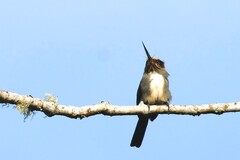
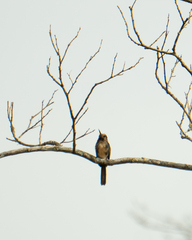
Three-toed Jacamar

Three-toed Jacamar

Jacamaralcyon tridactyla

LCNTNear ThreatenedVUENCR Endemic
Daily sighting probability <5% · Rare
at Belo Horizonte

In 3 days ~10% in a week ~20%

55 Verified sightings at Belo Horizonte
May Best month

About the Three-toed Jacamar

The three-toed jacamar (Jacamaralcyon tridactyla) is a species of bird in the family Galbulidae. It is monotypic within the genus Jacamaralcyon. It is endemic to Brazil. Its natural habitats are subtropical or tropical dry forest, subtropical or tropical moist lowland forest, and plantations. It is threatened by habitat loss.

The three-toed jacamar is one of 18 jacamar species in the family Galbulidae. It is in the monotypic genus Jacamaralcyon, and has no subspecies. When he first described it in 1807, French naturalist François Levaillant named the species "jacamaralcion", a combination of the words "jacamar" and "alcyon"—the latter a form of the word "halcyon", meaning "kingfisher". French ornithologist Louis Pierre Vieillot assigned it to the large jacamar genus Galbula when he established a scientific name for it in 1817, naming it Galbula tridactyla. In 1830, French ornithologist René Primevère Lesson created the genus Jacamaralcyon, separating the three-toed jacamar from other jacamar species on the basis of its unusual foot structure; the genus name is a nod to Levaillant's earlier common name for the bird. The specific name tridactyla is a combination... Wikipedia →

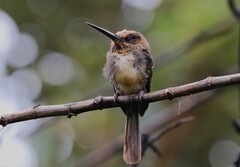
Sounds

Song0:08

Brazil · 2023

© Mateus Gonçalves Santos · XC783668 · CC BY-NC-SA 4.0

Song0:24

Brazil · 2020

© Ricardo Gagliardi · XC590066 · CC BY-NC-SA 4.0

Song0:19

Brazil · 2018

© Ross Gallardy · XC438768 · CC BY-NC-SA 4.0

Global Distribution

Parks Where Found

# Park Country Daily sighting probability

More parks will be added in future updates.

Cities Where Found

# City Country Daily sighting probability
1 Belo Horizonte 🇧🇷 Brazil
<5%

Before you go

What are the chances of seeing a Three-toed Jacamar in Belo Horizonte?

Rare

Under 5% of wildlife watchers report a Three-toed Jacamar sighting in Belo Horizonte on a given day, based on 55 verified sightings from GBIF citizen-science data. It is the 103rd most-seen of the 220 birds we can rate there. Over three days the chance rises to about 10%, and over a week to about 20%, if each day is a fresh chance.

When is the best time to see a Three-toed Jacamar in Belo Horizonte?

April–May and December–January

In those months about 10% of wildlife watchers report a Three-toed Jacamar in Belo Horizonte on a given day, against under 5% in February–March and June–November, the lowest months. Those are among Belo Horizonte's wettest months, with about 140 mm of rain a month against 5 mm in July.

Where else can you see a Three-toed Jacamar?

Only Belo Horizonte, in our data

Belo Horizonte is the only city on Wallace's Line with enough records to rate Three-toed Jacamar sightings: under 5% of wildlife watchers there report one on a given day.

Where does the Three-toed Jacamar sighting chance come from?

GBIF citizen-science records

It is estimated from how often the Three-toed Jacamar is recorded against all the birds logged in Belo Horizonte (55 verified sightings), calibrated against known sighting rates. Figures are rounded to the nearest 10% because citizen-science data supports honest approximations, not decimals, and months with records from fewer than five people show "—". How it works.

← Back to Belo Horizonte