Myllocerus discolor silhouette

Silhouette: Janat Graham (photograph), T. Michael Keesey (vectorization) · PhyloPic

Myllocerus discolor

Myllocerus discolor

Daily sighting probability <5% · Rare
at Bengaluru

In 3 days ~10% in a week ~30%

10 Verified sightings at Bengaluru
August Best month
☀️🌙 Day & Night When it's spotted

About the Myllocerus discolor

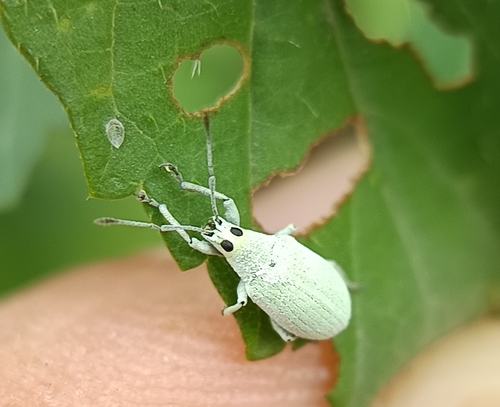
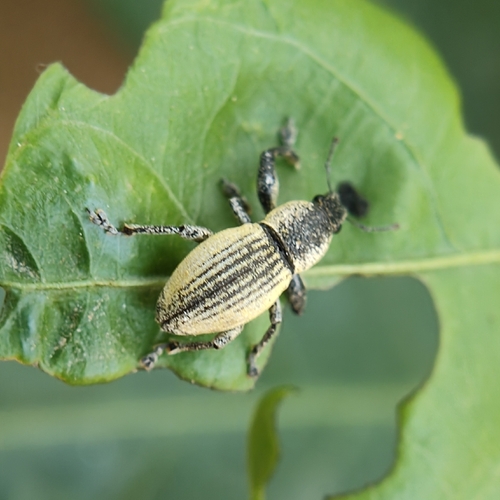
Myllocerus discolor, commonly known as mango ash weevil, is a species of weevil found in India, Sri Lanka and Myanmar. The Sri Lankan population is identified as the subspecies, Myllocerus discolor canescens. This small beetle is about 6 to 7 mm in length. Adult weevil is ferruginous brown in color. There is a white spot on the elytra and black mottling. It is characterized by the rostrum little broader at apex. Elytra broad with coarsely punctate striae. In pronotum, there is a central pale grey stripe and a short basal stripe laterally.

Eggs are ovoid, and light yellow in color. Grub is small, apodous and distinctly curved. Grub is pale white in color. Final grub is about 7 to 8 mm in length. Head chitinized and testaceous. Mandibles well developed and obtusely toothed. Mandibles contiguous to the labium. Thoracic segments are well developed than abdominal segments. Pupa exarate, elongate and bilaterally symmetrical. Pupa is brown in color and 6 to 7 mm in length. Pupal body wall is white which later turns to light brown.

Adults are abundant during summer. During summer, adult female lays eggs in the soil. It lays about 360 eggs over a period of 24... Wikipedia →

Global Distribution

Parks Where Found

# Park Country Daily sighting probability

More parks will be added in future updates.

Cities Where Found

# City Country Daily sighting probability
1 Bengaluru 🇮🇳 India
<5%

Before you go

What are the chances of seeing a Myllocerus discolor in Bengaluru?

Rare

Under 5% of wildlife watchers report a Myllocerus discolor sighting in Bengaluru on a given day, based on 10 verified sightings from GBIF citizen-science data. It is the 288th most-seen of the 477 insects we can rate there. Over three days the chance rises to about 10%, and over a week to about 30%, if each day is a fresh chance.

When is the best time to see a Myllocerus discolor in Bengaluru?

January and July–August

In those months about 10% of wildlife watchers report a Myllocerus discolor in Bengaluru on a given day, against under 5% in February–June and September–December, the lowest months.

What time of day is best to see a Myllocerus discolor?

Between 8 and 11 pm

Across all the parks we cover, that three-hour window holds the most Myllocerus discolor sightings with a recorded time, and about half of them come between 6 pm and 6 am: it is seen both by day and at night.

Where else can you see a Myllocerus discolor?

Only Bengaluru, in our data

Bengaluru is the only city on Wallace's Line with enough records to rate Myllocerus discolor sightings: under 5% of wildlife watchers there report one on a given day.

Where does the Myllocerus discolor sighting chance come from?

GBIF citizen-science records

It is estimated from how often the Myllocerus discolor is recorded against all the insects logged in Bengaluru (10 verified sightings), calibrated against known sighting rates. Figures are rounded to the nearest 10% because citizen-science data supports honest approximations, not decimals, and months with records from fewer than five people show "—". How it works.

← Back to Bengaluru