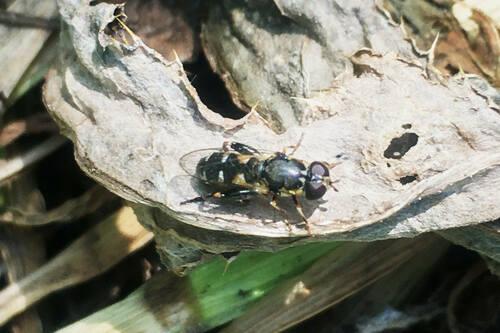
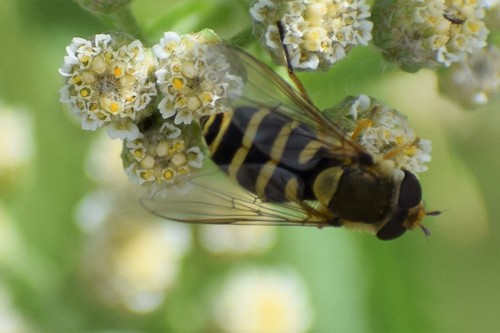
Thaumatomyia notata

Thaumatomyia notata

Thaumatomyia notata

Daily sighting probability <5% · Rare
at Brussels

In 3 days ~10% in a week ~30%

6 Verified sightings at Brussels
March Best month

About the Thaumatomyia notata

Thaumatomyia notata, the yellow swarming fly, is a species of 'frit flies' or 'grass flies' belonging to the family Chloropidae subfamily Chloropinae. This species is present in most of Europe, in the Afrotropical realm, in the Near East, in North Africa, and in the Indomalayan realm.

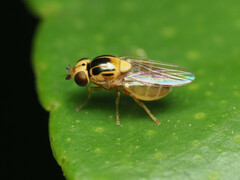
The adults grow up to 3 millimetres (0.12 in) long. The thorax and the eyes margins are bright yellow, mesonotum shows brown longitudinal bands and yellow stripes, the abdomen is yellow with large horizontal brown stripes.

They start flying in late March or in the first half of April and can be encountered feeding on nectar of flowers and various sweet liquids and excretions. They overwinter hibernating as adults, after at least two generations in a year.

In Europe in some localities from late Summer through December this species shows an aggregation behaviour, forming big swarms appearing as clouds or smoke, that invade buildings and parks. Larvae usually live in roots of grasses. They are carnivorous, mainly preying on 'root aphids' ('Sugar-beet root aphids' Pemphigus fuscicornis, 'Lettuce root aphids' Pemphigus bursarius, etc.). Wikipedia →

Global Distribution

Parks Where Found

# Park Country Daily sighting probability

More parks will be added in future updates.

Cities Where Found

# City Country Daily sighting probability
1 Brussels 🇧🇪 Belgium
<5%

Before you go

What are the chances of seeing a Thaumatomyia notata in Brussels?

Rare

Under 5% of wildlife watchers report a Thaumatomyia notata sighting in Brussels on a given day, based on 6 verified sightings from GBIF citizen-science data. It is the 295th most-seen of the 337 insects we can rate there. Over three days the chance rises to about 10%, and over a week to about 30%, if each day is a fresh chance.

When is the best time to see a Thaumatomyia notata in Brussels?

March–April and August

In those months about 10% of wildlife watchers report a Thaumatomyia notata in Brussels on a given day, against under 5% in May–July and September–February, the lowest months.

Where else can you see a Thaumatomyia notata?

Only Brussels, in our data

Brussels is the only city on Wallace's Line with enough records to rate Thaumatomyia notata sightings: under 5% of wildlife watchers there report one on a given day.

Which relatives of the Thaumatomyia notata live in Brussels?

Same order: Diptera

The closest relatives of the Thaumatomyia notata that you can see in Brussels (order Diptera, Flies) are Marmalade Hover Fly (about 20%), Common Drone Fly (about 20%) and Yellow-Haired Sun Fly (about 20%), with each one's daily chance of a sighting.

Where does the Thaumatomyia notata sighting chance come from?

GBIF citizen-science records

It is estimated from how often the Thaumatomyia notata is recorded against all the insects logged in Brussels (6 verified sightings), calibrated against known sighting rates. Figures are rounded to the nearest 10% because citizen-science data supports honest approximations, not decimals, and months with records from fewer than five people show "—". How it works.

← Back to Brussels