Mallophora ruficauda

Mallophora ruficauda

Mallophora ruficauda

Daily sighting probability ~10% · With luck
at Buenos Aires

In 3 days ~20% in a week ~40%

120 Verified sightings at Buenos Aires
January Best month

About the Mallophora ruficauda

Mallophora ruficauda is a species of parasitic robber fly in the family Asilidae, endemic to South and Central America. Like other robber flies, M. ruficauda is known for its aggressive behavior and predation upon other insects, especially bees. M. ruficauda (like other members of the genus Mallophora) mimics a bumblebee to fool predators into thinking it has a painful sting and is not worth eating.

M. ruficauda larvae parasitize scarab beetles and likely serve as an important biocontrol for the beetles, a pest species that eats the roots and tubers of plants while in the larval stage. On the other hand, adult M. ruficauda are apicultural pests because they feed on worker honeybees.

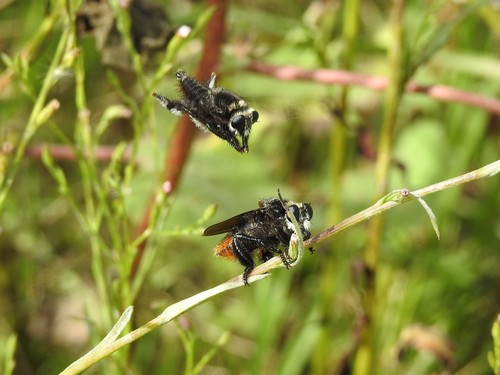
M. ruficauda is a bumblebee mimic, meaning it appears very similar to a bumblebee despite actually being a fly. It is large and covered in dense black hair (setae) with a patch of yellow on the thorax, and has a pointed black abdomen with a spot of reddish hair at the tip. The wings are smoky brown and generate a buzzing sound during flight, similar to the wings of bees. The head is black and the face is covered in white hairs, which are also found on the ventral side of the femora, tibia... Wikipedia →
Global Distribution

Parks Where Found

# Park Country Daily sighting probability

More parks will be added in future updates.

Cities Where Found

# City Country Daily sighting probability
1 Buenos Aires 🇦🇷 Argentina
~10%

Before you go

What are the chances of seeing a Mallophora ruficauda in Buenos Aires?

With luck

About 10% of wildlife watchers report a Mallophora ruficauda sighting in Buenos Aires on a given day, based on 120 verified sightings from GBIF citizen-science data. It is the 100th most-seen of the 558 insects we can rate there. Over three days the chance rises to about 20%, and over a week to about 40%, if each day is a fresh chance.

When is the best time to see a Mallophora ruficauda in Buenos Aires?

January

In that month about 20% of wildlife watchers report a Mallophora ruficauda in Buenos Aires on a given day, against under 5% in March to November, the lowest months.

Where else can you see a Mallophora ruficauda?

Only Buenos Aires, in our data

Buenos Aires is the only city on Wallace's Line with enough records to rate Mallophora ruficauda sightings: about 10% of wildlife watchers there report one on a given day.

Where does the Mallophora ruficauda sighting chance come from?

GBIF citizen-science records

It is estimated from how often the Mallophora ruficauda is recorded against all the insects logged in Buenos Aires (120 verified sightings), calibrated against known sighting rates. Figures are rounded to the nearest 10% because citizen-science data supports honest approximations, not decimals, and months with records from fewer than five people show "—". How it works.

← Back to Buenos Aires