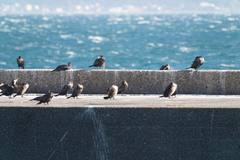
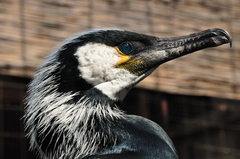
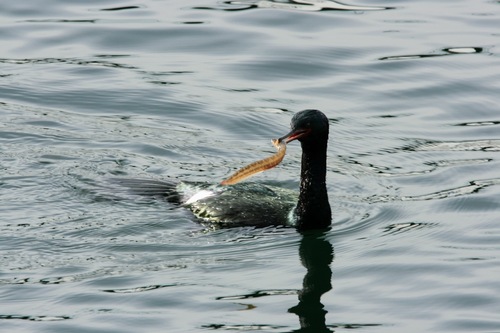
Japanese Cormorant

Japanese Cormorant

Phalacrocorax capillatus

LCLeast ConcernNTVUENCR
Daily sighting probability ~10% · With luck
at Busan

In 3 days ~30% in a week ~50%

23 Verified sightings at Busan
April Best month

About the Japanese Cormorant

The Japanese cormorant (Phalacrocorax capillatus), also known as Temminck's cormorant, is a species of cormorant native to coastal areas of the east Palearctic. The species has a black body with a white throat and cheeks and a partially yellow bill. Juveniles are plainer and browner in appearance. It is one of the larger cormorants and is comparable in size to the great cormorant. Adults measure 81 to 92 cm (32 to 36 in) in length with a wingspan of around 152 cm (60 in), and may weigh 2.3 to 3.55 kg (5.1 to 7.8 lb).

The Japanese cormorant is found along the coasts of East Asia, including China, Japan, North Korea, the Russian Far East, South Korea and Taiwan. It is migratory in parts of its range and feeds mainly on fish, which it catches by diving underwater.

It is one of the species of cormorant traditionally trained by fishermen in Japan for cormorant fishing, a practice known as ukai (鵜飼). In Japanese, the species is known as umiu (ウミウ; "sea cormorant"). The fishing masters of the Nagara River traditionally use this species to catch ayu.

"Phalacrocorax capillatus". Integrated Taxonomic Information System. Retrieved 24 January 2006. ��2�... Wikipedia →

Global Distribution

Parks Where Found

# Park Country Daily sighting probability

More parks will be added in future updates.

Cities Where Found

# City Country Daily sighting probability
1 Kitakyushu 🇯🇵 Japan
~10%
2 Busan 🇰🇷 South Korea
~10%
3 Qingdao 🇨🇳 China
<5%
4 Naha 🇯🇵 Japan
<5%
5 Tokyo 🇯🇵 Japan
<5%
6 Osaka 🇯🇵 Japan
<5%
7 Nagoya 🇯🇵 Japan
<5%
8 Seoul 🇰🇷 South Korea
<5%

Before you go

What are the chances of seeing a Japanese Cormorant in Busan?

With luck

About 10% of wildlife watchers report a Japanese Cormorant sighting in Busan on a given day, based on 23 verified sightings from GBIF citizen-science data. It is the 44th most-seen of the 112 birds we can rate there. Over three days the chance rises to about 30%, and over a week to about 50%, if each day is a fresh chance.

When is the best time to see a Japanese Cormorant in Busan?

March and April

In those months about 20% of wildlife watchers report a Japanese Cormorant in Busan on a given day, against under 5% in May and September, the lowest months.

Is Busan the best place to see a Japanese Cormorant?

Among the best

Of the 8 cities where we can rate Japanese Cormorant sightings, Busan ranks 2nd at about 10%, level with the leaders once rounded. The best odds are in Kitakyushu (Japan, about 10%).

Where does the Japanese Cormorant sighting chance come from?

GBIF citizen-science records

It is estimated from how often the Japanese Cormorant is recorded against all the birds logged in Busan (23 verified sightings), calibrated against known sighting rates. Figures are rounded to the nearest 10% because citizen-science data supports honest approximations, not decimals, and months with records from fewer than five people show "—". How it works.

← Back to Busan