Light-vented Bulbul

Light-vented Bulbul

Pycnonotus sinensis

Silhouette: Andy Wilson · PhyloPic

LCLeast ConcernNTVUENCR
Daily sighting probability ~10% · With luck
at Busan

In 3 days ~40% in a week ~70%

32 Verified sightings at Busan
440 In 1 park From 2019 to 2026
March Best month
☀️ Diurnal When it's spotted

About the Light-vented Bulbul

The light-vented bulbul (Pycnonotus sinensis), also called the Chinese bulbul, is a species of bird in the bulbul family found in Asia. A common species of songbird that favors lightly wooded habitats, it can frequently be seen in towns, suburbs and urban parks within its range.

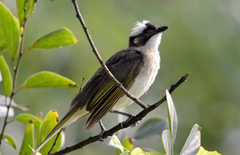
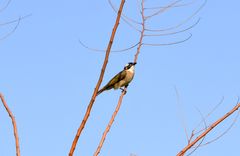
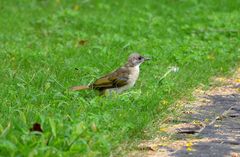
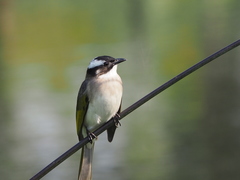
The light-vented bulbul is around 19 cm (7.5 in) in length. It has a black crown and moustachial stripe, with white patches covering the nape and the sides of its black head. It has white plumage from its eyes to the back of its head. The upperparts are greyish-brown mixed with olive. The wings and tail are brown fringed with bright olive. The underparts are whitish with a pale brown breastband. It is noisy and sings very brightly and variably with a cha-ko-lee...cha-ko-lee... sound.

In Hong Kong, the light-vented bulbul is abundant in lightly wooded areas, cultivated land and shrubland, whereas the red-whiskered bulbul is the common bulbul of suburbs and urban parks.[1] In Taiwan, however, the light-vented bulbul dominates all of these habitats, though it is replaced along the east coast by Styan's bulbul. Chinese bulbuls are seen frequently in Shanghai, where it is perhaps the third most... Wikipedia →

Sounds

Song1:00

China · 2026

© Bo Shunqi 薄顺奇 · XC1180521 · CC BY-NC-SA 4.0

Call0:40

China · 2026

© Albert Lastukhin · XC1138422 · CC BY-NC-ND 4.0

Alarm call0:24

China · 2025

© Dave Guo · XC999967 · CC BY-NC-SA 4.0

Global Distribution

Parks Where Found

# Park Country Daily sighting probability
1 Taroko National Park 🇹🇼 Taiwan
~20%

More parks will be added in future updates.

Cities Where Found

# City Country Daily sighting probability
1 Zhuhai [Macau] 🇨🇳 China
>90%
2 Taichung 🇹🇼 Taiwan
>90%
3 Shijiazhuang 🇨🇳 China
>90%
4 Kaohsiung 🇹🇼 Taiwan
~90%
5 Taipei 🇹🇼 Taiwan
~90%
6 Suzhou 🇨🇳 China
~90%
7 Shanghai 🇨🇳 China
~90%
8 Chengdu 🇨🇳 China
~90%
9 Tainan 🇹🇼 Taiwan
~90%
10 Changsha 🇨🇳 China
~90%

Zoos & Centres Where Found

# Zoo / Centre Country
1 Zoo Miami 🇺🇸 United States In captivity
2 Beijing Wildlife Park 🇨🇳 China In captivity
3 Kadoorie Farm and Botanic Garden 🇭🇰 Hong Kong SAR China In captivity
4 无锡动物园 🇨🇳 China In captivity
5 Hong Kong Zoological and Botanical Gardens 🇨🇳 China In captivity
6 Edward Youde Aviary 🇭🇰 Hong Kong SAR China In captivity

Before you go

What are the chances of seeing a Light-vented Bulbul in Busan?

With luck

About 10% of wildlife watchers report a Light-vented Bulbul sighting in Busan on a given day, based on 32 verified sightings from GBIF citizen-science data. It is the 33rd most-seen of the 112 birds we can rate there. Over three days the chance rises to about 40%, and over a week to about 70%, if each day is a fresh chance.

When is the best time to see a Light-vented Bulbul in Busan?

March

In that month about 30% of wildlife watchers report a Light-vented Bulbul in Busan on a given day, against about 10% in February, April–July, September and November, the lowest months.

What time of day is best to see a Light-vented Bulbul?

Between 9 am and noon

Across all the parks we cover, that three-hour window holds the most Light-vented Bulbul sightings with a recorded time, and about 7 in 10 of them come between 6 am and 6 pm: it is a daytime animal.

Is Busan the best place to see a Light-vented Bulbul?

41st of 47

Of the 47 cities where we can rate Light-vented Bulbul sightings, Busan ranks 41st at about 10%. The best odds are in Zhuhai [Macau] (China, over 90%), Taichung (Taiwan, over 90%) and Shijiazhuang (China, over 90%).

Where does the Light-vented Bulbul sighting chance come from?

GBIF citizen-science records

It is estimated from how often the Light-vented Bulbul is recorded against all the birds logged in Busan (32 verified sightings), calibrated against known sighting rates. Figures are rounded to the nearest 10% because citizen-science data supports honest approximations, not decimals, and months with records from fewer than five people show "—". How it works.

← Back to Busan