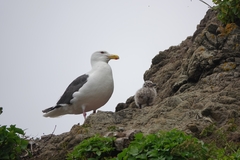
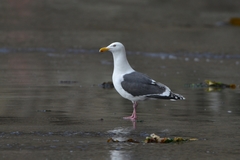
Slaty-backed Gull

Slaty-backed Gull

Larus schistisagus

Silhouette: Sharon Wegner-Larsen · PhyloPic

LCLeast ConcernNTVUENCR
Daily sighting probability ~10% · With luck
at Busan

In 3 days ~20% in a week ~40%

18 Verified sightings at Busan
January Best month
☀️ Diurnal When it's spotted

About the Slaty-backed Gull

The slaty-backed gull (Larus schistisagus) is a large, white-headed gull that breeds on the north-eastern coast of the Palearctic, but travels widely during nonbreeding seasons. It is similar in appearance to the western gull and the glaucous-winged gull. Another alternate name is Pacific gull, though it also applies to a Southern Hemisphere species, L. pacificus.

The genus name is from Latin larus, which appears to have referred to a gull or other large seabird. The specific schistisagus is from Neo-Latin schistus, "slate", and Latin sagus, "cloak". The Slaty-backed Gull is native to the Pacific coast of northeastern Asia. Individuals have strayed to various places throughout North America, including Alaska, New England and Texas. On 3 November 2012, an individual was spotted in Finland. The species has only been spotted three times before in Europe.

It is tied with the yellow-footed gull for fourth-largest gull species, measuring 55–68.5 cm (21.7–27.0 in) in length, 132–160 cm (52–63 in) in wingspan, and 1.05–1.7 kg (2.3–3.7 lb) in weight. Among standard measurements, the wing chord is 40 to 48 cm (16 to 19 in),... Wikipedia →

Sounds

Call0:31

Japan · 2025

© Uku Paal · XC1016573 · CC BY-NC-SA 4.0

Begging call0:10

Russian Federation · 2013

© Vadim Ivushkin · XC805988 · CC BY-NC-SA 4.0

Flight call0:07

Russian Federation · 2015

© Albert Lastukhin · XC266262 · CC BY-NC-SA 4.0

Global Distribution

Parks Where Found

# Park Country Daily sighting probability

More parks will be added in future updates.

Cities Where Found

# City Country Daily sighting probability
1 Sapporo 🇯🇵 Japan
~10%
2 Busan 🇰🇷 South Korea
~10%
3 Tokyo 🇯🇵 Japan
<5%
4 New York City 🇺🇸 United States
<5%
5 Los Angeles 🇺🇸 United States
<5%
6 Nagoya 🇯🇵 Japan
<5%
7 Seoul 🇰🇷 South Korea
<5%
8 Osaka 🇯🇵 Japan
<5%
9 Toronto 🇨🇦 Canada
<5%

Before you go

What are the chances of seeing a Slaty-backed Gull in Busan?

With luck

About 10% of wildlife watchers report a Slaty-backed Gull sighting in Busan on a given day, based on 18 verified sightings from GBIF citizen-science data. It is the 56th most-seen of the 112 birds we can rate there. Over three days the chance rises to about 20%, and over a week to about 40%, if each day is a fresh chance.

When is the best time to see a Slaty-backed Gull in Busan?

March and December–January

In those months about 20% of wildlife watchers report a Slaty-backed Gull in Busan on a given day, against under 5% in April–May and July–November, the lowest months. Those are among Busan's driest months, with about 55 mm of rain a month against 290 mm in July.

What time of day is best to see a Slaty-backed Gull?

Between 8 and 11 am

Across all the parks we cover, that three-hour window holds the most Slaty-backed Gull sightings with a recorded time, and about 8 in 10 of them come between 6 am and 6 pm: it is a daytime animal.

Is Busan the best place to see a Slaty-backed Gull?

Among the best

Of the 9 cities where we can rate Slaty-backed Gull sightings, Busan ranks 2nd at about 10%, level with the leaders once rounded. The best odds are in Sapporo (Japan, about 10%).

Which relatives of the Slaty-backed Gull live in Busan?

Same genus: Larus

The closest relatives of the Slaty-backed Gull that you can see in Busan (genus Larus, Large White-headed Gulls) are Black-tailed Gull (about 60%), Vega Gull (about 10%) and Common Gull (about 10%), with each one's daily chance of a sighting.

Where does the Slaty-backed Gull sighting chance come from?

GBIF citizen-science records

It is estimated from how often the Slaty-backed Gull is recorded against all the birds logged in Busan (18 verified sightings), calibrated against known sighting rates. Figures are rounded to the nearest 10% because citizen-science data supports honest approximations, not decimals, and months with records from fewer than five people show "—". How it works.

← Back to Busan