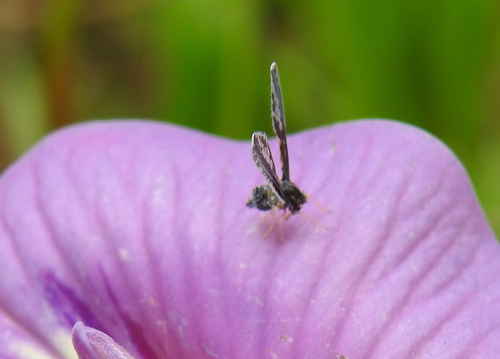
Long-Winged Planthopper

Long-Winged Planthopper

Proutista moesta

Daily sighting probability ~10% · With luck
at Colombo [Sri Jayawardenepura Kotte]

In 3 days ~30% in a week ~60%

17 Verified sightings at Colombo [Sri Jayawardenepura Kotte]
May Best month

About the Long-Winged Planthopper

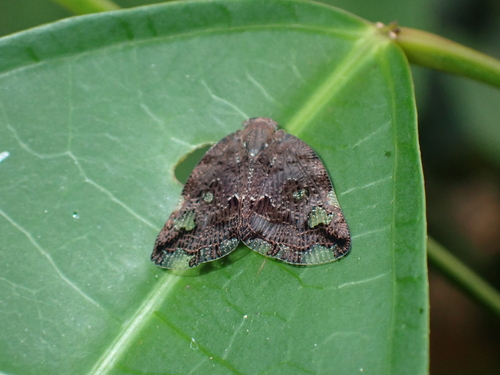
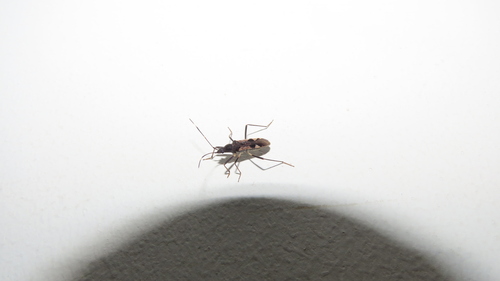
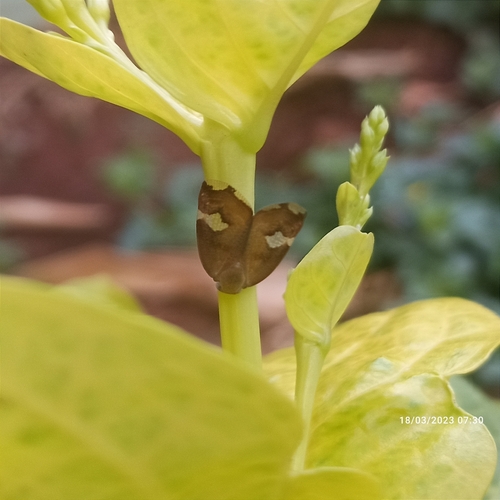
Proutista moesta is a common species of planthopper from the family Derbidae, tribe Zoraidini. It is found in tropical parts of Asia from India to southern parts of China, some islands in the western Pacific (Taiwan, parts of Japan, Philippines, Guam, parts of Northern Marianas, Palau, parts of the Federated States of Micronesia, Indonesia, Papua New Guinea), as well as in the Indian Ocean (Seychelles, Maldives). There is also a record from eastern Africa, a possible recent introduction. P. moesta can be common on crops like oil palms, coconut palms, sugarcane and several cereals, where it sucks the sap from the plants. It is often regarded as a pest of these crops, a vector of phytoplasma diseases and a biosecurity risk in countries outside its distribution range. Males of P. moesta are smaller (around 6.9 mm) than females (around 7.6 mm) when measured from the tip of the head to the end of the forewings. The forewings alone have a length of around 6.1 mm for males or around 6.6 mm for females. The colour is predominantly black, but the legs, antennae, facial ridges and the rostrum are yellowish to light orange. The ridges on the mesonotum and the clypeus are whitish to light yellow and the body has scattered white dots. The black forewings have some clear patches, mainly along the costal margin and in the distal half between the hind margin and the media vein. When at rest, the insect raises its wings above the body and spreads them out at an angle of about 60°. Wikipedia →
Global Distribution

Parks Where Found

# Park Country Daily sighting probability

More parks will be added in future updates.

Cities Where Found

# City Country Daily sighting probability
1 Thiruvananthapuram 🇮🇳 India
~10%
2 Colombo [Sri Jayawardenepura Kotte] 🇱🇰 Sri Lanka
~10%
3 Jakarta 🇮🇩 Indonesia
~10%
4 Kochi 🇮🇳 India
<5%
5 Bengaluru 🇮🇳 India
<5%
6 Bangkok 🇹🇭 Thailand
<5%
7 Singapore 🇸🇬 Singapore
<5%

Before you go

What are the chances of seeing a Long-Winged Planthopper in Colombo [Sri Jayawardenepura Kotte]?

With luck

About 10% of wildlife watchers report a Long-Winged Planthopper sighting in Colombo [Sri Jayawardenepura Kotte] on a given day, based on 17 verified sightings from GBIF citizen-science data. It is the 73rd most-seen of the 182 insects we can rate there. Over three days the chance rises to about 30%, and over a week to about 60%, if each day is a fresh chance.

When is the best time to see a Long-Winged Planthopper in Colombo [Sri Jayawardenepura Kotte]?

May, October and December

In those months about 20% of wildlife watchers report a Long-Winged Planthopper in Colombo [Sri Jayawardenepura Kotte] on a given day, against under 5% in January, March and July, the lowest months.

Is Colombo [Sri Jayawardenepura Kotte] the best place to see a Long-Winged Planthopper?

Among the best

Of the 7 cities where we can rate Long-Winged Planthopper sightings, Colombo [Sri Jayawardenepura Kotte] ranks 2nd at about 10%, level with the leaders once rounded. The best odds are in Thiruvananthapuram (India, about 10%).

Which relatives of the Long-Winged Planthopper live in Colombo [Sri Jayawardenepura Kotte]?

Same order: Hemiptera

The closest relatives of the Long-Winged Planthopper that you can see in Colombo [Sri Jayawardenepura Kotte] (order Hemiptera, True Bugs, Hoppers, Aphids, and allies) are Eggplant Horned Planthopper (about 10%), Black Planthopper (about 10%) and Metochus nudipes (about 10%), with each one's daily chance of a sighting.

Where does the Long-Winged Planthopper sighting chance come from?

GBIF citizen-science records

It is estimated from how often the Long-Winged Planthopper is recorded against all the insects logged in Colombo [Sri Jayawardenepura Kotte] (17 verified sightings), calibrated against known sighting rates. Figures are rounded to the nearest 10% because citizen-science data supports honest approximations, not decimals, and months with records from fewer than five people show "—". How it works.

← Back to Colombo [Sri Jayawardenepura Kotte]