Peters' Tree Skink

Peters' Tree Skink

Lankascincus fallax

Silhouette: David Orr · PhyloPic

LCLeast ConcernNTVUENCR
Daily sighting probability ~20% · Possible
at Colombo [Sri Jayawardenepura Kotte]

In 3 days ~40% in a week ~70%

17 Verified sightings at Colombo [Sri Jayawardenepura Kotte]
April Best month
🌅 Crepuscular When it's spotted

About the Peters' Tree Skink

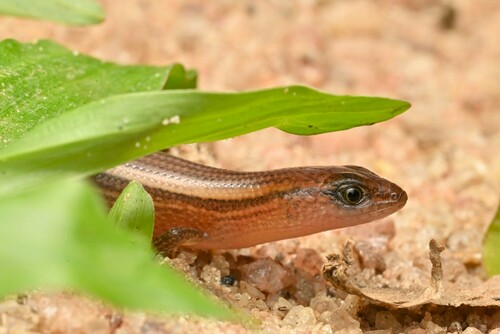
Lankascincus fallax, also known commonly as the common supple skink and Peters's tree skink, is a species of lizard in the family Scincidae. The species is found in Sri Lanka and Western Ghats (India). Fronto-parietal is fused, unlike in all other Lanka skinks (where it is divided on others). Midbody scales rows 24–28. Lamellae under fourth toe are 13–18.

Males are distinguish with red-throat. Dorsum pale to dark brown each dorsal scale with a pale stripe joining to form longitudinal line on dorsum. A yellowish brown stripe running from posterior edge of the eye to beyond middle of the tail. Throat color varies from red, blue or cream, with white spots, presumably depending on the reproductive status. Venter unpatterned creamy. Ventral scales with a frosted pattern, forming longitudinal lines.

Iris yellow in female and bright red in males. Lay 1 egg laid per clutch in loose soil. Peters W (1860). "Mittheilung über einige interessante Amphibien, welche von dem durch seine zoologischen Schriften rühmlichst bekannten österreichischen Naturforscher Professor Schmarda während seiner auf mehrere Weltheile ausgedehnten... Wikipedia →

Global Distribution

Parks Where Found

# Park Country Daily sighting probability

More parks will be added in future updates.

Cities Where Found

# City Country Daily sighting probability
1 Colombo [Sri Jayawardenepura Kotte] 🇱🇰 Sri Lanka
~20%
2 Kochi 🇮🇳 India
~10%

Before you go

What are the chances of seeing a Peters' Tree Skink in Colombo [Sri Jayawardenepura Kotte]?

Possible

About 20% of wildlife watchers report a Peters' Tree Skink sighting in Colombo [Sri Jayawardenepura Kotte] on a given day, based on 17 verified sightings from GBIF citizen-science data. It is the 13th most-seen of the 23 reptiles we can rate there. Over three days the chance rises to about 40%, and over a week to about 70%, if each day is a fresh chance.

When is the best time to see a Peters' Tree Skink in Colombo [Sri Jayawardenepura Kotte]?

April and June–July

In those months about 30% of wildlife watchers report a Peters' Tree Skink in Colombo [Sri Jayawardenepura Kotte] on a given day, against under 5% in February, May and December, the lowest months.

What time of day is best to see a Peters' Tree Skink?

Between 3 and 6 pm

Across all the parks we cover, that three-hour window holds the most Peters' Tree Skink sightings with a recorded time, and about 7 in 10 of them come between 6 am and 6 pm: it is most active around dawn and dusk.

Is Colombo [Sri Jayawardenepura Kotte] the best place to see a Peters' Tree Skink?

Yes

Of the 2 cities where we can rate Peters' Tree Skink sightings, Colombo [Sri Jayawardenepura Kotte] has the highest daily chance: about 20%. Next come Kochi (India, about 10%).

Which relatives of the Peters' Tree Skink live in Colombo [Sri Jayawardenepura Kotte]?

Same family: Scincidae

The closest relatives of the Peters' Tree Skink that you can see in Colombo [Sri Jayawardenepura Kotte] (family Scincidae, Skinks) are Common Dotted Garden Skink (about 20%) and Hambegamuwa Sun Skink (about 10%), with each one's daily chance of a sighting.

Where does the Peters' Tree Skink sighting chance come from?

GBIF citizen-science records

It is estimated from how often the Peters' Tree Skink is recorded against all the reptiles logged in Colombo [Sri Jayawardenepura Kotte] (17 verified sightings), calibrated against known sighting rates. Figures are rounded to the nearest 10% because citizen-science data supports honest approximations, not decimals, and months with records from fewer than five people show "—". How it works.

← Back to Colombo [Sri Jayawardenepura Kotte]