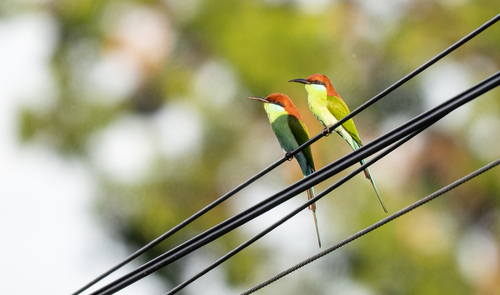
Rufous-crowned Bee-eater

Rufous-crowned Bee-eater

Merops americanus

LCLeast ConcernNTVUENCR
Daily sighting probability ~10% · With luck
at Davao City

In 3 days ~30% in a week ~60%

19 Verified sightings at Davao City
July Best month
☀️ Diurnal When it's spotted

About the Rufous-crowned Bee-eater

The rufous-crowned bee-eater (Merops americanus) is a species of bird in the family Meropidae. It is endemic to the Philippines, where it is widely distributed. Despite its scientific name, it is not found in the New World, and its name is likely erroneous.

It was previously considered a subspecies of the blue-throated bee-eater (M. viridis), but was split as a distinct species by the IUCN Red List and BirdLife International in 2014, and the International Ornithological Congress followed suit in 2022. It is still confused with M. viridis as it is still called blue-throated bee-eater by many including eBird. It differs from M. viridis in having a red-brown crown and mantle (rather than dark brown), and a paler greenish-blue throat and cheeks (rather than dark blue).

This specific species has yet to be studied in depth. This species is presumed to be an insectivore, and true to its name feeds heavily on bees. This species is considered a pest by bee-keepers. This species breeds from February to May in communal nest burrows on sloping ground and banks. These tunnels go as far as 1 m deep. Average clutch size 3 to 5 eggs. Wikipedia →
Global Distribution

Parks Where Found

# Park Country Daily sighting probability

More parks will be added in future updates.

Cities Where Found

# City Country Daily sighting probability
1 Davao City 🇵🇭 Philippines
~10%
2 Manila 🇵🇭 Philippines
<5%

Before you go

What are the chances of seeing a Rufous-crowned Bee-eater in Davao City?

With luck

About 10% of wildlife watchers report a Rufous-crowned Bee-eater sighting in Davao City on a given day, based on 19 verified sightings from GBIF citizen-science data. It is the 45th most-seen of the 100 birds we can rate there. Over three days the chance rises to about 30%, and over a week to about 60%, if each day is a fresh chance.

When is the best time to see a Rufous-crowned Bee-eater in Davao City?

July

In that month about 30% of wildlife watchers report a Rufous-crowned Bee-eater in Davao City on a given day, against under 5% in January and November, the lowest months.

What time of day is best to see a Rufous-crowned Bee-eater?

Between 10 am and 1 pm

Across all the parks we cover, that three-hour window holds the most Rufous-crowned Bee-eater sightings with a recorded time, and about 8 in 10 of them come between 6 am and 6 pm: it is a daytime animal.

Is Davao City the best place to see a Rufous-crowned Bee-eater?

Yes

Of the 2 cities where we can rate Rufous-crowned Bee-eater sightings, Davao City has the highest daily chance: about 10%. Next come Manila (Philippines, under 5%).

Where does the Rufous-crowned Bee-eater sighting chance come from?

GBIF citizen-science records

It is estimated from how often the Rufous-crowned Bee-eater is recorded against all the birds logged in Davao City (19 verified sightings), calibrated against known sighting rates. Figures are rounded to the nearest 10% because citizen-science data supports honest approximations, not decimals, and months with records from fewer than five people show "—". How it works.

← Back to Davao City