About the Melon Fly
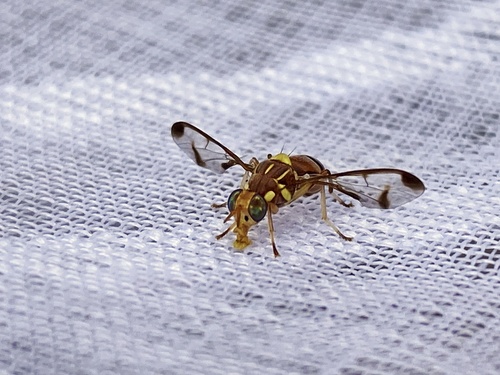
Zeugodacus cucurbitae, the melon fly, is a fruit fly of the family Tephritidae. It is a serious agricultural pest, particularly in Hawaii. The adult melon fly is 6 to 8 mm in length. Distinctive characteristics include its wing pattern, its long third antennal segment, the reddish yellow dorsum of the thorax with light yellow markings, and the yellowish head with black spots.
The egg is elliptical, about 2 mm long, and pure white. It is almost flat on the ventral surface, and more convex on the dorsal. Eggs are often somewhat longitudinally curved. The larva is a cylindrical-maggot shape, elongated, with the anterior end narrowed a somewhat curved ventrally. It has anterior mouth hooks, ventral fusiform areas and a flattened caudal end. Last instar larvae range from 7.5 to 11.8 mm in length.
The puparium ranges in color from dull red or brownish yellow to dull white, and is about 5 to 6 mm in length. Development period from egg to adult ranges from 12 to 28 days. The female may lay as many as 1,000 eggs. Eggs are generally laid in young fruit 2-4mm deep, but are also laid in the succulent stems... Wikipedia →