Miranda's White-lipped Frog

Miranda's White-lipped Frog

Leptodactylus macrosternum

Silhouette: Jose Carlos Arenas-Monroy · PhyloPic

LCLeast ConcernNTVUENCR
Daily sighting probability ~20% · Possible
at Fortaleza

In 3 days ~40% in a week ~70%

18 Verified sightings at Fortaleza
5 In 1 park From 2019 to 2026
February Best month
🌙 Nocturnal When it's spotted

About the Miranda's White-lipped Frog

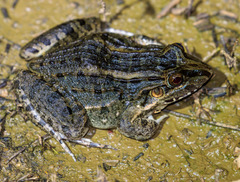
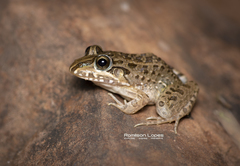
Leptodactylus macrosternum is a species of frogs in the family Leptodactylidae. It is found in northern Argentina and adjacent eastern Bolivia, Paraguay, northern Uruguay, and southern and western Brazil. The specific name chaquensis refers to the area of Gran Chaco in Argentina. The common names Cei's white-lipped frog and Miranda's white-lipped frog have been coined for it, although this particular species lacks the light upper lip stripe common in the genus.

Adult males measure 65–94 mm (2.6–3.7 in) and adult females 69–98 mm (2.7–3.9 in) in snout–vent length. No light upper lip stripe is present. The dorsum and the flanks have several well-developed pairs of skin folds. Toes have lateral fringes.

Sexually active males have a pair of keratinized thumb spines. They have three distinct advertisement calls: growls, grunts, and trills, of which the first one is the most frequent. Tadpoles of Gosner stage 36 measure 42 mm (1.7 in) in total length.

Leptodactylus macrosternum is a ground-dwelling species occurring near ponds and flooded areas at elevations below 1,000 m (3,300 ft). The eggs are deposited in large foam nests over puddles... Wikipedia →

Sounds

Recording0:23

Uruguay · 2026

Sebastián Gómez Barboza Silveira · iNaturalist · CC0

Recording0:01

Argentina · 2025

© Camilo Garcia Gonzalez · iNaturalist · CC BY-NC 4.0

Recording0:35

Brazil · 2021

© Breno Farias · iNaturalist · CC BY-NC 4.0

Global Distribution

Parks Where Found

# Park Country Daily sighting probability
1 El Impenetrable National Park 🇦🇷 Argentina
~30%

More parks will be added in future updates.

Cities Where Found

# City Country Daily sighting probability
1 Fortaleza 🇧🇷 Brazil
~20%

Before you go

What are the chances of seeing a Miranda's White-lipped Frog in Fortaleza?

Possible

About 20% of wildlife watchers report a Miranda's White-lipped Frog sighting in Fortaleza on a given day, based on 18 verified sightings from GBIF citizen-science data. It is the 3rd most-seen of the 7 amphibians we can rate there. Over three days the chance rises to about 40%, and over a week to about 70%, if each day is a fresh chance.

When is the best time to see a Miranda's White-lipped Frog in Fortaleza?

February

In that month about 40% of wildlife watchers report a Miranda's White-lipped Frog in Fortaleza on a given day, against under 5% in June to December, the lowest months. That is one of Fortaleza's wettest months, with about 150 mm of rain against almost none in September.

What time of day is best to see a Miranda's White-lipped Frog?

Between 7 and 10 pm

Across all the parks we cover, that three-hour window holds the most Miranda's White-lipped Frog sightings with a recorded time, and about 9 in 10 of them come between 6 pm and 6 am: it is mostly seen at night.

Where else can you see a Miranda's White-lipped Frog?

Only Fortaleza, in our data

Fortaleza is the only city on Wallace's Line with enough records to rate Miranda's White-lipped Frog sightings: about 20% of wildlife watchers there report one on a given day.

Which relatives of the Miranda's White-lipped Frog live in Fortaleza?

Same genus: Leptodactylus

The closest relatives of the Miranda's White-lipped Frog that you can see in Fortaleza (genus Leptodactylus, Neotropical Grass Frogs) are Northeastern Pepper Frog (about 20%) and Pernambuco White-lipped Frog (about 10%), with each one's daily chance of a sighting.

Where does the Miranda's White-lipped Frog sighting chance come from?

GBIF citizen-science records

It is estimated from how often the Miranda's White-lipped Frog is recorded against all the amphibians logged in Fortaleza (18 verified sightings), calibrated against known sighting rates. Figures are rounded to the nearest 10% because citizen-science data supports honest approximations, not decimals, and months with records from fewer than five people show "—". How it works.

← Back to Fortaleza