Oriole Warbler

Oriole Warbler

Hypergerus atriceps

Silhouette: Sheatherius · PhyloPic

LCLeast ConcernNTVUENCR
Daily sighting probability ~10% · With luck
at Freetown

In 3 days ~10% in a week ~30%

5 Verified sightings at Freetown
70 In 1 park From 2019 to 2026
January Best month
☀️ Diurnal When it's spotted

About the Oriole Warbler

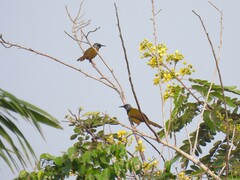
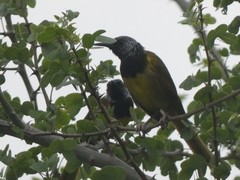
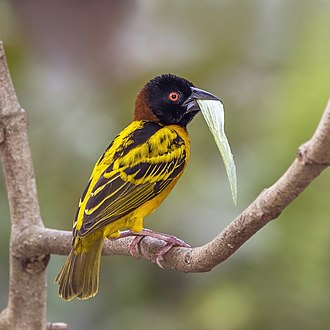
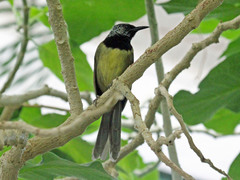
The oriole warbler (Hypergerus atriceps) is a large warbler in the family Cisticolidae, and the only member of the genus Hypergerus. This bird is a resident breeder in west Africa from southern Senegal to Cameroon. This skulking passerine is typically found in dense thickets usually near water. The oriole warbler builds a large untidy nest suspended from palm leaves.

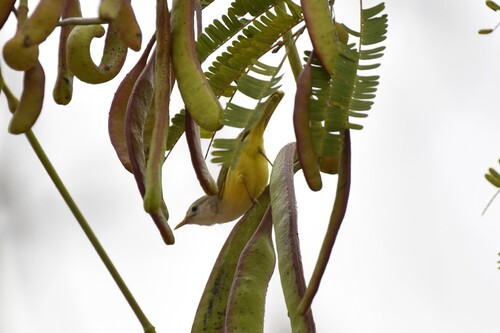
These 20-cm long warblers have a long tail, strong legs and a long black bill. At a weight of around 30 g (1.1 oz) the oriole warbler may be the largest of the species-rich Cisticolidae family. Adults are light olive above, yellow below and have a black hood. The species' name refers to their resemblance to the unrelated but similarly black and yellow orioles. The sexes are similar, but juveniles are duller.

Like most warblers, the oriole warbler is insectivorous. The song is a loud whistled duetted toooo-ooo-eee-oooo, oooo-ooo-eee-oooo. The male always leads the duet and the female answers, though this is done in a manner that is temporally rather loose.

Birds of The Gambia by Barlow, Wacher and Disley, ISBN 1-873403-32-1 Ryan, Peter (2006). Family Cisticolidae (Cisticolas and allies). pp. 378–492 in... Wikipedia →

Sounds

Song0:34

Gambia · 2025

© Romuald Mikusek · XC1042901 · CC BY-NC-SA 4.0

Alarm call0:30

Gambia · 2022

© Joost van Bruggen · XC896700 · CC BY-NC-ND 4.0

Song0:26

Senegal · 2023

© Alain Malengreau · XC861683 · CC BY-NC-SA 4.0

Global Distribution

Parks Where Found

# Park Country Daily sighting probability
1 Niokolo-Koba National Park 🇸🇳 Senegal
~20%

More parks will be added in future updates.

Cities Where Found

# City Country Daily sighting probability
1 Yaoundé 🇨🇲 Cameroon
~20%
2 Serrekunda 🇬🇲 Gambia
~20%
3 Lomé 🇹🇬 Togo
~20%
4 Abuja 🇳🇬 Nigeria
~20%
5 Lagos 🇳🇬 Nigeria
~10%
6 Accra 🇬🇭 Ghana
~10%
7 Freetown 🇸🇱 Sierra Leone
~10%

Zoos & Centres Where Found

# Zoo / Centre Country
1 Sedgwick County Zoo 🇺🇸 United States In captivity
2 Oregon Zoo 🇺🇸 United States In captivity

Before you go

What are the chances of seeing an Oriole Warbler in Freetown?

With luck

About 10% of wildlife watchers report an Oriole Warbler sighting in Freetown on a given day, based on 5 verified sightings from GBIF citizen-science data. It is the 67th most-seen of the 79 birds we can rate there. Over three days the chance rises to about 10%, and over a week to about 30%, if each day is a fresh chance.

When is the best time to see an Oriole Warbler in Freetown?

January

In that month about 20% of wildlife watchers report an Oriole Warbler in Freetown on a given day, against under 5% in February, May–June, September and December, the lowest months. That is one of Freetown's driest months, with almost no rain against 700 mm in August. March–April, July–August and October–November have too few records to rate.

What time of day is best to see an Oriole Warbler?

Between 8 and 11 am

Across all the parks we cover, that three-hour window holds the most Oriole Warbler sightings with a recorded time, and about 8 in 10 of them come between 6 am and 6 pm: it is a daytime animal.

Is Freetown the best place to see an Oriole Warbler?

7th of 7

Of the 7 cities where we can rate Oriole Warbler sightings, Freetown ranks 7th at about 10%. The best odds are in Yaoundé (Cameroon, about 20%), Serrekunda (Gambia, about 20%) and Lomé (Togo, about 20%).

Where does the Oriole Warbler sighting chance come from?

GBIF citizen-science records

It is estimated from how often the Oriole Warbler is recorded against all the birds logged in Freetown (5 verified sightings), calibrated against known sighting rates. Figures are rounded to the nearest 10% because citizen-science data supports honest approximations, not decimals, and months with records from fewer than five people show "—". How it works.

← Back to Freetown