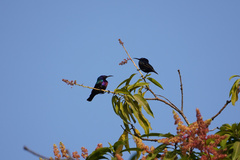
Splendid Sunbird

Splendid Sunbird

Cinnyris coccinigastrus

Silhouette: Sheatherius · PhyloPic

LCLeast ConcernNTVUENCR
Daily sighting probability ~20% · Possible
at Freetown

In 3 days ~40% in a week ~70%

17 Verified sightings at Freetown
June Best month
☀️ Diurnal When it's spotted

About the Splendid Sunbird

The splendid sunbird (Cinnyris coccinigastrus) is a sunbird. The sunbirds are a group of very small Old World passerine birds which feed largely on nectar, although they will also feed on insects, especially when feeding young.

Their flight is fast and direct on short wings. Most species can take nectar by hovering like a hummingbird, but usually perch to feed most of the time. The splendid sunbird breeds in west and central tropical Africa. One or two eggs are laid in an oval suspended nest in a tree. It is a seasonal migrant within its range.

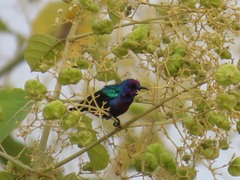
Splendid sunbirds are 15 cm long, and have medium-long thin down-curved bills and brush-tipped tubular tongues, both adaptations to their nectar feeding. The adult male is mainly glossy purple, with a dark green back and wing bar, and a crimson breast patch. The female is greenish-brown above and yellowish below.

This species is a common breeder in wet savannah and woodland with oil palms, Elaeis guineensis. The latter provide sap from the incisions made in the trunk to collect the liquid to make palm wine. Wikipedia →

Sounds

Song0:55

Ivory Coast · 2026

© Étienne Leroy · XC1186471 · CC BY-NC-SA 4.0

Song0:23

Guinea-Bissau · 2019

© Antonio Xeira · XC749572 · CC BY-NC-ND 4.0

Song0:04

Ghana · 2021

© Brendan Sloan · XC721362 · CC BY-NC-ND 4.0

Global Distribution

Parks Where Found

# Park Country Daily sighting probability

More parks will be added in future updates.

Cities Where Found

# City Country Daily sighting probability
1 Serrekunda 🇬🇲 Gambia
~40%
2 Yaoundé 🇨🇲 Cameroon
~20%
3 Abuja 🇳🇬 Nigeria
~20%
4 Accra 🇬🇭 Ghana
~20%
5 Freetown 🇸🇱 Sierra Leone
~20%
6 Lomé 🇹🇬 Togo
~20%
7 Abidjan 🇨🇮 Côte d'Ivoire
~10%
8 Dakar 🇸🇳 Senegal
~10%

Zoos & Centres Where Found

# Zoo / Centre Country
1 San Diego Zoo 🇺🇸 United States In captivity
2 Houston Zoo 🇺🇸 United States In captivity
3 London Zoo 🇬🇧 United Kingdom In captivity

Before you go

What are the chances of seeing a Splendid Sunbird in Freetown?

Possible

About 20% of wildlife watchers report a Splendid Sunbird sighting in Freetown on a given day, based on 17 verified sightings from GBIF citizen-science data. It is the 19th most-seen of the 79 birds we can rate there. Over three days the chance rises to about 40%, and over a week to about 70%, if each day is a fresh chance.

When is the best time to see a Splendid Sunbird in Freetown?

June

In that month about 30% of wildlife watchers report a Splendid Sunbird in Freetown on a given day, against about 10% in February, September and December, the lowest months. That is one of Freetown's wettest months, with about 400 mm of rain against almost none in January. March–April, July–August and October–November have too few records to rate.

What time of day is best to see a Splendid Sunbird?

Between 8 and 11 am

Across all the parks we cover, that three-hour window holds the most Splendid Sunbird sightings with a recorded time, and about 9 in 10 of them come between 6 am and 6 pm: it is a daytime animal.

Is Freetown the best place to see a Splendid Sunbird?

5th of 8

Of the 8 cities where we can rate Splendid Sunbird sightings, Freetown ranks 5th at about 20%. The best odds are in Serrekunda (Gambia, about 40%), Yaoundé (Cameroon, about 20%) and Abuja (Nigeria, about 20%).

Which relatives of the Splendid Sunbird live in Freetown?

Same genus: Cinnyris

The closest relatives of the Splendid Sunbird that you can see in Freetown (genus Cinnyris, Cinnyris Sunbirds) are Variable Sunbird (about 30%) and Copper Sunbird (about 10%), with each one's daily chance of a sighting.

Where does the Splendid Sunbird sighting chance come from?

GBIF citizen-science records

It is estimated from how often the Splendid Sunbird is recorded against all the birds logged in Freetown (17 verified sightings), calibrated against known sighting rates. Figures are rounded to the nearest 10% because citizen-science data supports honest approximations, not decimals, and months with records from fewer than five people show "—". How it works.

← Back to Freetown