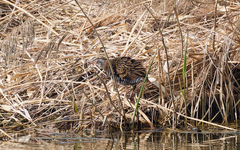
Brown-cheeked Rail

Brown-cheeked Rail

Rallus indicus

Silhouette: Ferran Sayol · PhyloPic

LCLeast ConcernNTVUENCR
Daily sighting probability ~10% · With luck
at Fuzhou

In 3 days ~20% in a week ~40%

11 Verified sightings at Fuzhou
February Best month
☀️ Diurnal When it's spotted

About the Brown-cheeked Rail

The brown-cheeked rail or eastern water rail (Rallus indicus) is a species of bird in the family Rallidae. It breeds in northern Mongolia, eastern Siberia, northeast China, Korea and northern Japan, and winters in southeast Asia. It used to be considered a subspecies of the water rail.

The species differs from the slightly smaller nominate form through its paler upperparts, brown-tinged underparts and a brown stripe through the eye. Compared to R. a. korejewi, it is darker above, has a browner breast, white on the throat and a more obvious brown eyestripe. As indicated above, it has different vocalisations to the other forms, and is now usually given full species status, although its behaviour, nest and eggs are identical to those of other subspecies of water rail.

The brown-cheeked rail is 23–29 cm (9.1–11.4 in) in length and can weigh 75–190 g (2.6–6.7 oz). In addition to its distinctive plumage, it has very different vocalisations from the water rail, and it was considered a separate species in early works, including the first edition (1898) of Fauna of British India, but later demoted to a subspecies by E. C. Stuart Baker in the second edition (1929). It was... Wikipedia →

Sounds

Call0:16

China · 2026

© Peter Boesman · XC1147795 · CC BY-NC-ND 4.0

Alarm call0:14

Japan · 2025

© Uku Paal · XC1016460 · CC BY-NC-SA 4.0

Song0:29

China · 2024

© Ding Li Yong · XC927602 · CC BY-NC-ND 4.0

Global Distribution

Parks Where Found

# Park Country Daily sighting probability

More parks will be added in future updates.

Cities Where Found

# City Country Daily sighting probability
1 Fuzhou 🇨🇳 China
~10%
2 Tokyo 🇯🇵 Japan
<5%
3 Beijing 🇨🇳 China
<5%
4 Shanghai 🇨🇳 China
<5%
5 Wuhan 🇨🇳 China
<5%
6 Nagoya 🇯🇵 Japan
<5%
7 Suzhou 🇨🇳 China
<5%
8 Hangzhou 🇨🇳 China
<5%
9 Osaka 🇯🇵 Japan
<5%
10 Taipei 🇹🇼 Taiwan
<5%

Before you go

What are the chances of seeing a Brown-cheeked Rail in Fuzhou?

With luck

About 10% of wildlife watchers report a Brown-cheeked Rail sighting in Fuzhou on a given day, based on 11 verified sightings from GBIF citizen-science data. It is the 59th most-seen of the 82 birds we can rate there. Over three days the chance rises to about 20%, and over a week to about 40%, if each day is a fresh chance.

When is the best time to see a Brown-cheeked Rail in Fuzhou?

February

In that month about 40% of wildlife watchers report a Brown-cheeked Rail in Fuzhou on a given day, against under 5% in January, March–June and August–November, the lowest months. That is one of Fuzhou's driest months, with about 75 mm of rain against 250 mm in June.

What time of day is best to see a Brown-cheeked Rail?

Between 3 and 6 pm

Across all the parks we cover, that three-hour window holds the most Brown-cheeked Rail sightings with a recorded time, and about 9 in 10 of them come between 6 am and 6 pm: it is a daytime animal.

Is Fuzhou the best place to see a Brown-cheeked Rail?

Yes

Of the 11 cities where we can rate Brown-cheeked Rail sightings, Fuzhou has the highest daily chance: about 10%. Next come Tokyo (Japan, under 5%) and Beijing (China, under 5%).

Which relatives of the Brown-cheeked Rail live in Fuzhou?

Same family: Rallidae

The closest relatives of the Brown-cheeked Rail that you can see in Fuzhou (family Rallidae, Rails, Gallinules, and Coots) are White-breasted Waterhen (about 20%), Common Moorhen (about 10%) and Slaty-breasted Rail (about 10%), with each one's daily chance of a sighting.

Where does the Brown-cheeked Rail sighting chance come from?

GBIF citizen-science records

It is estimated from how often the Brown-cheeked Rail is recorded against all the birds logged in Fuzhou (11 verified sightings), calibrated against known sighting rates. Figures are rounded to the nearest 10% because citizen-science data supports honest approximations, not decimals, and months with records from fewer than five people show "—". How it works.

← Back to Fuzhou