Cuyaba Dwarf Frog

Cuyaba Dwarf Frog

Physalaemus nattereri

Silhouette: PhyloPic

LCLeast ConcernNTVUENCR
Daily sighting probability ~20% · Possible
at Goiânia

In 3 days ~50% in a week ~80%

6 Verified sightings at Goiânia
November Best month
🌙 Nocturnal When it's spotted

About the Cuyaba Dwarf Frog

Physalaemus nattereri (common name: Cuyaba dwarf frog) is a frog native to central and southeastern Brazil and eastern Bolivia and Paraguay. It inhabits savanna and Cerrado regions, always near permanent or temporary water bodies such as ponds and swamps, where it typically nests. The species is not adapted to areas with human activity.

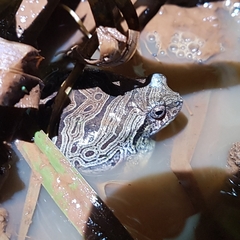
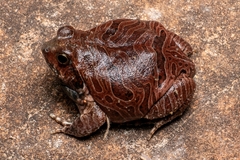
Males have an average length of 4.7 centimeters (1.9 in), while females measure 4.9 centimeters (1.9 in). The dorsal coloration ranges from light brown to dark brown or reddish, featuring a mosaic of darker spots or stripes. The ventral surface is light brown with dark spots. The species is unmistakable in its habitat due to a pair of ocelli on the posterior part of its body. Its testicles and other organs are brightly colored, a rare trait among anurans, caused by a high concentration of melanocytes.

Its diet is generalist and opportunistic, primarily consisting of termites and ants. Despite an effective defense strategy and highly potent toxins, it can be preyed upon by various animals, including birds and beetles. Its primary predators are giant water bugs, which often attack during reproduction and metamorphosis. One defense mechanism is deimatic behaviour, where the frog inflates its lungs, lowers its head, and raises its posterior, displaying its ocelli to startle predators, appearing as a larger animal facing them. Additionally, its ocelli contain venomous macro glands that produce a fast-acting toxin with a median lethal dose comparable to that of a jararaca snake.

Its reproduction is explosive, meaning all individuals gather synchronously at breeding sites for a few days, typically between October and January. Males form choruses and vocalize after heavy rainfall exceeding 50 millimeters to attract females. Their call consists of simple, multi-pulsed, harmonic notes. During amplexus, which is axillary, the pair moves to the water's edge, where they deposit approximately 3 500 eggs in a foam nest. The nest is created from mucus secreted by the female, whipped into foam by the male's hind legs in a motion akin to whisking egg whites. The tadpoles have a grayish-brown dorsum and a globular body. Their metamorphosis takes 20 to 30 days. Wikipedia →

Sounds

Recording0:30

Brazil · 2021

© Laurent Quéno · iNaturalist · CC BY-NC 4.0

Recording0:10

Brazil · 2025

© Jean Martins · iNaturalist · CC BY-NC 4.0

Global Distribution

Parks Where Found

# Park Country Daily sighting probability

More parks will be added in future updates.

Cities Where Found

# City Country Daily sighting probability
1 Goiânia 🇧🇷 Brazil
~20%

Before you go

What are the chances of seeing a Cuyaba Dwarf Frog in Goiânia?

Possible

About 20% of wildlife watchers report a Cuyaba Dwarf Frog sighting in Goiânia on a given day, based on 6 verified sightings from GBIF citizen-science data. Over three days the chance rises to about 50%, and over a week to about 80%, if each day is a fresh chance.

When is the best time to see a Cuyaba Dwarf Frog in Goiânia?

February and October–November

In those months about 40% of wildlife watchers report a Cuyaba Dwarf Frog in Goiânia on a given day, against under 5% in March–September and December–January, the lowest months. Those are among Goiânia's wettest months, with about 170 mm of rain a month against almost none in July.

What time of day is best to see a Cuyaba Dwarf Frog?

Between 7 and 10 pm

Across all the parks we cover, that three-hour window holds the most Cuyaba Dwarf Frog sightings with a recorded time, and about 8 in 10 of them come between 6 pm and 6 am: it is mostly seen at night.

Where else can you see a Cuyaba Dwarf Frog?

Only Goiânia, in our data

Goiânia is the only city on Wallace's Line with enough records to rate Cuyaba Dwarf Frog sightings: about 20% of wildlife watchers there report one on a given day.

Where does the Cuyaba Dwarf Frog sighting chance come from?

GBIF citizen-science records

It is estimated from how often the Cuyaba Dwarf Frog is recorded against all the amphibians logged in Goiânia (6 verified sightings), calibrated against known sighting rates. Figures are rounded to the nearest 10% because citizen-science data supports honest approximations, not decimals, and months with records from fewer than five people show "—". How it works.

← Back to Goiânia