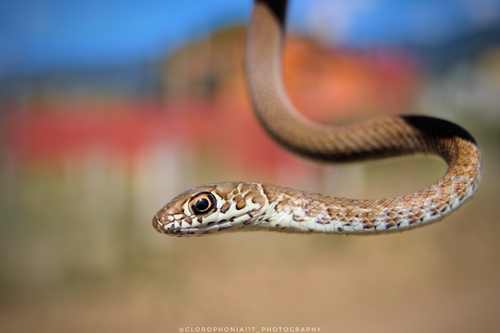
About the Western Mexico Whiptail
Aspidoscelis costatus, also known as the western Mexico whiptail, is a species of whiptail lizard endemic to Mexico, including Guerrero, Morelos, and Puebla in southern Mexico, as well as other Mexican states. Its range spans both temperate and tropical habitats, and even densely populated urban areas. Its common name, the Western Mexico Whiptail, can easily be confused with the Western Whiptail, which refers to a different lizard, Aspidoscelis tigris.
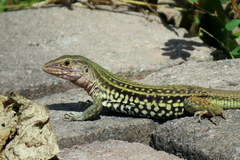
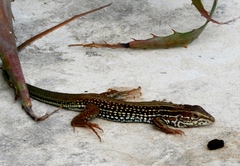
A small lizard, up to only 4 inches SVL (snout to vent length), this striped lizard has a pointed snout, a slender body, a pair of long hind legs, and an extremely long tail. Its whip-like, tapering tail, if not recently shortened from caudal autotomy (self-amputation of the tail), may be more than two times its SVL. Therefore, although this dwarf lizard has a short SVL length, it can reach a total length of close to 1 foot, tail included, giving the false impression that it's a long lizard. When the lizards fight to maintain territory or compete for mates, they whip their long tails around, therefore its common name is the whiptail lizard. They are often found under low desert scrubs, rocks, or nosing around leaf litter. Whiptails are diurnal but mostly solitary creatures, except during the breeding season, when males start accompanying females around.
Aspidoscelis are not sit-and-wait ambush predators. Instead, they are non-territorial, active "widely foraging" lizards. They move quite frequently, and almost incessantly, in short gaits and at a frenetic pace. Foraging is their primary activity throughout the day. They are aseen busy probing with their snouts under leaf-litter, in crevices, scratching in the ground, or digging furiously through piles of accumulated debris. When they are on the move under plants or through leaf-litter, their jerky bouts of start-stop movement create unique crunching sounds from disturbed dry leaves. When Aspidoscelis must run away from threats, they run fast at top speeds of 18 mph (29 km/h), and appear to keep their tails behind the body in a straight line similar to a galloping crocodile, running across barren open areas to reach the cover of dense shrubs.
There are limited reports about Aspidoscelis costatus, simply because the nomenclatural changes for the genus Aspidoscelis was recommended by T.W. Reeder et al. as recent as 2002. Prior to that, this species was under the genus Cnemidophorus, in the family Teiidae. Wikipedia →